
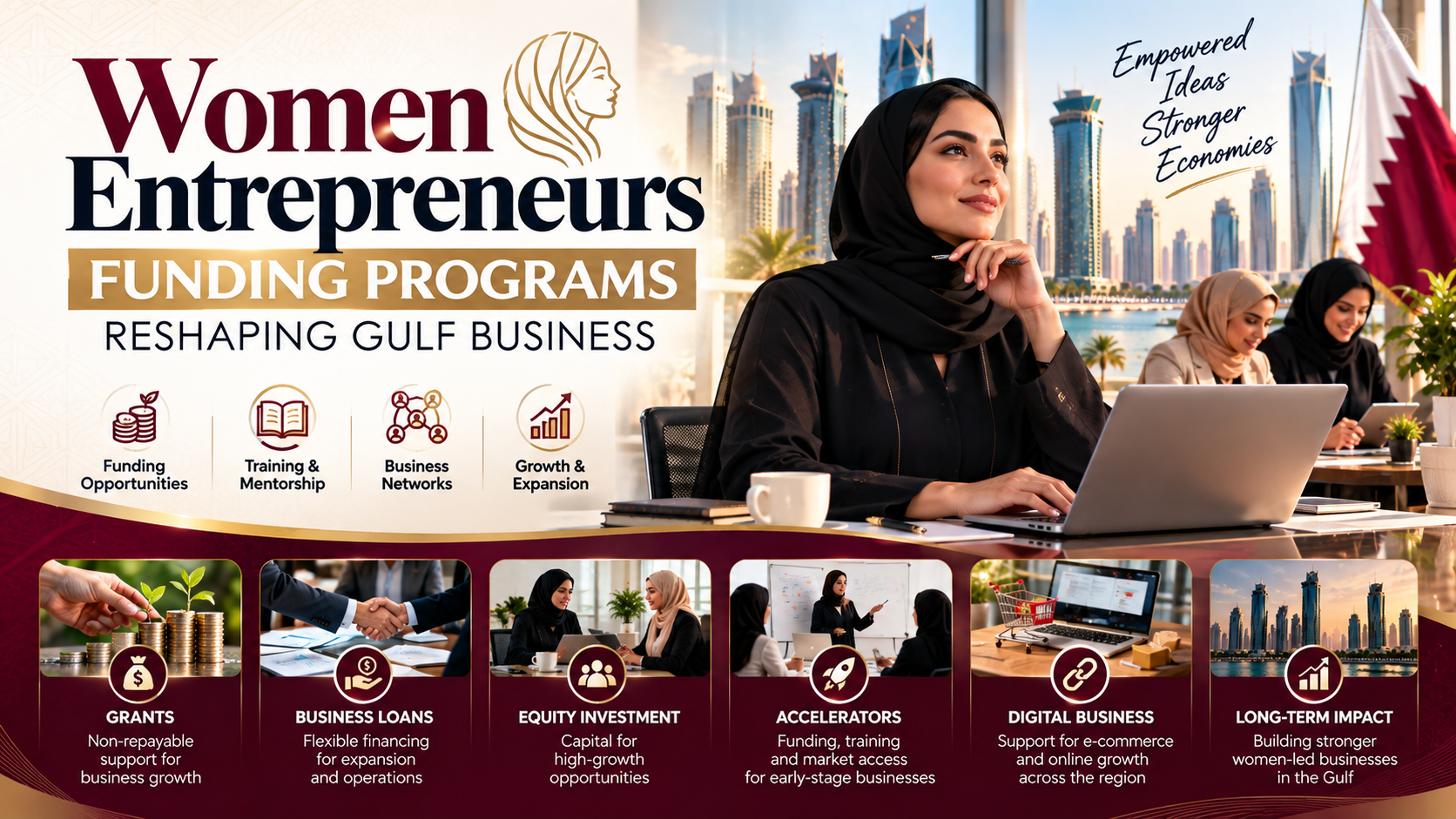
Women-owned businesses are becoming an increasingly important part of the Gulf's private-sector economy. Across the region, governments, banks, investment organizations, and entrepreneurship programs are introducing initiatives designed to improve women's access to capital, training, networks, and business support.
Funding is especially important for businesses moving beyond the early startup stage. Access to suitable financing can help founders invest in employees, technology, marketing, equipment, expansion, and new markets.
At the same time, funding is only one part of business growth. Women entrepreneurs also need access to mentorship, financial education, market opportunities, and networks that can support long-term development.
Why Women's Business Funding Matters
Access to finance can influence how quickly a small business can grow.
A founder may have a viable business idea but still face challenges when trying to secure capital for expansion. Traditional financing can also involve eligibility requirements, collateral, financial records, or operating histories that newer businesses may not yet have.
Funding programs aimed at women entrepreneurs can help address some of these barriers by providing different forms of support.
Depending on the program, this may include:
- Grants
- Loans
- Equity investment
- Training
- Mentorship
- Business advisory services
- Networking opportunities
- Accelerator programs
The exact eligibility requirements and funding structures vary by country and organization.
Women-Led Business Growth in Qatar
Qatar has continued to develop its entrepreneurship and private-sector ecosystem, creating opportunities for women to participate in business ownership and expansion.
Women entrepreneurs operate across sectors including:
- Professional services
- Retail
- Food and hospitality
- Technology
- Education
- Healthcare
- Fashion
- E-commerce
- Creative industries
For founders, access to financing can support the transition from a small operation to a more established business.
Funding may be used to hire employees, improve digital infrastructure, open a physical location, develop products, or expand into new customer segments.
Different Types of Funding Available
Women entrepreneurs should not assume that all business funding works in the same way.
Grants
Grants generally do not require repayment, but they can have strict eligibility requirements and application processes.
Some programs may target specific industries, stages of business development, or strategic economic priorities.
Business Loans
Loans provide capital that must be repaid, usually with interest.
They may be suitable for established businesses with predictable revenue and a clear repayment plan.
Equity Investment
Equity financing involves receiving capital in exchange for an ownership interest in the business.
This can provide significant growth capital, but founders need to understand how investment affects ownership and decision-making.
Accelerators and Incubators
Some entrepreneurship programs combine funding with mentorship, training, networking, and business development support.
These programs can be particularly useful for early-stage founders who need more than capital alone.
Women Entrepreneur Funding Gulf Programs
The Gulf region has a growing network of organizations supporting entrepreneurship and private-sector development.
However, programs differ significantly in their objectives.
Some focus on startups. Others support established small and medium-sized businesses. Some are sector-specific, while others are designed around innovation, technology, or economic diversification.
Women entrepreneurs researching women entrepreneur funding Gulf opportunities should therefore compare:
- Eligibility
- Funding amount
- Repayment requirements
- Equity requirements
- Application deadlines
- Business stage
- Industry restrictions
- Residency requirements
- Required documentation
Checking the current terms directly with the funding organization is important because programs and eligibility rules can change.
What Funding Can Help Businesses Achieve
Capital can support several areas of business growth.
Hiring
Additional employees can help founders delegate operational work and focus on business development.
Technology
Businesses may invest in websites, e-commerce platforms, accounting systems, customer relationship management tools, cybersecurity, or specialized software.
Marketing
Funding can support branding, digital advertising, content creation, search optimization, events, and customer acquisition.
Product Development
Businesses may use capital to improve existing products or develop new offerings.
Market Expansion
Established companies may require funding to enter new cities, countries, or customer segments.
Women Entrepreneurs and Digital Business
Digital commerce has created additional opportunities for women-led businesses.
An entrepreneur can potentially reach customers across the Gulf without immediately establishing physical locations in every market.
Digital businesses may use funding for:
- E-commerce development
- Digital payment systems
- Online advertising
- Social media marketing
- Inventory management
- Logistics
- Customer support
- Data analytics
For many founders, these investments can become part of a broader growth strategy.
Funding Alone Does Not Guarantee Growth
Receiving funding does not automatically make a business successful.
Entrepreneurs still need to manage:
- Cash flow
- Pricing
- Customer acquisition
- Staffing
- Operations
- Compliance
- Financial reporting
- Competition
A founder should therefore have a clear plan for how the funding will generate measurable business value.
Before applying, it can help to define specific objectives.
For example:
Funding goal: QAR 500,000
Use: Hiring, technology, marketing, and inventory
Expected outcome: Increased capacity and revenue
The actual figures will vary by business, but the principle is the same. Funding should be connected to a defined business objective.
Building a Strong Funding Application
A strong application should clearly explain the business opportunity.
Entrepreneurs may need to provide:
- Business plan
- Financial statements
- Revenue information
- Market research
- Growth projections
- Ownership details
- Identification documents
- Funding requirements
- Planned use of capital
Applications should avoid vague statements about growth.
Instead of simply saying:
"The funding will help us expand."
a stronger application explains what the funding will finance and what business outcome is expected.
The Role of Mentorship and Networks
Capital is only one part of the entrepreneurial ecosystem.
Mentorship can help founders understand financial planning, hiring, pricing, operations, and market expansion.
Business networks can also create opportunities for:
- Partnerships
- Suppliers
- Investors
- Customers
- Professional services
- Industry knowledge
For women entrepreneurs entering sectors where they have historically had fewer professional connections, these networks can be particularly valuable.
Gulf Business Growth and Economic Diversification
Women's participation in entrepreneurship also fits into broader Gulf economic diversification strategies.
Gulf economies have increasingly focused on developing private-sector businesses, technology, tourism, professional services, and other industries beyond traditional energy-related activities.
Women-led companies can contribute to this diversification by creating businesses, employing workers, introducing new products, and serving new customer groups.
This makes women's entrepreneurship relevant not only to individual founders but also to broader private-sector development.
What Women Entrepreneurs Should Check Before Accepting Funding
Not every funding opportunity will be appropriate for every business.
Before accepting capital, founders should review:
- Total funding amount
- Interest rate, if applicable
- Repayment schedule
- Equity dilution
- Investor rights
- Fees
- Reporting requirements
- Eligibility conditions
- Restrictions on fund usage
For equity investment in particular, entrepreneurs should understand how much ownership they are giving up and what rights the investor receives.
Professional financial or legal advice may be appropriate for significant financing agreements.
The Future of Women-Led Businesses in the Gulf
As entrepreneurship ecosystems mature, women entrepreneurs are likely to have access to a wider range of financing and business-development resources.
The most useful programs are not necessarily those offering the largest amount of money. Training, mentorship, market access, and networks can also influence whether a business can use capital effectively.
For founders, the focus should therefore be on finding funding that matches the company's stage, sector, financial position, and long-term objectives.
Final Thoughts
Funding programs are creating additional opportunities for women entrepreneurs across the Gulf, but capital is only one part of sustainable business growth.
Founders need to understand the difference between grants, loans, equity investment, and accelerator support before choosing a financing route.
They should also evaluate eligibility, repayment terms, ownership implications, and how the funding will be used.
For readers following women-led business growth in Qatar, staying informed about entrepreneurship programs, financing opportunities, and private-sector initiatives can help identify relevant opportunities as they become available.
Al Akhbar Publication covers business, economic, and regional developments relevant to readers following changes across Qatar and the wider Gulf.
Entrepreneurs looking for women entrepreneur funding Gulf opportunities should always verify current program requirements and deadlines directly with the relevant funding organization before applying.