
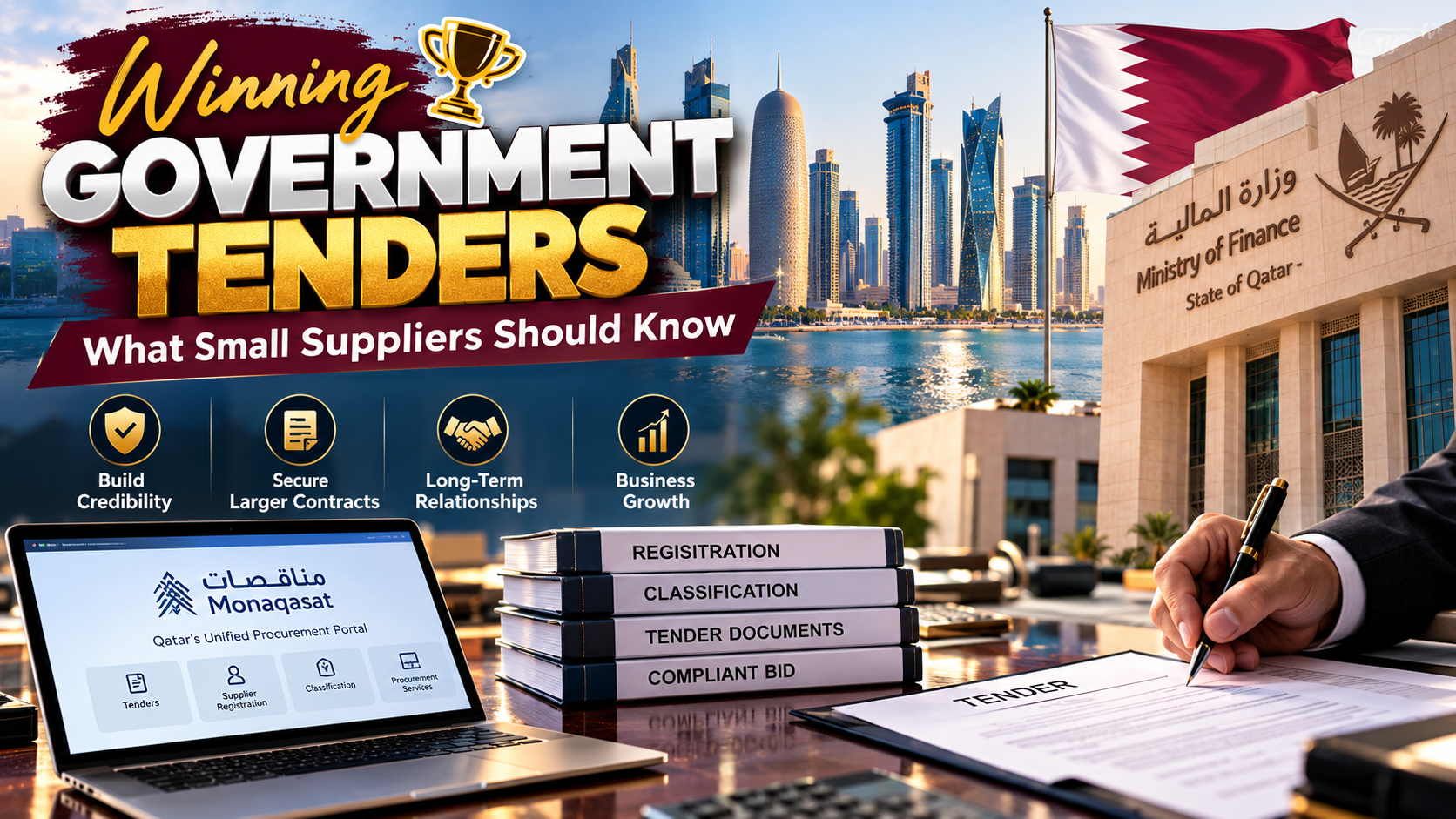
Winning a government tender can help a small business build credibility, secure larger contracts, and develop long-term commercial relationships. But the process involves more than offering the lowest price. Suppliers must understand the requirements, prepare accurate documents, demonstrate their ability to deliver, and submit a compliant bid before the deadline.
For businesses pursuing Government tenders Qatar, preparation is especially important. Qatar's Ministry of Finance operates the Unified Website of State Procurement, known as Monaqasat, where suppliers can access procurement services and apply for the relevant company classification. The official portal states that companies seeking to participate in government tenders must be classified.
Small suppliers do not necessarily need to compete for the largest contracts first. A better starting point is to identify opportunities that match their experience, capacity, and available resources.
1. Complete Supplier Registration and Classification Early
Before preparing a bid, confirm the registration and classification requirements that apply to your business and the tendering entity.
Qatar's Monaqasat portal provides separate classification services for contractors and for suppliers and service providers. The appropriate route depends on the nature of the company's activities.
For supplier and service-provider classification, the portal lists requirements that include a valid company profile and an audited financial statement for the latest financial year. It also identifies a company's first project contract as an important supporting document, while some other documents are optional. Requirements may vary by classification route and activity.
Start by checking the current requirements rather than waiting until a tender is published.
Prepare a folder containing your commercial registration, company profile, financial statements, relevant licences, project references, and other documents applicable to your activity. Check expiry dates and ensure that the information is consistent across all records.
Small supplier tender tips:
- Verify that your company activities match the goods or services you intend to provide.
- Check whether contractor classification or supplier and service-provider classification applies.
- Keep company records and supporting documents current.
- Allow time for registration, classification, and any additional approvals.
Completing these steps early reduces the risk of missing an opportunity because an administrative requirement remains unfinished.
2. Target Tenders That Match Your Business Capacity
A tender may look attractive because of its contract value, but the size of the opportunity is only one consideration.
Small suppliers should assess whether they have the staff, equipment, working capital, technical expertise, and delivery capacity to fulfil the contract. A project that exceeds those resources can create cash-flow problems and operational pressure even if the bid is successful.
Start by reviewing opportunities that align with your existing services and track record.
For example, a small IT supplier may be better prepared to deliver a defined equipment supply contract than a complex, multi-year technology implementation. Similarly, a maintenance company may be more competitive for a specific service requirement than a large project involving several specialist disciplines.
Before committing to a bid, ask:
- Does the scope match our core business activities?
- Can we meet the required delivery schedule?
- Do we have enough qualified personnel?
- Can we finance the work until payments are received?
- Do we meet the stated technical and financial criteria?
A realistic assessment helps suppliers concentrate on tenders they can deliver reliably rather than spreading resources across too many opportunities.
3. Read the Tender Documents Line by Line
Tender documents define what the purchasing entity expects from bidders. Missing a technical specification, mandatory form, guarantee, or submission instruction can put an otherwise capable supplier at a disadvantage.
Do not rely solely on a short tender summary. Review the complete documents available for the opportunity and identify all mandatory requirements.
Qatar's Public Works Authority, Ashghal, explains that its tendering process requires eligible companies to register in its e-tendering system. Its participation terms also specify tender-document fees and bid guarantees for the relevant opportunities. These requirements should not automatically be assumed to apply identically to every government tender.
Create a compliance checklist covering:
- Scope of work and technical specifications
- Eligibility and classification requirements
- Required forms and supporting documents
- Pricing format and payment conditions
- Delivery milestones and completion dates
- Bid security or tender guarantees, where required
- Submission method and closing time
- Contract terms and evaluation criteria
Assign responsibility for each item and review the checklist before submitting the bid.
4. Prepare a Clear and Competitive Price
Pricing a government contract involves more than calculating the direct cost of supplying a product or service.
Suppliers must account for labour, materials, transport, equipment, overheads, financing costs, and other expenses relevant to the contract. Depending on the project, they may also need to account for warranties, maintenance, installation, or after-sales support.
Underpricing can make a proposal look attractive initially but leave the business unable to fulfil its obligations profitably.
A simple pricing review should include:
|
Cost category |
What to consider |
|
Materials or goods |
Purchase price, quantities, and supplier terms |
|
Labour |
Staff time, specialist skills, and related costs |
|
Logistics |
Transport, storage, delivery, and handling |
|
Operations |
Equipment, utilities, and project overheads |
|
Risk allowance |
Reasonable provision for identifiable cost uncertainties |
|
Cash flow |
Timing of payments and the cost of financing the work |
Use the pricing format specified in the tender documents. If the buyer requires separate prices for individual items, optional services, or project stages, follow that structure carefully.
Before submission, check the calculations, quantities, tax treatment where applicable, and consistency between the commercial offer and technical proposal.
5. Demonstrate Experience Even If Your Company Is Small
A smaller supplier may not have an extensive portfolio of government contracts. However, a proposal can still demonstrate relevant capability through appropriate evidence.
Include completed projects, customer references, staff qualifications, certifications, technical resources, and examples of similar work where the tender permits or requests them.
The evidence should be specific and verifiable. Instead of stating that your company provides excellent service, explain what it delivered, which requirements it met, and what experience is relevant to the proposed contract.
If your business has not completed a similar project independently, do not exaggerate its experience. Where permitted, a suitable subcontracting or partnership arrangement may help address capability gaps. Check the tender conditions before relying on such arrangements.
Qatar's procurement framework provides for supplier classification based on factors that include financial and technical capability, experience, competencies, previous work, and performance evaluation.
A well-organized capability statement makes it easier for evaluators to assess whether your business meets the stated requirements.
6. Understand Support Available to Small Businesses
Qatar's procurement framework includes measures intended to support micro, small, and medium-sized enterprises.
According to the Ministry of Finance's Monaqasat SME information, eligible national micro-enterprises may be exempt from provisional and final guarantees for tenders valued below QAR 5 million. The portal also describes exemptions from tender-document fees for eligible micro, small, and medium-sized enterprises on tenders below that value. Other provisions concern classification fees and the possibility of restricting certain tenders to classified SMEs.
These benefits have specific eligibility conditions. Businesses should confirm their classification, national status where relevant, and the rules applicable to the individual tender before assuming an exemption applies.
The portal also currently states that mandatory submission of an In-Country Value (ICV) certificate as a condition for participating in government tenders has been postponed until the beginning of 2027. It encourages businesses to begin the certification process and says further updates will be announced. Suppliers should check the official portal for the latest position before submitting a bid.
These provisions can help eligible businesses plan their participation costs, but they do not remove the need to meet the tender's technical, commercial, and administrative requirements.
7. Submit a Complete Bid Before the Deadline
A strong proposal can still fail if it is submitted incorrectly or after the closing time.
Create an internal deadline that is earlier than the official submission deadline. This leaves time to resolve missing documents, obtain approvals, correct errors, and confirm that the submission has been received.
Before uploading or delivering the bid, verify that:
- Every mandatory form is complete.
- Required signatures and company stamps are included where specified.
- Supporting documents are attached in the requested format.
- Technical and commercial submissions follow the required structure.
- The price is consistent across the relevant forms.
- Required guarantees or supporting financial instruments are in place.
- The submission follows the correct platform and deadline.
For example, Ashghal's participation terms specify a tender guarantee for the relevant tenders and state that bids without the required guarantee will be excluded. This illustrates why checking the specific tender conditions is essential.
Keep copies of the final documents and the submission confirmation for your records.
8. Learn From Every Tender Submission
Not every compliant bid will win. Competition, technical scoring, pricing, eligibility, and the purchasing entity's evaluation criteria can all affect the outcome.
Small suppliers should treat each submission as an opportunity to improve their next proposal.
Maintain a record of the tenders pursued, submission dates, contract values, required documents, and results. Where feedback is available through the official process, review it to identify gaps in technical evidence, pricing, or compliance.
Over time, this record can help you determine which tender categories suit your business and where additional capabilities may be needed.
Avoid assuming that a low price alone will secure the next contract. A more effective strategy is to improve bid accuracy, demonstrate relevant experience, and choose opportunities that fit your operational strengths.
A Practical Checklist for Small Suppliers
|
Before bidding |
Before submission |
After submission |
|
Confirm registration and classification |
Complete the compliance checklist |
Record the tender reference |
|
Check eligibility |
Verify calculations and documents |
Track official communications |
|
Review the scope |
Confirm required guarantees |
Review available feedback |
|
Assess delivery and cash-flow capacity |
Submit through the required channel |
Update your tender records |
Final Thoughts
Winning government tenders requires preparation, accurate documentation, realistic pricing, and a clear understanding of what the purchasing entity expects. For small suppliers in Qatar, the process begins well before a bid is submitted.
Start by completing the relevant registration and classification steps. Focus on opportunities that match your capacity, read tender documents carefully, and demonstrate your experience with specific evidence. Then check every commercial and administrative requirement before submission.
Al Akhbar Publication can serve as a starting point for businesses seeking broader information about Qatar's commercial environment. For actual tender participation, suppliers should rely on the official Monaqasat portal and the relevant government entity's published tender documents for current requirements.
A disciplined approach will not guarantee an award, but it can help small suppliers avoid preventable errors and submit stronger, more credible proposals.