
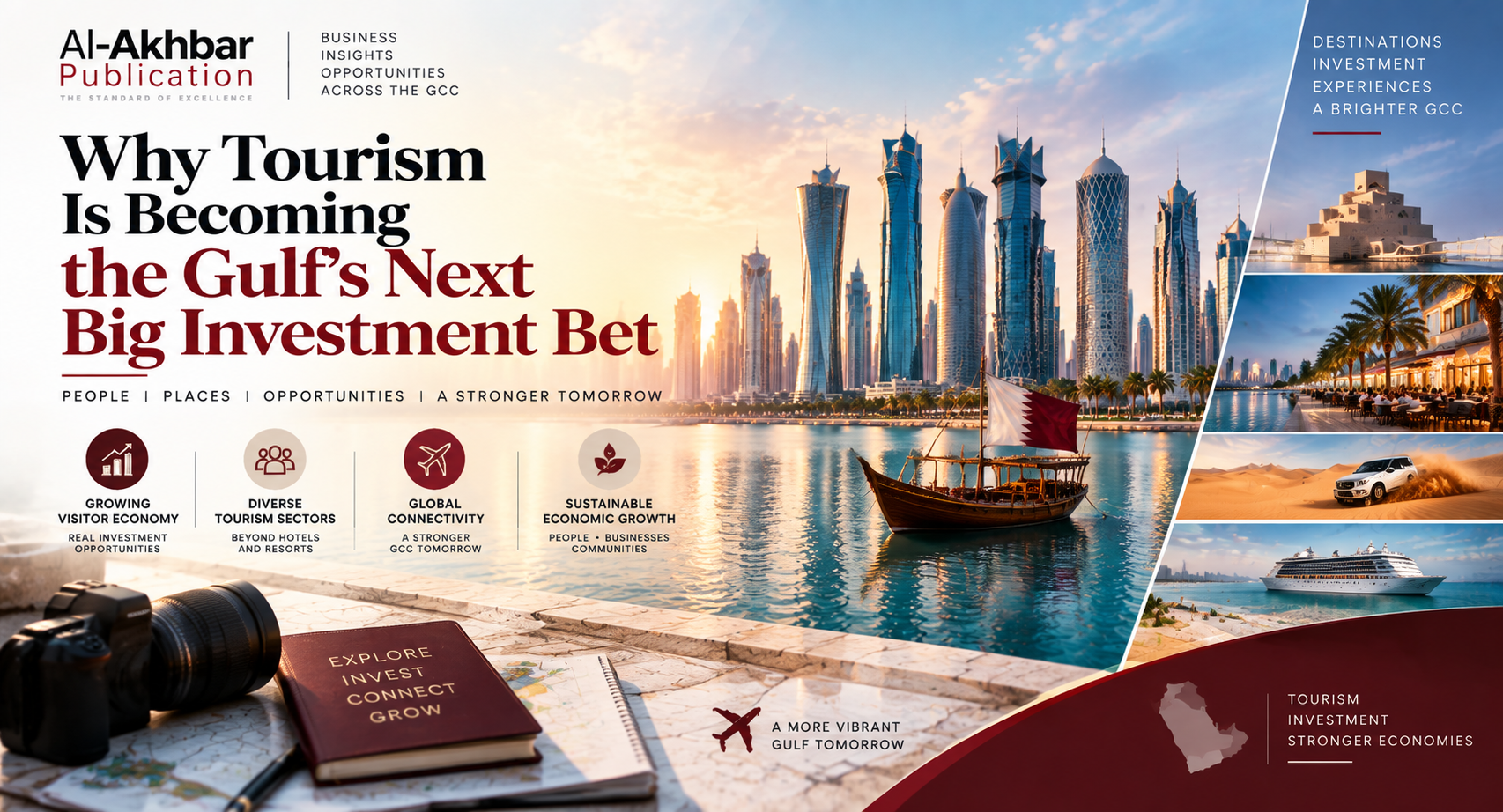
The Gulf's investment landscape is changing. Energy remains central to regional economies, but governments across the GCC are increasingly developing tourism as a long-term source of economic diversification, private-sector activity, employment, and international investment.
This shift is creating opportunities beyond hotels and resorts. Investors are looking at entertainment, restaurants, retail, transport, cultural attractions, cruise tourism, events, technology, and experiences designed around increasingly diverse visitor markets.
For investors evaluating Gulf tourism investment, the important question is no longer whether tourism has a role in the region's economy. It is how quickly the sector can expand and which parts of the tourism value chain may offer sustainable opportunities.
Why Is the Gulf Investing More in Tourism?
Tourism can support several parts of an economy at the same time.
A visitor does not only spend money on accommodation. Travel can generate demand for restaurants, transportation, retail, entertainment, attractions, events, and other services.
This makes tourism particularly attractive to governments pursuing economic diversification.
The region also has several advantages. Gulf countries have invested heavily in airports, roads, hotels, entertainment infrastructure, major events, and international connectivity. These investments create an ecosystem in which additional private-sector tourism projects can develop.
The result is a shift toward tourism as an economic sector rather than simply a leisure industry.
Qatar Shows What Tourism Growth Can Look Like
Qatar provides a useful example of this transformation.
According to Qatar Tourism's 2025 annual performance report, the country welcomed 5.1 million international visitors in 2025, representing 3.7% annual growth. Hotel room nights sold increased by 8.6% to more than 10.8 million, while average full-market hotel occupancy reached 71%.
The country's tourism growth is also becoming broader than traditional leisure travel.
Qatar Tourism reported that the MICE sector welcomed more than one million international business visitors in 2025 and secured 14 international event bids scheduled for 2026 and 2027. Qatar Calendar also delivered more than 600 events during the year.
These figures matter to investors because tourism demand is being supported by multiple visitor segments.
Qatar Tourism Sector Growth Is Extending Across the Economy
The opportunity is not limited to hotel development.
In the first half of 2025, Qatar welcomed more than 2.6 million international visitors. Hotel occupancy averaged 71%, while 5.23 million hotel nights were sold, a 7% increase from the same period in 2024.
Qatar Tourism also reported that tourism contributed approximately QAR 55 billion to GDP in 2024, equivalent to an estimated 8% of the economy. The country's Tourism Strategy 2030 targets a contribution of 10–12% of GDP.
For investors, this signals something important: tourism is being positioned as part of the country's broader economic-development strategy.
The Investment Opportunity Goes Beyond Hotels
Hotels may be one of the most visible tourism investments, but they represent only one part of the ecosystem.
Potential opportunities can emerge across:
- Hospitality and serviced accommodation
- Restaurants and food experiences
- Entertainment and attractions
- Retail and shopping destinations
- Sports tourism
- Cultural tourism
- Cruise tourism
- Business events and MICE
- Tourism technology
- Travel services
- Transportation and mobility
- Wellness and lifestyle experiences
This diversification can make tourism investment more interesting because different businesses can participate without owning a large hotel or resort.
A company providing tourism technology, for example, may benefit from increasing visitor volumes without taking on the capital requirements of a major hospitality development.
Events Are Becoming a Tourism Investment Driver
Major events can create significant short-term visitor demand while also helping destinations build long-term recognition.
Sports competitions, cultural festivals, exhibitions, concerts, business conferences, and shopping events can encourage visitors to travel during specific periods.
Qatar's recent tourism performance demonstrates the potential of this approach. Qatar Tourism attributed strong December 2025 visitor numbers partly to major international events, including the FIFA Arab Cup Qatar 2025.
The investment opportunity therefore extends to businesses that support the event ecosystem.
Hotels need guests. Restaurants need visitors. Transportation providers need passengers. Retailers need foot traffic. Event organizers need venues and services.
This creates interconnected demand.
Cruise Tourism Adds Another Growth Channel
Cruise tourism is another area attracting attention in the Gulf.
Qatar's 2024/2025 cruise season included 87 ship calls, representing a 19% increase over the previous season, and brought more than 360,000 cruise visitors. Qatar Tourism and Mwani Qatar expected around 130 cruise calls for the 2025/2026 season, with visitor numbers projected to exceed 450,000.
Cruise passengers can generate spending across several industries, including transportation, restaurants, retail, attractions, tours, and hospitality.
As Gulf destinations develop their cruise infrastructure, businesses connected to this visitor economy may find additional opportunities.
Why International Investors Are Paying Attention
International investors generally look for markets where infrastructure, demand, government strategy, and private-sector opportunities are developing together.
The Gulf increasingly offers this combination in tourism.
Large infrastructure investments have already created modern airports, hotels, entertainment venues, convention facilities, and transportation networks.
At the same time, governments are actively promoting tourism and encouraging private-sector participation.
Qatar Tourism, for example, explicitly identifies private-sector investment as part of its tourism-development approach and aims to diversify tourism offerings while increasing visitor spending.
This policy direction can provide a foundation for businesses considering regional expansion.
The Rise of Experience-Based Tourism
Tourists increasingly want more than accommodation.
They may look for food experiences, cultural activities, outdoor adventures, wellness services, shopping, entertainment, sports, and locally distinctive attractions.
That creates room for smaller and specialized businesses.
A boutique food concept, cultural experience, guided tour company, wellness operator, or technology platform can potentially participate in tourism growth without competing directly with major hotel groups.
For investors, this means the tourism opportunity should be viewed as a value chain, not a single asset class.
Technology Could Become an Important Part of Tourism Investment
Technology is changing how visitors discover, book, experience, and review destinations.
Tourism businesses increasingly rely on digital booking systems, mobile applications, online payments, customer data, personalized recommendations, digital marketing, and automated customer service.
Qatar's tourism ecosystem already demonstrates the role technology can play. In 2025, its Hayya platform processed nearly one million e-visa applications and supported major events with more than 1.1 million ticket scans.
This creates opportunities for technology companies that can solve practical tourism problems.
Sustainability Will Matter More to Investors
Tourism growth also creates responsibilities.
More visitors can mean greater demand for water, energy, transportation, waste management, and infrastructure. Investors therefore need to consider whether tourism projects can grow without creating unsustainable operating costs or excessive environmental pressure.
Sustainable design, efficient buildings, responsible resource use, smart transportation, and better waste management can become increasingly important.
Sustainability is not only an environmental consideration. It can also influence operating efficiency, regulatory expectations, investor confidence, and long-term asset value.
What Investors Should Evaluate Before Entering the Gulf Tourism Market
Strong visitor numbers do not automatically make every tourism project a good investment.
Investors should examine several factors before committing capital.
Market demand:
Is there sufficient demand for the proposed tourism product?
Target visitors:
Will the project serve domestic, GCC, international, business, leisure, or multiple visitor segments?
Location:
How accessible is the project to airports, hotels, attractions, business districts, and transportation?
Competition:
What similar tourism products already exist?
Seasonality:
Will demand remain stable throughout the year?
Operating costs:
Can the business maintain healthy margins after staffing, utilities, marketing, maintenance, and other expenses?
Government strategy:
Does the project align with the destination's broader tourism-development plans?
Scalability:
Can the concept expand into additional locations or markets?
These questions can help separate genuine opportunities from projects driven primarily by short-term excitement.
Why Gulf Tourism Investment Could Keep Growing
Several long-term factors support continued tourism development across the region.
Governments want to diversify their economies. Infrastructure is improving. International connectivity is strong. Major events attract global attention. Hospitality capacity is expanding, while destinations are developing new cultural, entertainment, sports, and leisure products.
Qatar's 2025 results provide a concrete example of how these factors can interact. Visitor arrivals increased, hotel demand strengthened, accommodation revenue reached QAR 8.3 billion, and the country continued expanding events, MICE, cruise tourism, and international marketing initiatives.
The broader opportunity is therefore not simply about attracting more tourists. It is about building businesses around their entire journey.
What Could Make the Gulf Tourism Market More Attractive?
The next phase of Gulf tourism may depend on quality as much as volume.
Destinations will need to offer experiences that encourage visitors to stay longer, spend more, return, and recommend the destination to others.
For investors, this could favor businesses that solve specific gaps rather than simply adding another undifferentiated tourism product.
A successful project might combine hospitality with entertainment, retail with culture, or technology with personalized travel experiences.
The strongest opportunities may emerge where multiple parts of the tourism economy intersect.
Final Thoughts
Tourism is becoming an increasingly important part of the Gulf's economic diversification story.
Qatar's recent performance illustrates the scale of the opportunity. The country welcomed 5.1 million international visitors in 2025, sold more than 10.8 million hotel room nights, and continued expanding events, business tourism, cruise activity, and tourism infrastructure.
For investors, the opportunity goes well beyond building hotels. Hospitality, food, entertainment, retail, events, transportation, technology, culture, and specialized experiences can all participate in the growing visitor economy.
However, successful Gulf tourism investment will require more than following a regional trend. Investors need to understand demand, competition, operating costs, visitor behavior, regulations, location, and long-term development plans.
As destinations across the region continue building diversified tourism economies, businesses that offer distinctive experiences and solve genuine market needs could be well positioned to participate in the next phase of Gulf growth.