
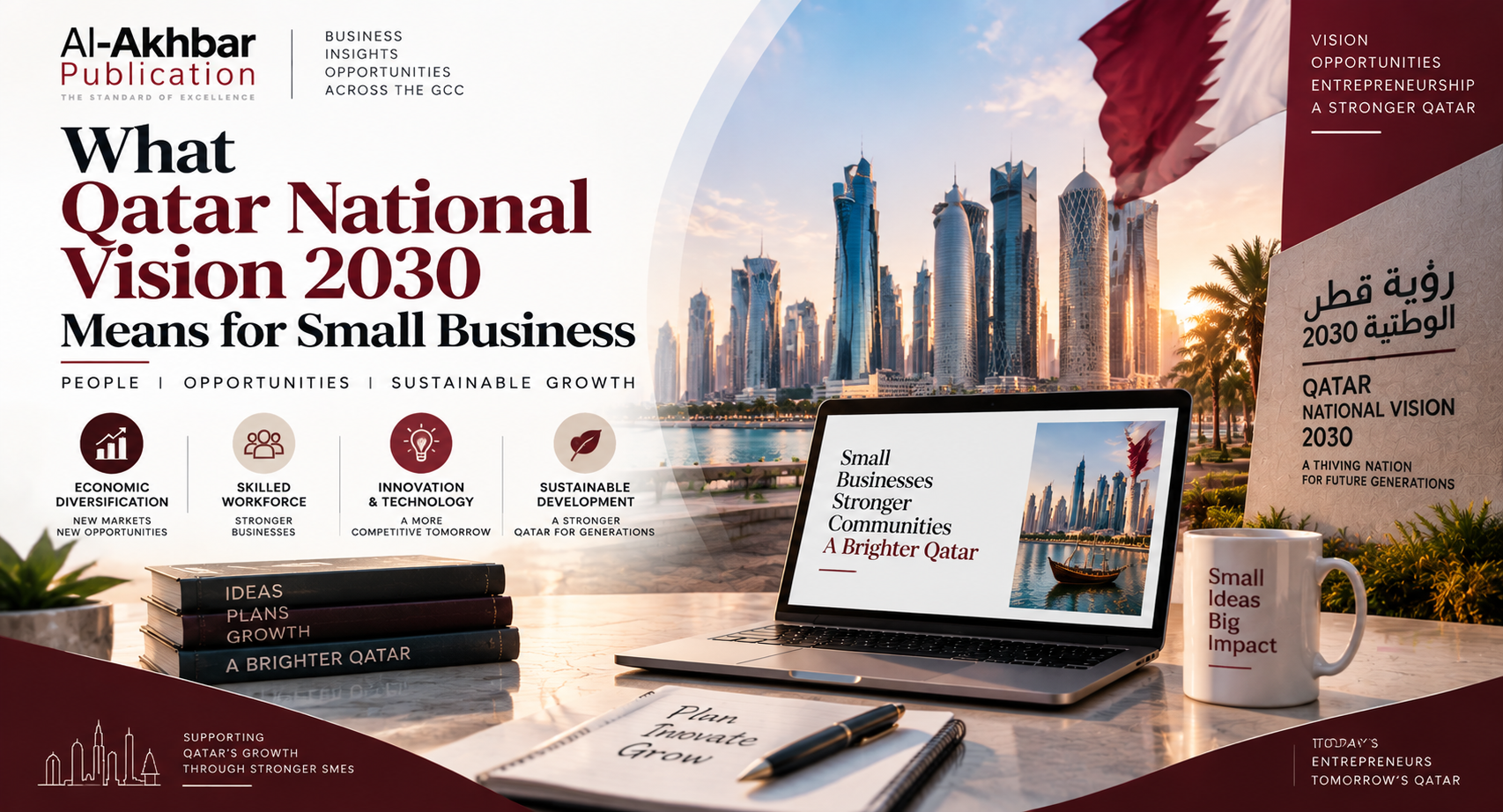
Qatar National Vision 2030 is more than a long-term government development plan. It is shaping how Qatar approaches economic growth, entrepreneurship, technology, sustainability, and private-sector development.
For small businesses, this creates both opportunities and new expectations. Companies that understand the direction of the country's economic development can make better decisions about investment, skills, technology, partnerships, and growth.
Understanding Qatar National Vision 2030 can therefore help SME owners see where their businesses may fit within Qatar's wider economic goals.
What Is Qatar National Vision 2030?
Qatar National Vision 2030 is a national development framework built around four main pillars:
- Economic development
- Social development
- Human development
- Environmental development
The vision aims to support sustainable economic and social progress while helping Qatar develop a more diversified and knowledge-based economy.
For small businesses, the economic and human development pillars are particularly relevant. They connect to areas such as entrepreneurship, workforce skills, innovation, productivity, and private-sector participation.
Why Does Qatar National Vision 2030 Matter to SMEs?
Small and medium-sized enterprises are an important part of a diversified economy. They create jobs, provide specialist services, support larger companies, and introduce new products and ideas into the market.
The Qatar SME business impact can therefore extend beyond individual companies. A stronger SME sector can contribute to a more diverse private economy and create opportunities across different industries.
Businesses that align with national development priorities may also find opportunities through government initiatives, major projects, supply chains, and private-sector partnerships.
1. Economic Diversification Creates New Opportunities
One of the central objectives of Qatar's development strategy is reducing reliance on hydrocarbons by expanding other sectors.
This creates opportunities for SMEs operating in areas such as:
- Technology
- Tourism
- Logistics
- Professional services
- Education
- Healthcare
- Manufacturing
- Creative industries
- Financial services
- Environmental solutions
A small business does not necessarily need to operate in a large strategic sector to benefit. Supporting industries can also gain from increased demand as these sectors expand.
For example, a growing tourism industry creates opportunities for businesses providing marketing, transportation, events, hospitality services, technology, and specialised consulting.
2. Technology Is Becoming More Important
Digital transformation is changing how businesses operate.
For SMEs, technology can improve everyday processes such as:
- Customer communication
- Accounting
- Inventory management
- Marketing
- Sales
- Data analysis
- Online payments
- Customer service
Cloud software, automation, artificial intelligence, and digital commerce can allow smaller businesses to compete more efficiently without building large internal teams.
The important point is that technology should solve a genuine business problem. Investing in software simply because it is new does not automatically create value.
3. Skills and Human Capital Matter
Human development is another important part of Qatar's long-term strategy.
For small businesses, this highlights the importance of developing employees and building capabilities that support productivity.
SMEs can focus on:
- Professional training
- Digital skills
- Leadership development
- Industry certifications
- Customer-service training
- Management capabilities
- Technical expertise
A skilled workforce can help a small business deliver better services while reducing dependence on external support.
Continuous learning is particularly important as technology and customer expectations change.
4. Innovation Can Help SMEs Compete
Small businesses can sometimes innovate faster than larger organisations because they have fewer layers of decision-making.
Innovation does not always mean developing a completely new product. It can involve improving an existing process or finding a better way to serve customers.
For example, an SME could:
- Automate repetitive tasks
- Develop a digital service
- Improve delivery processes
- Introduce new payment options
- Use customer data more effectively
- Create a specialised service
- Develop a more efficient production method
Small improvements can make a meaningful difference when they reduce costs, save time, or improve customer experience.
5. SMEs Can Participate in Larger Supply Chains
Qatar's major infrastructure, tourism, energy, technology, and business projects can create demand for specialist suppliers.
This can provide opportunities for smaller companies that can meet specific procurement requirements.
An SME may not win a major project directly, but it could become a supplier or subcontractor to a larger organisation.
To prepare for these opportunities, businesses should maintain:
- Clear company documentation
- Professional financial records
- Appropriate certifications
- Reliable service processes
- Strong delivery capabilities
- Professional proposals
- Consistent quality standards
Being procurement-ready can make it easier to respond when relevant opportunities arise.
6. Sustainability Is Becoming a Business Consideration
Environmental development is one of the four pillars of Qatar National Vision 2030.
For SMEs, sustainability can influence both operations and customer expectations.
Businesses can consider practical steps such as:
- Reducing unnecessary energy consumption
- Minimising waste
- Improving resource efficiency
- Using digital documentation
- Reducing unnecessary packaging
- Choosing efficient equipment
- Measuring operational costs
Sustainable practices can sometimes reduce expenses as well. Lower energy and material consumption, for example, can improve operational efficiency.
7. Tourism and Hospitality Can Benefit Smaller Businesses
Qatar's growing tourism and events ecosystem can create opportunities for SMEs beyond traditional hotels and travel companies.
Small businesses can support visitors and events through:
- Food services
- Transportation
- Event production
- Retail
- Digital marketing
- Photography
- Entertainment
- Translation
- Local experiences
- Technology services
This illustrates how national economic priorities can create indirect opportunities for smaller companies.
An SME should therefore consider not only where government investment is going but also which supporting services those sectors will need.
8. Digital Presence Is Becoming Essential
A strong digital presence can help SMEs reach customers, establish credibility, and compete beyond their immediate network.
A business website, local search visibility, social media presence, online reviews, and digital communication channels can all contribute to customer acquisition.
For many businesses, the website should function as more than an online brochure. It can support enquiries, bookings, sales, customer education, and lead generation.
SMEs should therefore evaluate their digital presence as part of their broader growth strategy.
What Should Small Businesses Do Now?
Understanding a national vision is useful, but SMEs need to translate broad economic priorities into practical decisions.
A business owner can start by asking:
|
Question |
Why It Matters |
|
Which sectors are growing? |
Identifies potential markets |
|
What problems do these sectors need solved? |
Reveals business opportunities |
|
Which skills will become more valuable? |
Helps guide recruitment and training |
|
Can technology improve operations? |
Supports efficiency |
|
Could the business enter larger supply chains? |
Creates new revenue opportunities |
|
What sustainability improvements are practical? |
Supports efficiency and environmental goals |
|
Is the digital presence strong enough? |
Helps reach customers and partners |
These questions turn a broad national strategy into a practical business-planning exercise.
How SMEs Can Prepare for Future Growth
Businesses should avoid trying to change everything at once.
Instead, focus on areas with the clearest connection to revenue and operational efficiency.
Start by identifying the company's current strengths and weaknesses. Then consider where new demand may emerge and whether the business has the skills and resources to serve it.
The next step may involve upgrading technology, training employees, improving marketing, developing a new service, or building relationships with larger organisations.
Small, consistent improvements can position an SME for opportunities as Qatar's economy continues to develop.
What Challenges Should SMEs Consider?
National economic development creates opportunities, but businesses still need to manage practical challenges.
These may include:
- Increasing competition
- Changing customer expectations
- Technology costs
- Talent shortages in specialised areas
- Compliance requirements
- Access to financing
- Scaling operations
- Maintaining service quality during growth
Alignment with national priorities does not guarantee business success.
SMEs still need a viable business model, strong financial management, customer demand, efficient operations, and effective leadership.
The Bigger Picture for Qatar's Small Businesses
Qatar National Vision 2030 provides a long-term direction for the country's economic and social development. For SMEs, the most important takeaway is that opportunities may emerge not only from large national projects but also from the ecosystems developing around them.
A technology company may support tourism. A logistics business may serve manufacturing. A professional-services firm may help companies entering new markets. A small supplier may become part of a much larger procurement network.
This interconnected economy can give SMEs multiple ways to participate in Qatar's continued development.
Why Al Akhbar Publications Covers Qatar's Business Landscape
Al Akhbar Publications provides business-focused coverage that helps readers understand developments affecting companies, investors, professionals, and entrepreneurs across Qatar and the wider Gulf.
Following economic policies and market developments can help business owners identify trends before making strategic decisions.
For SME owners, staying informed is not simply about knowing what the government plans. It is about understanding how those developments may influence customers, suppliers, investment, technology, skills, and future opportunities.
Final Thoughts
Qatar National Vision 2030 is helping shape the country's approach to diversification, human development, innovation, sustainability, and private-sector growth.
For small businesses, this direction can create opportunities across established and emerging industries. SMEs can prepare by investing in skills, adopting useful technology, strengthening their digital presence, improving operational efficiency, and looking for ways to participate in growing supply chains.
The businesses most prepared for change may be better positioned to take advantage of new demand as Qatar continues working toward its long-term development goals.