
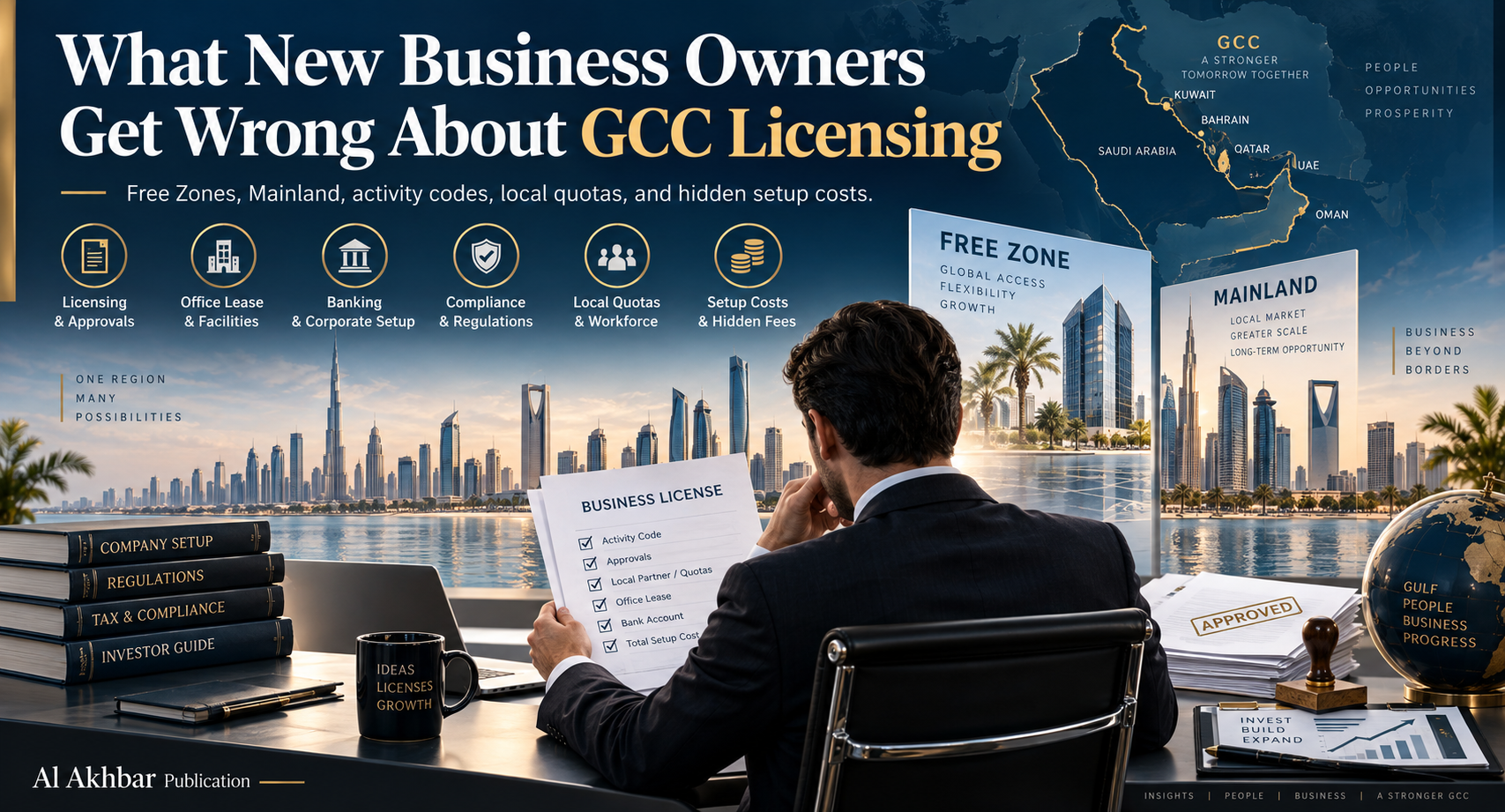
Summary: Setting up a business in the GCC offers great rewards but comes with strict legal realities. New owners often fail by assuming one license covers all countries, mischoosing between Free Zones and Mainland, picking wrong activity codes, ignoring local hiring quotas, and overlooking hidden costs like office leases and document attestation.
Setting up a company in the Gulf Cooperation Council (GCC) is an incredibly smart move for modern entrepreneurs. The region offers amazing tax benefits, world-class infrastructure, and a rapidly booming economy.
Countries like Saudi Arabia and the UAE are heavily investing in diversifying their markets. This creates endless opportunities for foreign investors in tech, retail, and services.
However, many investors arrive with false assumptions. They think opening a shop in Riyadh, Dubai, or Doha works exactly like it does in Western markets.
Failing to understand the nuances of GCC business licensing can lead to frozen bank accounts or massive fines. Here are the critical business setup mistakes in Gulf regions that new entrepreneurs make.
Assuming One License Covers the Entire GCC
The single most common mistake is treating the GCC as a single, unified trade zone. It is easy to see why, given the shared culture and geography of the region.
The legal reality is quite different. The GCC is a political and economic alliance, but each country operates under its own strict legal framework.
This includes Saudi Arabia, the UAE, Qatar, Kuwait, Oman, and Bahrain. A commercial license issued in Dubai does not give you the right to open an office in Riyadh.
You cannot legally hire staff or trade in Muscat with a UAE license. You must secure a separate, independent commercial registration for every single country you plan to operate within.
There are absolutely no shortcuts here. Attempting to cross borders without the proper local documentation will result in severe penalties. It can also permanently damage your reputation with local authorities.
Misunderstanding Free Zones vs. Mainland Setup
Newcomers frequently default to Free Zones because they sound perfect on paper. They offer fast setup, 100% foreign ownership, and zero corporate tax wrappers.
However, choosing a Free Zone without analyzing your target market is a massive structural pitfall. Free Zone companies face strict operational limitations that can stall your growth.
Free Zones were designed to attract foreign capital for international trade. They are legally restricted from trading directly with the local "Mainland" market.
To sell to local consumers, you need a local distributor or a specific commercial agent. If your business model relies on bidding for government contracts, a Free Zone license is often the wrong choice.
Government entities usually require Mainland-registered companies. Similarly, if you plan to open physical retail shops on local streets, you will ultimately need a Mainland license.
Always align your license type with your actual daily operations. Choosing the wrong jurisdiction will force you to restart the entire process.
Choosing the Wrong Activity Code
When applying for your permit, you cannot just write a vague description of your business. You must select specific activities from a standardized government matrix.
These codes are often based on international classification systems. To save money or bypass strict approvals, some founders select a generic code that roughly resembles their plan.
This is a very dangerous trap. If your license says "Management Consultancy" but you are actively managing logistics, you are trading outside your legal scope.
This mismatch is the number one reason corporate bank account applications are rejected in the Gulf. Banks strictly verify your activities against your approved license.
You must ensure an exact match for the following reasons:
- Smooth banking setup:
Banks will only open accounts for clearly defined business activities.
- Clear legal scope:
You protect yourself from arbitrary fines for illegal trading.
- Accurate operational compliance:
Your business stays on the right side of local law.
A mismatched code leads to frozen corporate operations. Always be highly specific about what services or products you plan to offer from day one.
Overlooking Nationalisation and Shareholder Rules
While the GCC has drastically eased foreign ownership rules, certain sectors still require local participation. You must also account for strict local workforce quotas.
Programs like Saudization in Saudi Arabia or Emiratisation in the UAE are strict legal requirements. They dictate that companies must hire a specific percentage of local citizens.
These quotas are based entirely on your industry and company size. You cannot just hire an entirely expat workforce and ignore the local labor laws.
Failing to factor the cost of local talent into your initial business plan can destroy your profit margins. Local hiring often comes with specific salary expectations.
You need to budget for these required hires before your GCC business licensing is even approved. Ignoring this step will halt your setup process entirely.
Underestimating "Hidden" Operational Setup Costs
New owners frequently budget only for the upfront cost of the government license fee. They completely overlook the mandatory secondary expenses required to make that license active.
A commercial license cannot be issued or renewed without a legally registered, physical commercial lease. Virtual desks or P.O. Boxes rarely suffice for mainland corporate entities.
In Dubai, this means getting an Ejari. In Saudi Arabia, you need a certified lease via the Balady platform. Rent is a mandatory, non-negotiable operational cost.
You also face steep attestation fees for your corporate documents. Board resolutions and articles of association must be notarized and apostilled in your home country.
These documents then need to be translated into Arabic by certified ministries in the target GCC nation. This paperwork alone can cost thousands of dollars.
It can also take several months to clear through the various embassies. Factor this time and cost into your initial launch budget to avoid cash flow surprises.
Why Choose Al Akhbar Publication?
Navigating the Gulf market requires more than just guesswork. You need reliable insights and strong connections to truly succeed in this competitive environment.
Al-Akhbar Publication is a premier Strategic Business Hub. We are dedicated to connecting industrial leaders, local sellers, and modern consumers across the GCC and beyond.
We have evolved beyond traditional media to build a modern ecosystem for the entire Middle East. Our focus is 100% commercial and designed to help you grow.
We provide the infrastructure for sellers to thrive in the digital age. We offer high-impact digital visibility, deep market insights, and a direct gateway to regional consumers.
For consumers, we act as a verified directory to find reliable services and premium deals across the region. This builds the trust needed for your business to flourish.
For businesses, we are a catalyst for cross-border trade and industrial growth. We facilitate the strategic B2B networking partnerships you need to scale.
Al-Akhbar is also your premier destination for the latest news from Qatar and the globe. We bring you facts with integrity and speed to guide your most important business decisions.
Conclusion:
Expanding into the Middle East offers unmatched growth potential for your brand. However, success requires careful planning and a deep respect for local laws.
Do not let simple paperwork errors or misunderstanding local regulations slow your momentum. Take the time to research your specific activity codes and real estate needs.
Avoiding these common pitfalls requires a solid understanding of GCC business licensing. With the right preparation, you can build a profitable, fully compliant business in one of the world's most dynamic markets.
Ready to navigate the GCC market with confidence and connect with the right partners? Explore Al-Akhbar Publication today to gain the insights and visibility your business needs to thrive