
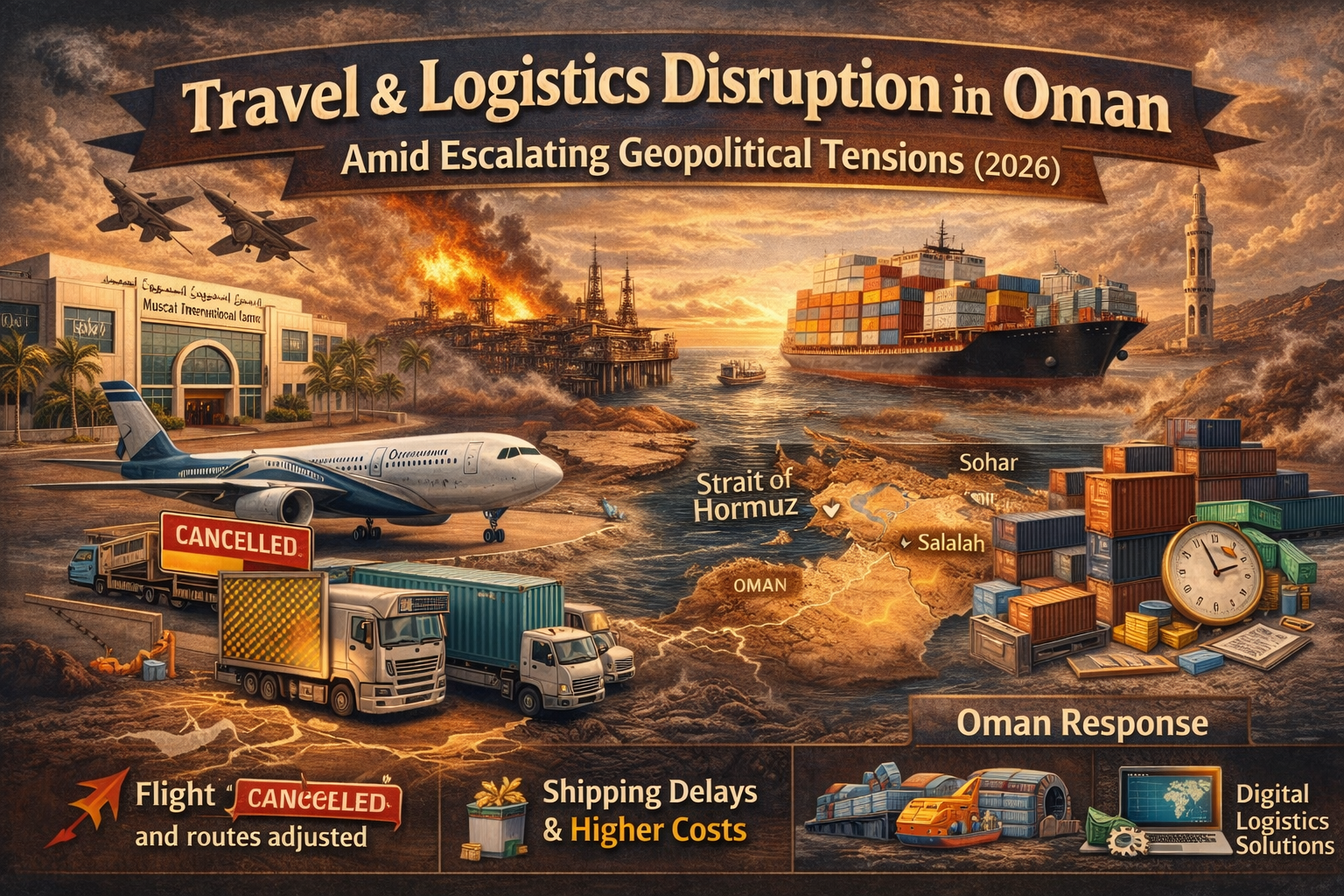
The ongoing geopolitical tensions between Iran, Israel, and the USA have had far-reaching consequences, particularly in the transportation and logistics sectors. Oman, strategically located along vital shipping and air corridors, has found itself grappling with significant disruptions that have affected aviation, cargo routes, and supply chain logistics. The Strait of Hormuz, a key maritime passage that Oman shares with Iran, has become a focal point of geopolitical tension, causing ripple effects that have impacted Oman’s economy and business operations.
This blog explores how the escalation of regional conflicts has disrupted air travel, cargo shipping, and logistics in Oman, affecting businesses, travelers, and the broader economy. We will examine the extent of these disruptions, their causes, and the long-term implications for Oman's economic stability, focusing on the aviation industry, maritime shipping routes, supply chain delays, and logistical planning challenges.
1. Overview of the Impact on Aviation Hubs
Oman’s major aviation hubs, particularly Muscat International Airport, have been severely impacted by the ongoing tensions. As one of the key transportation hubs for the Gulf region, Oman’s air travel industry relies heavily on seamless international and regional connections. However, the growing instability has led to flight cancellations, delays, and adjustments in flight routes, all of which have disrupted the aviation sector.
Flight Cancellations and Re-routing
The escalating conflict between Iran, Israel, and the USA has led to flight cancellations in Oman and across the broader Gulf region. Airlines, particularly those with flights passing through the Strait of Hormuz and other potentially dangerous airspaces, have been forced to adjust their flight routes to ensure the safety of passengers and crew.
Key impacts include:
-
Cancellations of regional flights due to airspace closure and security concerns.
-
Increased flight duration for certain routes as airlines re-route to avoid regions impacted by the conflict.
-
Higher operational costs for airlines due to longer flight paths and fuel usage.
For Oman’s national carrier, Oman Air, these disruptions have led to operational losses, particularly for flights bound for Iran, Israel, and other affected regions. In addition, airlines serving Oman have seen a decline in international passenger traffic, with travelers opting for safer routes outside the region.
Security Concerns and Airspace Closures
In addition to cancellations, airspace closures have also become a significant concern. As tensions rise, the risk of accidental military confrontations increases, leading to airspace restrictions over key transit routes. Many flights that previously passed through the region now have to take detours, which in turn increases fuel consumption, operational costs, and the travel time for airlines.
Passenger and Cargo Operations Affected
-
Airlines have been forced to scale back operations, cutting routes or suspending services to certain destinations entirely.
-
Cargo carriers have faced delays as certain airspace corridors, critical for time-sensitive goods, were rerouted or closed.
-
International travelers have experienced higher prices and longer travel times as airlines adjust schedules to accommodate the political climate.
2. Disruptions to Shipping Routes and Maritime Trade
The Gulf region’s maritime routes, particularly the Strait of Hormuz, play a vital role in global oil transport. It is one of the world’s most critical chokepoints, with about 20% of the world’s crude oil passing through it. As tensions between Iran, Israel, and the USA escalate, there have been increasing fears of a blockade or disruption of shipping lanes, affecting not only oil transport but also general cargo shipping.
Disrupted Shipping Routes
Oman, with its strategic ports such as Sohar and Salalah, relies heavily on the smooth flow of goods through these global shipping routes. However, with the potential for military action in the Strait of Hormuz and surrounding areas, global shipping lines are being forced to alter their routes. This disruption has had a ripple effect on Oman’s ports, causing delays in both imports and exports.
Key effects on Oman’s shipping industry:
-
Increased shipping times due to detours taken by vessels to avoid risky areas.
-
Shipping delays in major Omani ports, affecting businesses that rely on the timely delivery of goods.
-
Rising shipping costs as insurance premiums soar, particularly for vessels passing through high-risk zones.
Supply Chain Challenges
Oman’s economy is dependent on the smooth flow of goods through its shipping lanes. The delays in shipping routes have led to supply chain bottlenecks, particularly for sectors such as construction, manufacturing, and retail, which rely on timely deliveries of goods and raw materials.
-
Construction materials and machinery used in Oman's infrastructure development projects have faced delays.
-
Imported consumer goods, particularly electronics, clothing, and food products, are also affected, causing temporary price hikes due to delayed deliveries.
The disruption in shipping has highlighted the vulnerabilities in Oman’s reliance on global shipping lanes and its dependency on uninterrupted supply chains. As companies face higher costs and delays, the economic impact on local businesses is significant.
3. Supply Chain and Logistics Impact: Delays and Cost Increases
Beyond the aviation and shipping disruptions, the logistics sector in Oman has also experienced significant delays. The ripple effect of regional instability has strained businesses’ ability to receive and distribute goods in a timely and cost-effective manner.
Increased Transportation Costs
As a result of air and sea disruptions, transportation costs have risen across various industries. This increase in logistics costs is being felt by businesses in Oman, particularly those in the retail, manufacturing, and consumer goods sectors. The cost of transportation, both by air and sea, has skyrocketed as companies are forced to re-route shipments, find alternative carriers, and pay higher insurance premiums.
For instance, shipping insurance premiums have surged due to the increased risk in the region. Cargo owners and businesses that rely on international trade are facing higher operational costs, which could be passed down to the consumers, leading to inflationary pressures.
Bottlenecks in Supply Chains
Supply chains in Oman, which rely heavily on imports from Asia and Europe, are experiencing bottlenecks due to disrupted shipping schedules. Products and raw materials from global suppliers are now delayed, with businesses in Oman struggling to meet production targets. This is particularly concerning for industries like automotive, electronics, and construction, where just-in-time inventories are critical for operations.
-
Retailers are facing empty shelves as they await inventory from international suppliers.
-
Manufacturers are unable to meet their production quotas because of missing raw materials and delayed shipments.
This logistical disruption is not only slowing down the economy but also leading to increased operational costs for businesses, which will ultimately affect consumer prices.
4. Oman’s Response: Strategies for Mitigating Disruption
As a small but strategically important nation, Oman has taken proactive steps to mitigate the disruption caused by regional instability. With its strategic geographic location between key energy routes, Oman is positioned to play a pivotal role in ensuring the continuity of regional trade despite the ongoing tensions.
Increasing Investments in Infrastructure
Oman has been making significant investments in its ports and logistics infrastructure in an effort to expand its maritime capabilities and reduce the reliance on congested shipping lanes. For instance:
-
The Sohar Port has been upgraded to accommodate larger vessels and improve cargo handling capacities.
-
Salalah Port has enhanced its container terminal capabilities to attract more global shipping lines.
These initiatives are designed to ensure that Oman remains a key player in global shipping routes, even when tensions affect nearby areas.
Strengthening Digital Logistics Solutions
Oman’s logistics sector has increasingly embraced digital solutions to streamline operations. The country has invested in supply chain digitization to improve efficiency, reduce bottlenecks, and increase the flexibility of its supply chains.
By using advanced tracking systems and real-time data analytics, businesses in Oman can better manage inventory, avoid delays, and respond to disruptions quickly. This digital transformation in logistics is crucial for maintaining competitiveness in a volatile environment.
5. Long-Term Economic Implications for Oman
While the immediate disruptions caused by the Iran-Israel-USA tensions are causing delays and price increases, Oman’s economy is resilient, and the country’s long-term strategy of diversification will help it navigate the challenges. The oil price surge may offer short-term benefits, but the economic diversification plans under Vision 2040 will enable Oman to reduce its dependence on oil and increase stability across other sectors such as renewable energy, tourism, and digital businesses.
In the logistics sector, diversification away from traditional shipping routes will play a key role in safeguarding Oman’s economic future. Investments in infrastructure, transportation, and technology will ensure that Oman can handle future disruptions more effectively.
Conclusion: Navigating Travel & Logistics Disruption in Oman
Oman has faced significant disruptions in aviation, maritime trade, and logistics due to the escalating tensions between Iran, Israel, and the USA. These disruptions have caused delays, cost increases, and supply chain bottlenecks that have affected businesses and consumers alike. While the country has benefited from a temporary rise in oil prices, the long-term impact on its economy will depend on how well it adapts to these challenges.
By investing in infrastructure, embracing digital transformation, and diversifying its economy, Oman can mitigate the adverse effects of regional tensions and position itself for long-term growth. The key to future success lies in resilience, flexibility, and the strategic use of technology to overcome logistical hurdles in a rapidly changing geopolitical landscape.