
Introduction
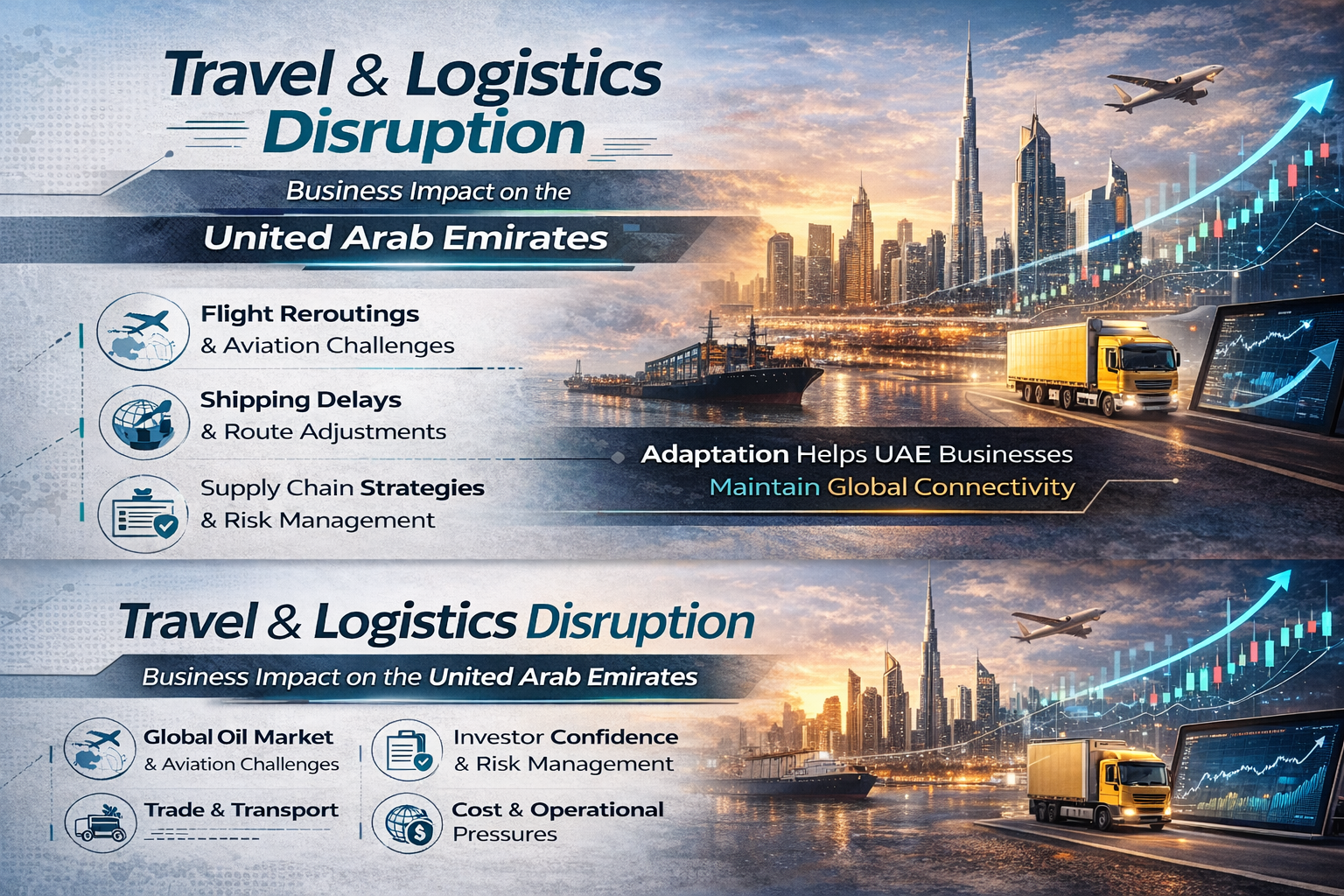
Travel and logistics are among the most interconnected sectors of the global economy. Any change in airspace access, flight routing, shipping lanes, or transit insurance can influence trade efficiency, supply chains, tourism flows, and corporate operations. In recent months, heightened regional uncertainty led to adjustments across aviation and logistics networks in the Gulf region.
The United Arab Emirates holds a unique position as a global transit hub linking Asia, Europe, Africa, and the Americas. With world-class airports, ports, and free zones, the UAE’s economy depends heavily on smooth travel and logistics operations. This blog explores how recent disruptions affected travel and logistics in the UAE, and how businesses adapted to maintain continuity and competitiveness.
UAE’s Strategic Role as a Global Transit Hub
The UAE has invested heavily over decades to become a preferred gateway for international trade and travel.
Key Strengths:
Geographical position connecting major global markets
Advanced aviation and port infrastructure
Integrated free zones and logistics clusters
Strong customs and trade facilitation systems
Because of this central role, even minor regional disruptions require rapid operational responses.
Regional Airspace Adjustments and Aviation Impact
Regional uncertainty led to selective airspace adjustments that affected flight planning across the Middle East.
Observed Developments:
Rerouting of some international flights
Longer flight paths for specific destinations
Adjusted departure and arrival schedules
Increased fuel planning and coordination
Despite these challenges, UAE airports remained fully operational.
Airline Operational Adaptation in the UAE
UAE-based airlines and international carriers demonstrated strong operational flexibility.
Operational Responses:
Dynamic route planning and scheduling
Use of alternative air corridors
Enhanced coordination with aviation authorities
Real-time passenger communication systems
These measures minimized passenger inconvenience and maintained safety standards.
Impact on Passenger Travel and Business Mobility
Business travel and tourism are key contributors to the UAE economy.
Passenger-Related Impacts:
Slightly longer travel times on select routes
Rescheduling of some business trips
Increased reliance on digital meetings
Continued demand for leisure travel
Overall passenger confidence remained stable due to UAE’s safety reputation.
Tourism Sector Response and Resilience
Tourism businesses adjusted strategies to maintain momentum.
Tourism Adaptation Measures:
Flexible booking and cancellation policies
Promotion of regional and domestic tourism
Focus on premium and experience-based travel
Enhanced customer communication
Hotels, airlines, and tour operators maintained steady occupancy levels.
Cargo Aviation and Air Freight Adjustments
Air cargo plays a critical role in time-sensitive trade.
Cargo Sector Changes:
Adjusted cargo flight routing
Revised delivery timelines
Prioritization of high-value goods
Increased coordination with logistics partners
Despite adjustments, cargo throughput remained strong.
Maritime Logistics and Shipping Route Planning
The UAE’s ports are essential nodes in global shipping networks.
Shipping-Related Adjustments:
Revised shipping schedules
Alternative routing considerations
Increased voyage planning
Close coordination with insurers and port authorities
Port operations continued without interruption.
Impact on Import and Export Businesses
Companies involved in trade experienced planning challenges rather than shutdowns.
Business Impacts:
Slightly higher logistics costs
Longer transit times for select routes
Increased focus on inventory management
Enhanced supply chain visibility
Most businesses absorbed these changes through planning and diversification.
Logistics Cost Management Strategies
UAE businesses focused on cost control and efficiency.
Cost Management Actions:
Route optimization
Bulk shipping and consolidation
Long-term contracts with logistics providers
Digital freight management tools
These strategies limited cost escalation.
Role of UAE Ports and Free Zones
Free zones and ports provided flexibility during disruptions.
Key Advantages:
Efficient customs clearance
Integrated warehousing solutions
Multimodal transport connectivity
Business-friendly regulatory frameworks
This helped maintain trade flows.
Supply Chain Planning and Inventory Strategy
Uncertainty encouraged smarter inventory management.
Supply Chain Adjustments:
Increased safety stock for critical goods
Diversification of supplier locations
Regional sourcing strategies
Advanced demand forecasting
Supply chain resilience improved as a result.
Digitalization in Logistics Operations
Technology played a crucial role in managing disruption.
Digital Tools Adopted:
Real-time shipment tracking
AI-based route optimization
Automated customs documentation
Integrated logistics platforms
Digital logistics reduced uncertainty and delays.
Impact on E-Commerce and Retail Logistics
Online retail logistics adapted efficiently.
E-Commerce Trends:
Strong last-mile delivery performance
Increased use of local fulfillment centers
Customer transparency on delivery timelines
Stable consumer demand
E-commerce growth remained unaffected.
SME and Startup Logistics Challenges
Small and medium enterprises faced unique challenges.
SME Responses:
Partnering with third-party logistics providers
Sharing warehouse and transport capacity
Using digital freight marketplaces
Adjusting pricing strategies
Flexibility helped SMEs stay competitive.
Insurance, Compliance, and Risk Management
Travel and logistics disruption influenced insurance planning.
Risk Management Measures:
Revised cargo insurance coverage
Enhanced compliance monitoring
Contingency planning
Diversified transit options
Risk-aware planning reduced exposure.
Workforce and Operations Management
Logistics and aviation workforces adapted to changing demands.
Workforce Adjustments:
Flexible shift planning
Cross-training employees
Remote coordination teams
Productivity monitoring systems
Operational efficiency remained high.
Comparison with Global Logistics Disruptions
Compared to other global hubs, UAE disruptions were limited.
Comparative Strengths:
Faster operational response
Better infrastructure readiness
Strong public-private coordination
Lower congestion and delays
This reinforced the UAE’s reliability image.
Business Confidence in UAE Logistics Sector
Despite uncertainty, confidence remained strong.
Confidence Drivers:
Policy stability
Infrastructure investment
Transparent communication
Proven crisis management
Businesses continued long-term planning.
Long-Term Improvements Triggered by Disruption
Disruptions often drive innovation.
Long-Term Benefits:
More resilient logistics networks
Increased digital adoption
Stronger regional partnerships
Improved contingency planning
These improvements strengthen competitiveness.
Future Outlook for UAE Travel & Logistics
Looking ahead, the UAE remains well-positioned.
Outlook Factors:
Continued infrastructure expansion
Smart logistics initiatives
Sustainable aviation investments
Global trade integration
The UAE is expected to maintain its hub status.
Conclusion
Travel and logistics disruptions tested operational flexibility across the Gulf. In the UAE, advanced infrastructure, proactive planning, and digital readiness ensured continuity rather than disruption. Airlines, ports, logistics providers, and businesses adjusted routes, schedules, and strategies without major interruptions.
These adaptations not only preserved economic activity but also strengthened long-term resilience. The UAE’s ability to manage uncertainty while sustaining global connectivity highlights its position as one of the world’s most reliable trade and travel hubs.