
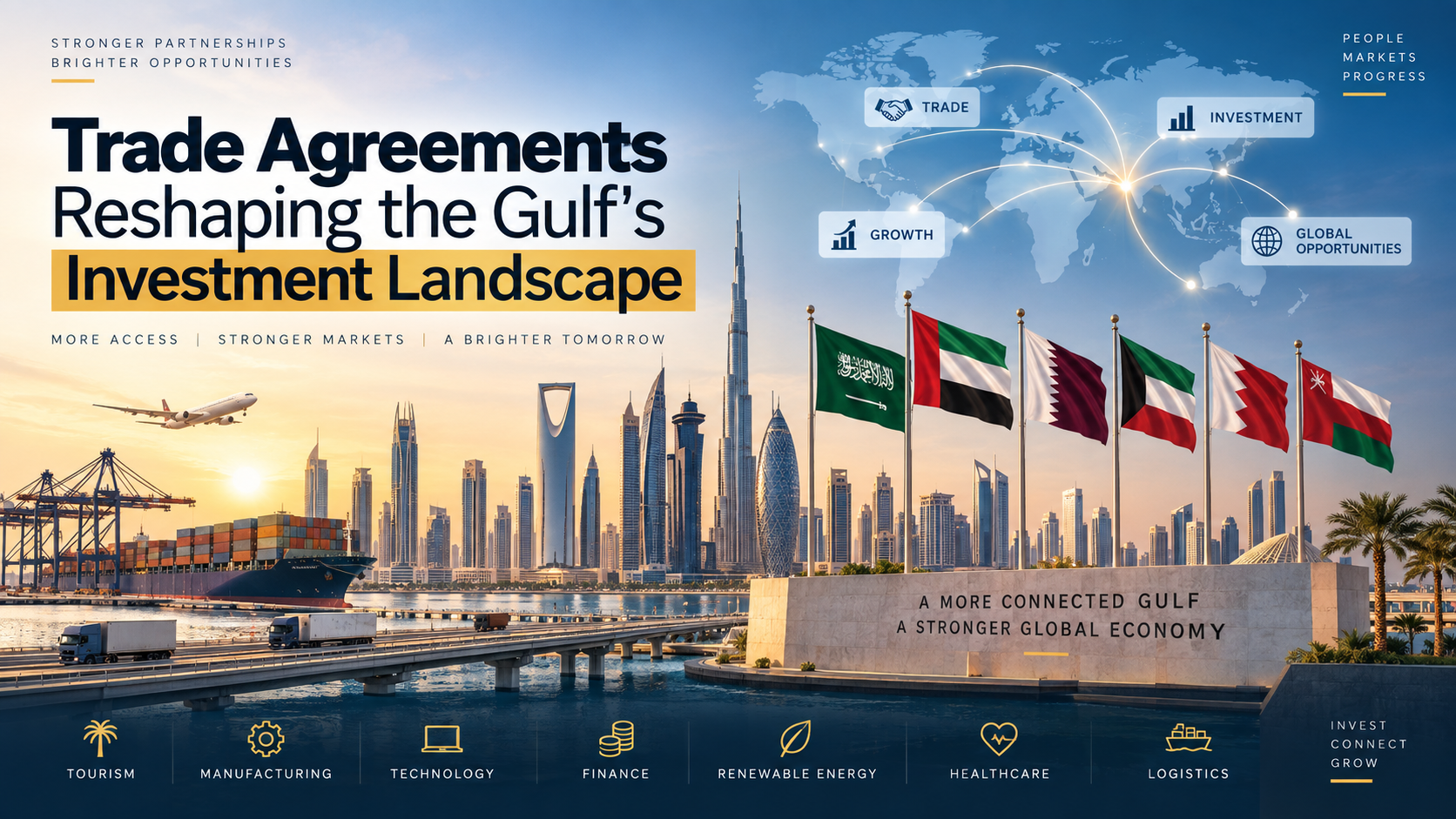
The Gulf investment landscape is changing rapidly. For decades, oil and gas shaped much of the region's economic activity. Today, Gulf countries are expanding into tourism, logistics, technology, manufacturing, finance, renewable energy, healthcare, and other sectors.
Trade agreements are an important part of this transformation. They can reduce trade barriers, improve market access, strengthen economic relationships, and create opportunities for companies looking to expand across borders.
For investors watching the GCC investment landscape, these agreements can influence where businesses establish operations, how they structure supply chains, and which Gulf markets offer the strongest growth opportunities.
What Are Gulf Trade Agreements?
Trade agreements are arrangements between countries or economic blocs that establish rules for trade and investment.
Depending on the agreement, they can address:
- Import and export duties
- Market access
- Customs procedures
- Investment protections
- Services
- Intellectual property
- Government procurement
- Digital trade
- Rules of origin
The exact provisions differ from one agreement to another.
For businesses, clearer trade rules can make cross-border expansion easier to evaluate.
Why Trade Agreements Matter to Investors
Investors look at more than the size of a domestic market.
They also consider how easily a business can reach customers in neighbouring and international markets.
Trade agreements can influence:
- Market access
- Supply-chain costs
- Export opportunities
- Business certainty
- Foreign investment decisions
- Regional expansion strategies
A company may therefore choose a Gulf location not only because of its local demand but also because of its access to wider markets.
The GCC Is Becoming More Connected to Global Markets
The Gulf Cooperation Council consists of:
- Saudi Arabia
- United Arab Emirates
- Qatar
- Kuwait
- Bahrain
- Oman
These economies have different economic structures and investment priorities, but they share an interest in increasing international trade and attracting investment.
Trade relationships with major economies can support these ambitions by creating additional commercial links beyond the region.
The GCC's Existing Trade Framework
The GCC has an established customs union and a common market framework designed to improve economic integration among member states.
The GCC Customs Union was launched in 2003, while the GCC Common Market began in 2008.
These frameworks are intended to facilitate economic interaction within the bloc.
However, businesses still need to consider individual national regulations, licensing requirements, ownership rules, tax systems, and sector-specific requirements when entering individual GCC markets.
Free Trade Agreements Can Expand Market Access
Free trade agreements can reduce or eliminate certain tariffs and establish clearer rules for businesses operating between participating economies.
For Gulf companies, greater market access can support:
- Export growth
- International partnerships
- Manufacturing expansion
- Regional distribution
- Foreign investment
For overseas investors, agreements can make Gulf-based production and distribution more strategically attractive.
The UAE's Global Trade Network
The UAE has pursued an extensive network of economic partnerships, including its Comprehensive Economic Partnership Agreements, or CEPAs.
These agreements aim to strengthen trade and investment relationships with selected international markets.
For investors, the significance goes beyond exports. Greater connectivity can support the UAE's position as a commercial and logistics hub connecting businesses with markets across the Middle East, Asia, Africa, and beyond.
Saudi Arabia's Growing Investment Opportunities
Saudi Arabia is undergoing significant economic transformation through Vision 2030.
The country is investing heavily in areas beyond traditional hydrocarbons.
Priority sectors include:
- Tourism
- Entertainment
- Logistics
- Manufacturing
- Technology
- Mining
- Renewable energy
- Healthcare
International trade relationships can support these sectors by increasing access to markets, suppliers, technologies, and investment partners.
Qatar Is Expanding Its International Economic Links
Qatar has also focused on strengthening international trade and investment relationships.
Its strategic position, energy resources, infrastructure, and investment programmes make it an important market within the Gulf.
Trade relationships can support opportunities in areas such as:
- Logistics
- Energy
- Financial services
- Tourism
- Technology
- Infrastructure
For investors, these connections can provide additional opportunities beyond Qatar's domestic market.
Trade Agreements and Supply Chains
One of the biggest investment considerations is supply-chain efficiency.
Companies increasingly examine where they can:
- Source raw materials.
- Manufacture products.
- Store inventory.
- Distribute goods.
- Reach customers.
Trade agreements can influence the cost and ease of these activities.
A company may choose a Gulf location partly because it provides efficient access to several surrounding markets.
Logistics Is Becoming More Important
The Gulf's geographic position gives it a strategic advantage between major markets in Asia, Europe, and Africa.
Large investments in ports, airports, roads, free zones, and logistics infrastructure are reinforcing this position.
Trade agreements can complement this infrastructure by improving the commercial conditions for moving goods between markets.
This creates opportunities for:
- Warehousing
- Freight
- E-commerce
- Distribution
- Manufacturing
- Supply-chain technology
Manufacturing Benefits From Market Access
Economic diversification requires more than attracting service businesses.
Gulf countries are also seeking to develop manufacturing capabilities.
Improved access to international markets can make local production more attractive.
Potential areas include:
- Food processing
- Pharmaceuticals
- Chemicals
- Advanced manufacturing
- Construction materials
- Automotive components
- Technology products
When manufacturers can serve both local and international customers, the potential market becomes considerably larger.
Trade Agreements Can Support Foreign Direct Investment
Foreign direct investment, or FDI, involves overseas companies investing in businesses, facilities, or operations in another country.
Investors generally consider factors such as:
- Market size
- Infrastructure
- Regulation
- Political and economic stability
- Labour availability
- Tax considerations
- Trade access
Trade agreements can strengthen the market-access component of this calculation.
Investment Zones Add Another Layer
Gulf countries have developed numerous economic and free zones to attract international companies.
These zones can offer combinations of:
- Business infrastructure
- Simplified procedures
- Logistics access
- Ownership structures
- Sector-specific incentives
However, incentives vary considerably between jurisdictions.
Businesses should assess the complete regulatory and commercial environment rather than choosing a location based on one incentive.
Digital Trade Is Becoming More Relevant
Trade is no longer limited to physical goods.
Digital services now play a growing role in international commerce.
Modern trade discussions increasingly involve:
- E-commerce
- Digital payments
- Data flows
- Cloud services
- Cybersecurity
- Digital intellectual property
As Gulf economies expand their technology sectors, digital trade rules may become increasingly important to investors.
Trade Agreements Can Encourage Economic Diversification
Diversification is one of the Gulf's major economic priorities.
Trade agreements can help by creating opportunities in sectors that are less dependent on hydrocarbons.
For example, improved market access can support companies in:
- Tourism
- Healthcare
- Education
- Technology
- Financial services
- Manufacturing
- Logistics
- Food production
This can contribute to broader economic resilience.
Investors Still Need to Understand Local Rules
A trade agreement does not remove every barrier to investment.
Companies entering a Gulf market should still examine:
- Company registration
- Foreign ownership rules
- Licensing
- Employment regulations
- Tax obligations
- Customs requirements
- Product standards
- Data regulations
An agreement may improve market access while national regulations continue to govern how a company operates locally.
What Investors Should Watch
The Gulf investment environment is likely to remain closely connected to developments in international trade.
Investors should monitor:
- New trade agreements
- Changes to customs rules
- Regional economic integration
- Foreign ownership policies
- Infrastructure investment
- Industrial strategies
- Digital trade regulations
- Sector-specific incentives
These factors can affect both short-term expansion plans and long-term investment decisions.
How Businesses Can Prepare
Companies considering Gulf expansion should take a structured approach.
Research the target market
Understand demand, competition, regulations, and operating costs.
Map the supply chain
Identify where products, materials, and services will cross borders.
Study applicable agreements
Determine whether preferential trade terms apply to the business.
Check rules of origin
Preferential tariffs often depend on specific origin requirements.
Compare Gulf markets
The GCC is not a single regulatory environment. Each country has its own requirements.
Seek professional advice
Legal, tax, customs, and investment specialists can help businesses understand complex requirements.
The Long-Term Investment Picture
Trade agreements are only one part of the Gulf's economic transformation.
Their impact becomes stronger when combined with:
- Large infrastructure projects
- Economic diversification
- Technology investment
- Logistics development
- Tourism expansion
- Industrial strategies
- Financial-market development
Together, these developments are creating a more diversified and internationally connected investment environment.
Why Choose Al Akhbar Publications?
Al Akhbar Publications provides informative coverage of business, economic, and investment developments relevant to readers following the Gulf and wider international markets.
Understanding changes in trade policy requires looking beyond individual agreements. Businesses and investors need to consider how new commercial relationships interact with economic diversification, infrastructure, regulation, and regional market development.
Through business-focused analysis and accessible reporting, Al Akhbar Publications helps readers follow the developments shaping the Gulf economy.
Conclusion
Trade agreements are becoming an increasingly important part of the Gulf's economic strategy. They can improve market access, strengthen international relationships, support supply chains, and create new opportunities for businesses and investors.
At the same time, trade agreements should not be viewed in isolation. Their impact depends on infrastructure, regulations, investment policies, domestic demand, and each country's broader economic strategy.
For companies evaluating the GCC investment landscape, understanding these developments can provide useful context when choosing markets, planning supply chains, and assessing expansion opportunities.
As Gulf economies continue moving beyond traditional oil dependence, international trade relationships are likely to remain an important part of the region's next stage of economic growth.