
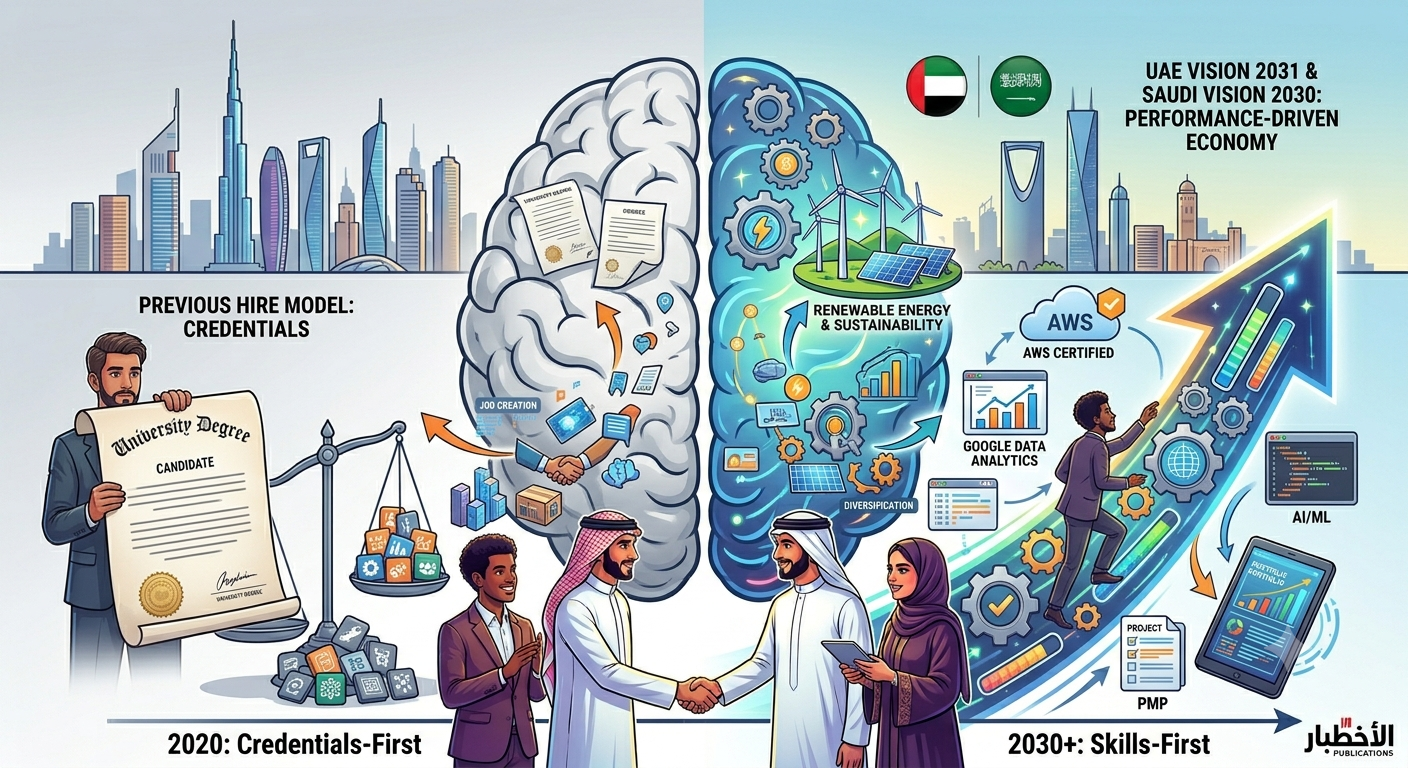
The Gulf region is undergoing one of the most significant labor market transformations in its modern history. As the UAE and Saudi Arabia accelerate economic diversification away from oil dependence, hiring priorities are shifting rapidly. Traditional job requirements based purely on academic degrees are being replaced by a more dynamic model focused on skills, adaptability, and measurable impact.
For job seekers and professionals aiming to build careers in the region, understanding this “new hiring economy” is essential. Recruiters are no longer asking only what you studied, they are asking what you can do.
At Al Akhbar Publications, we analyze these shifts closely as part of the region’s evolving professional and economic narrative.
From Credentials to Capability: A Structural Shift in Hiring
For decades, hiring in the Gulf was heavily credential-driven. A university degree from a recognized institution often acted as the primary gateway to employment. Today, that model is changing.
Recruiters in both the UAE and Saudi Arabia are increasingly prioritizing:
- Practical, job-ready skills
- Industry certifications
- Real-world project experience
- Digital and technical competency
- Problem-solving ability
This shift reflects broader economic goals under initiatives such as UAE Vision 2031 and Saudi Vision 2030, both of which emphasize innovation, technology, and private sector growth.
Employers are now focused on performance readiness, not just academic background.
Why the Gulf Hiring Market Is Changing So Fast
Several powerful forces are reshaping recruitment across the region.
1. Economic Diversification Programs
Both countries are investing heavily in non-oil sectors such as:
- Artificial intelligence
- Renewable energy
- Tourism and hospitality
- Logistics and supply chain
- Financial technology (FinTech)
These industries require specialized skill sets that traditional academic paths do not always fully cover.
2. Digital Transformation Acceleration
Organizations across the Gulf are rapidly adopting:
- Cloud computing
- Automation tools
- AI-driven analytics
- Cybersecurity frameworks
This creates demand for professionals who can adapt quickly and apply technical knowledge in real environments.
3. Global Talent Competition
The UAE and Saudi Arabia are now competing with global markets for skilled professionals. As a result, hiring standards are becoming more aligned with international benchmarks rather than regional norms.
What Recruiters in UAE Actually Look For
Recruiters in the UAE tend to focus on a blend of technical ability and cultural adaptability.
Key hiring priorities include:
- Demonstrated experience in relevant roles
- Strong digital literacy
- Communication skills in multicultural environments
- Ability to work in fast-paced business ecosystems
- Familiarity with global tools and platforms
In cities like Dubai and Abu Dhabi, employers value candidates who can integrate quickly into international teams and deliver measurable outcomes.
Soft skills are no longer optional, they are essential.
What Saudi Arabia Recruiters Prioritize
Saudi Arabia’s job market is expanding rapidly due to mega-projects like NEOM, The Red Sea Project, and Qiddiya.
Recruiters are particularly focused on:
- Large-scale project experience
- Engineering and infrastructure expertise
- AI and data-driven capabilities
- Government and enterprise alignment
- Leadership potential in emerging industries
Unlike traditional markets, Saudi hiring often emphasizes long-term contribution to national transformation initiatives.
Candidates who understand Vision 2030 priorities often have a competitive advantage.
The Rise of Certifications Over Degrees
One of the most significant shifts in the Gulf hiring economy is the growing importance of certifications.
Popular certifications now include:
- Google Data Analytics Certificate
- AWS Cloud Practitioner / Solutions Architect
- Cisco networking certifications
- PMP (Project Management Professional)
- Certified Information Security (CISSP, CEH)
These credentials signal job readiness and practical capability, often outweighing traditional academic qualifications in technical roles.
Employers view certifications as proof of updated, industry-relevant knowledge.
In-Demand Skills Across the Gulf Job Market
The most competitive candidates in the UAE and Saudi Arabia typically possess skills aligned with high-growth sectors.
Top skill categories include:
- Artificial Intelligence and Machine Learning
- Cybersecurity and digital risk management
- Cloud infrastructure and DevOps
- Data science and analytics
- Renewable energy engineering
- Digital marketing and performance analytics
These skills are not only in demand, they are shaping the future of the Gulf economy.
Soft Skills Are Becoming a Hiring Filter
While technical skills get candidates shortlisted, soft skills often determine final selection.
Recruiters consistently highlight the importance of:
- Adaptability in changing environments
- Cross-cultural communication
- Leadership and teamwork
- Critical thinking under pressure
- Time management and execution discipline
In multicultural workplaces like Dubai and Riyadh, communication clarity and professionalism are especially important.
The Role of Experience vs Potential
A notable shift in hiring philosophy is the balance between experience and potential.
Previously, candidates needed years of experience to be considered. Today, recruiters increasingly evaluate:
- Portfolio quality
- Internship or freelance work
- Real project contributions
- Open-source or independent work
- Problem-solving demonstrations
This is particularly relevant in tech, media, and startup ecosystems where agility matters more than tenure.
How Candidates Can Stay Competitive
To succeed in the Gulf’s evolving job market, candidates should focus on continuous development rather than static qualifications.
Practical strategies include:
- Building a strong digital portfolio
- Earning industry-recognized certifications
- Gaining freelance or project-based experience
- Learning region-specific market needs
- Improving communication and presentation skills
Employers are actively seeking individuals who show initiative and adaptability.
What This Means for the Future of Work in the Gulf
The Gulf hiring economy is moving toward a hybrid model that combines:
- Skills-based hiring
- Digital transformation readiness
- International workforce integration
- Performance-driven evaluation systems
This shift is creating more opportunities for global talent while raising expectations for local and regional professionals.
Over the next decade, hiring in the UAE and Saudi Arabia will continue to evolve toward competency-first recruitment models.
Final Thoughts
The new hiring economy in the Gulf is defined by one central principle: capability over credentials. Employers in the UAE and Saudi Arabia are no longer satisfied with traditional qualifications alone, they want proof of real-world impact, adaptability, and technical relevance.
For professionals aiming to succeed in this competitive environment, the message is clear: continuously upgrade your skills, stay aligned with industry trends, and focus on demonstrating value beyond your degree.
At Al Akhbar Publications, we continue to track these shifts as the region redefines what modern employment looks like in one of the world’s fastest-growing economic hubs.