
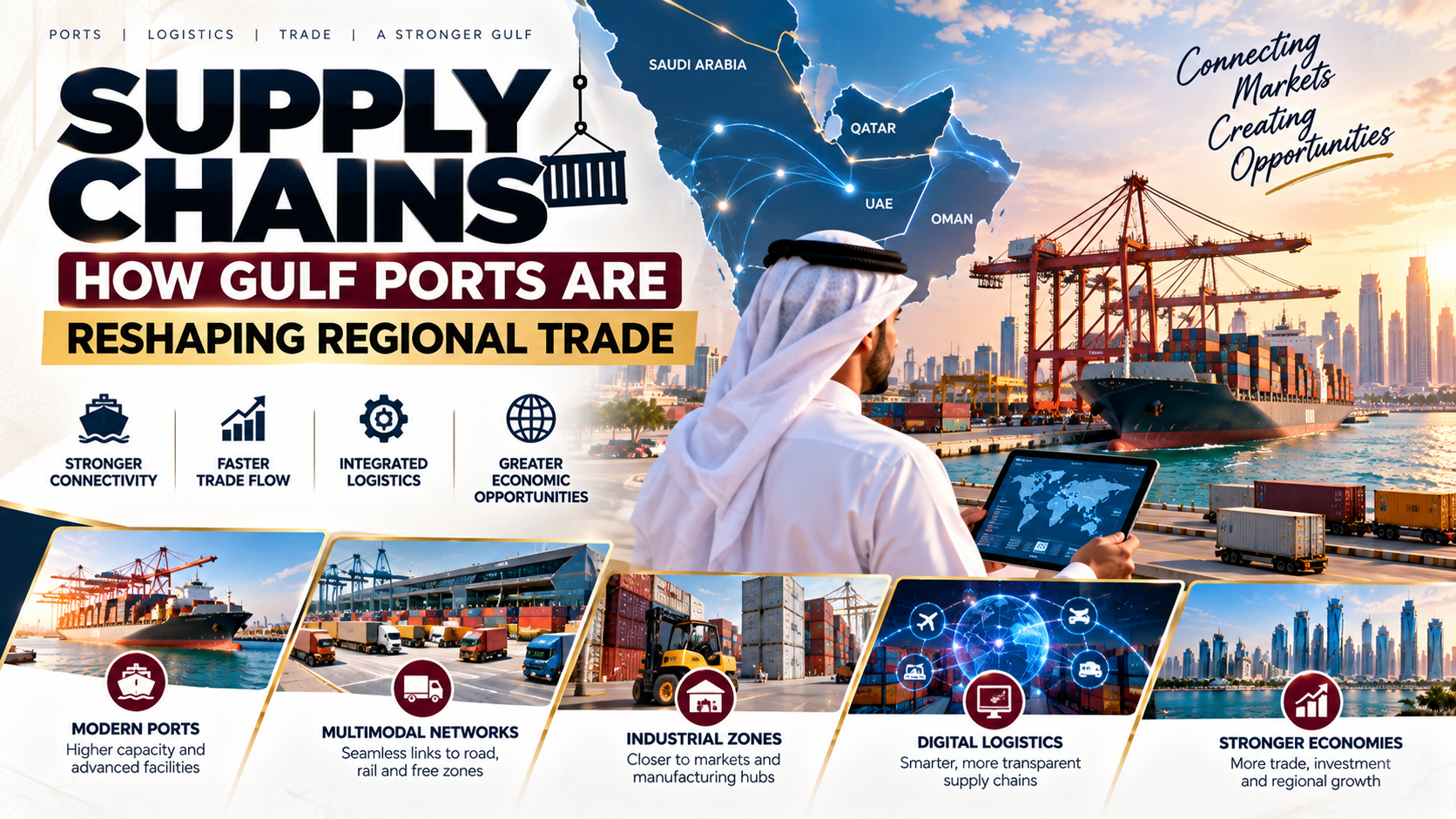
A modern port is no longer just a place where containers move from ships to trucks.
Across the Gulf, ports are increasingly being connected to warehouses, industrial zones, free zones, roads, rail networks and digital systems. That changes their role in regional trade.
The shift matters because supply chains are under pressure to become faster, more flexible and more resilient. Disruptions in major maritime routes have shown how quickly delays in one corridor can affect manufacturers, retailers and consumers far beyond the original point of disruption.
For the GCC, this has made logistics infrastructure a larger part of economic diversification. The IMF notes that GCC countries are working to strengthen regional infrastructure and integrate transport, energy and critical supply-chain systems while developing alternative ports and overland corridors to reduce dependence on vulnerable nodes.
From Port to Trade Ecosystem
Traditional port operations focused heavily on cargo handling.
The newer model is broader.
A port can connect several stages of the supply chain:
Ship → port → storage → industrial zone → road or rail → regional market
This creates more opportunities to move goods without repeatedly transferring them between disconnected systems.
Khalifa Port in Abu Dhabi provides a useful example. Its facilities include container, general cargo, RoRo, dry bulk, liquid and gas operations, along with warehousing and storage. Its connectivity also links maritime routes with highways, airports, rail and the nearby KEZAD economic zone.
That type of integration is becoming increasingly important as Gulf economies look beyond traditional energy exports.
Why Gulf Ports Matter to Regional Supply Chains
The Gulf sits between major trading regions including Asia, Europe and Africa.
That geographic position gives its ports a natural role in connecting different markets.
But geography alone is not enough.
A port becomes strategically valuable when cargo can move efficiently beyond the waterfront.
This means businesses increasingly care about:
- Container handling capacity
- Warehousing
- Customs processes
- Road connectivity
- Rail access
- Industrial zones
- Digital shipment tracking
- Storage capacity
- Multimodal transportation
- Availability of alternative routes
The result is a shift from thinking about a port as an isolated facility to viewing it as part of a wider logistics network.
GCC Logistics Trade Growth Is About Connectivity
The growth of GCC logistics trade growth is not simply about increasing the number of containers passing through ports.
It is also about improving how those goods move after arriving.
The IMF has noted that intra-GCC value-chain integration has strengthened significantly. The share of value added traded within GCC gross exports increased from about 5% in 2005 to 15% in 2021.
That matters because regional production increasingly depends on intermediate goods moving between countries.
A manufacturer may source raw materials from one Gulf market, process them in another, and distribute finished products through a third.
Ports and inland logistics infrastructure need to support that movement efficiently.
UAE: Connecting Ports With Inland Logistics
The UAE provides one of the clearest examples of this approach.
In May 2026, AD Ports Group announced a consolidated multimodal inland logistics network linking Khalifa Port and Fujairah Terminals with rail-linked dry ports, cargo depots and industrial areas. The network is designed to improve the movement of industrial inputs and finished goods while providing businesses with multiple gateway and inland options.
That is important because supply-chain resilience does not necessarily mean having one extremely large port.
It can mean having more than one practical route for moving goods.
If cargo can move through different terminals, inland depots or transport corridors, businesses may have more flexibility when one route becomes congested or disrupted.
Saudi Arabia Is Building a Wider Logistics Role
Saudi Arabia's logistics infrastructure is also becoming increasingly important to regional trade.
The country's position gives it access to both Red Sea and Gulf transport routes, while investment in logistics infrastructure supports its wider economic diversification plans.
The IMF's 2026 assessment highlighted Saudi Arabia's diversified logistics infrastructure as one factor supporting economic resilience. It also noted that Saudi infrastructure helped accommodate trade rerouting during disruptions to maritime traffic through the Strait of Hormuz.
Saudi ports are also adding and expanding shipping services.
For example, the Saudi Ports Authority reported the addition of MSC's Gulf Sea Shuttle services at King Abdulaziz Port in Dammam in April 2026, while additional services were expanded at Jeddah Islamic Port.
These developments show how individual ports can become components of larger regional shipping networks.
Qatar's Role in Gulf Trade
Qatar is also strengthening its position within the Gulf's broader logistics landscape.
Hamad Port provides Qatar with direct maritime access for containerised and general cargo, reducing dependence on land-based entry points for international goods.
For a country with a highly internationalised economy, port connectivity has implications far beyond shipping.
Imports of food, construction materials, machinery, consumer products and industrial inputs all depend on reliable logistics.
That makes port infrastructure part of economic resilience rather than simply a transportation asset.
Why Multimodal Transport Matters
A container arriving by ship still has to reach its final destination.
That final journey can involve trucks, trains, warehouses, distribution centres and industrial facilities.
This is why multimodal connectivity has become such an important part of Gulf logistics planning.
Khalifa Port, for example, combines deep-water maritime access with road, airport and direct rail connectivity. Its container terminal also provides links to the wider industrial ecosystem around KEZAD.
The advantage is simple: fewer disconnected handoffs can make supply chains easier to coordinate.
It can also give companies more options when choosing how to move cargo inland.
Digital Ports Are Changing Visibility
Physical infrastructure is only part of the transformation.
Digital systems are becoming equally important.
Saudi Arabia's Mawani Smart Ports platform, for example, brings together information on containers, ships and trucks and allows authorised users to access operational dashboards and reports.
Better visibility can help businesses understand where shipments are within the logistics process.
That matters when inventory planning depends on arrival times.
A company waiting for components can make different decisions when it has reliable shipment information compared with a situation where cargo status is unclear.
Resilience Is Becoming a Core Logistics Metric
Recent disruptions have changed how businesses think about supply chains.
For years, efficiency often meant finding the fastest or least expensive route.
Now, businesses also need to consider what happens when that route is interrupted.
The World Bank reported that global supply-chain stress remained elevated in early 2026, with shipping rerouting contributing to longer transit times. It also noted that freight rates rose as fuel costs and geopolitical tensions increased.
For Gulf economies, this makes alternative routes and diversified logistics infrastructure increasingly valuable.
A resilient supply chain may therefore involve:
- Multiple ports
- Alternative shipping routes
- Inland dry ports
- Additional storage
- Rail connectivity
- Flexible customs processes
- Digital shipment visibility
- Regional coordination
Ports Are Supporting Industrial Development
The relationship between ports and industry is becoming increasingly close.
Businesses often want to locate manufacturing, processing and distribution activities near reliable logistics infrastructure.
That reduces the distance between imported inputs and production facilities while making exports easier to organise.
AD Ports Group's inland logistics network illustrates this relationship. The network is designed to connect industrial cargo clients with ports, dry ports, cargo depots and regional markets.
The port therefore becomes part of the industrial strategy rather than simply the final stop for an incoming shipment.
What This Means for Regional Trade
The long-term effect could be a more connected Gulf trading system.
Instead of each country developing logistics infrastructure independently, stronger regional connections can allow goods to move through several complementary hubs.
The IMF has identified stronger regional integration as one way GCC economies can create greater resilience against external shocks. It specifically points to transport coordination, alternative infrastructure and more integrated supply-chain systems as important priorities.
This could benefit manufacturers, retailers, exporters and logistics companies across the region.
It also creates opportunities for non-oil sectors that depend on reliable movement of goods.
The Bigger Picture
The Gulf's logistics transformation is ultimately about more than ports.
It is about creating an interconnected system where maritime infrastructure, industrial zones, warehouses, roads, railways and digital platforms work together.
That model can help the GCC serve not only its domestic markets but also trade routes connecting Asia, Europe and Africa.
The UAE's expanding multimodal network, Saudi Arabia's logistics infrastructure and Qatar's maritime connectivity all form part of this wider shift.
For businesses, the value of a port increasingly depends on what happens after the ship arrives.
Final Thoughts
Gulf ports are becoming strategic pieces of regional economic infrastructure.
Their role is expanding from cargo handling to include storage, industrial connectivity, digital visibility and multimodal transportation. At the same time, geopolitical disruptions are making supply-chain resilience more important than ever.
The strongest logistics hubs will not simply be those with the largest terminals. They will be the ones that connect efficiently to the businesses, markets and transport corridors around them.
For readers following these changes, Al Akhbar Publication provides a broader view of the economic and business developments shaping Qatar and the wider Gulf.
As regional trade continues to evolve, the real story may be less about which port handles the most cargo and more about which logistics network can move that cargo most reliably from origin to market.