
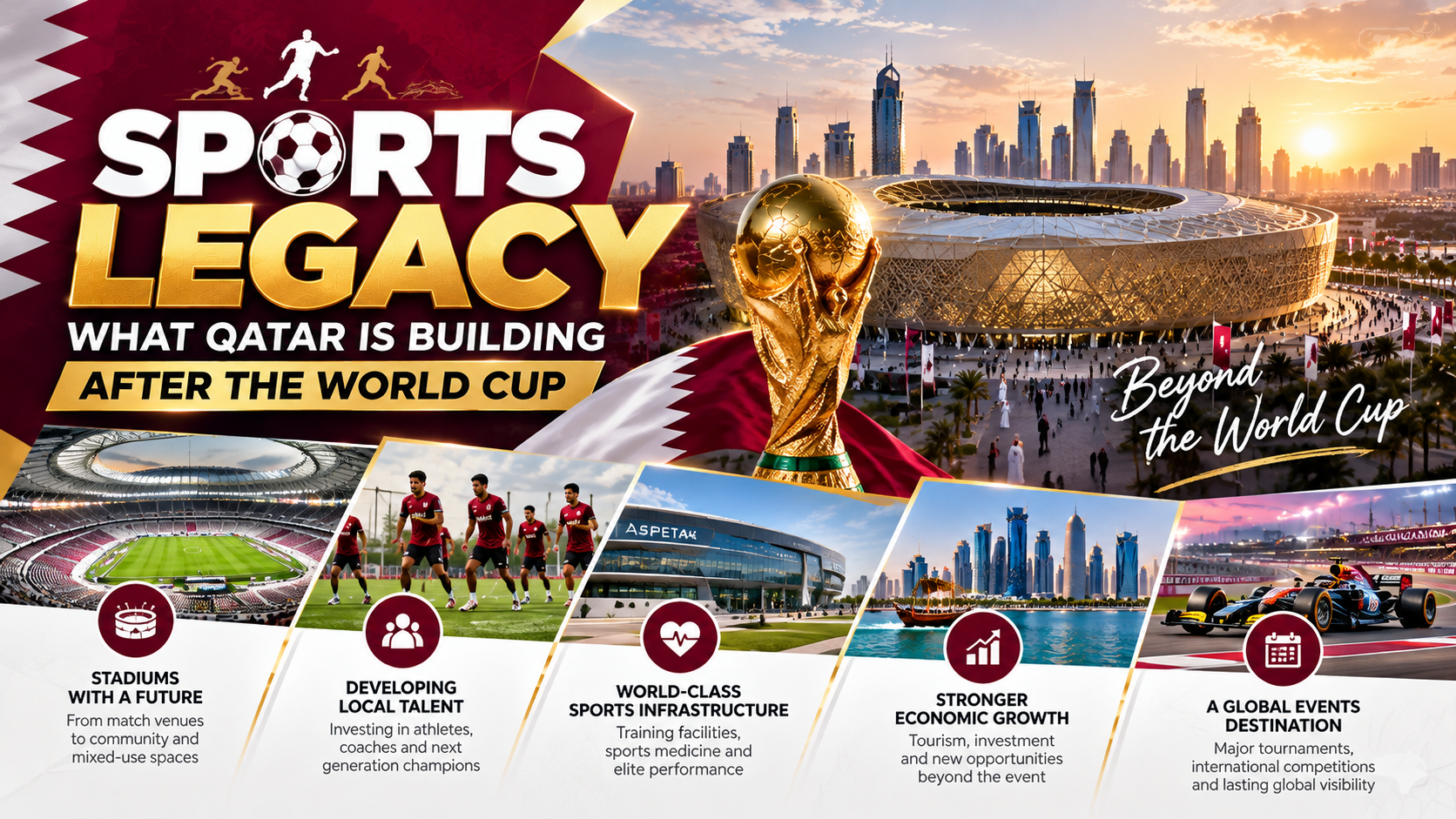
The final whistle of the 2022 FIFA World Cup did not mark the end of Qatar’s sports ambitions.
The tournament left behind stadiums, transport networks, training facilities, event-management expertise and a much larger international profile. The bigger question now is how Qatar can continue using those assets after the tournament.
For Qatar, the World Cup was part of a broader strategy to develop sports, tourism and non-hydrocarbon economic activity. The IMF found that the tournament's visitor spending and broadcasting-related activity contributed up to 1% of Qatar's 2022 GDP, while the infrastructure developed around the event supported longer-term diversification.
The legacy is therefore about more than football. It is about what happens when a country uses a major sporting event as a platform for its next stage of development.
From Hosting One World Cup to Building a Sports Hub
Qatar had already invested heavily in sport before 2022.
Its sports strategy includes four broad areas: direct investment in the sports industry, hosting major events, elite athlete development and sports diplomacy.
The World Cup strengthened all four.
Qatar has since continued hosting major international competitions and events. The infrastructure and experience developed around the tournament can support future competitions without starting from scratch each time.
This gives the country an advantage when competing to host international sporting events.
The goal is not simply to be remembered as a World Cup host. It is to remain relevant between major tournaments.
What Happened to the World Cup Stadiums?
The stadiums are among the most visible parts of Qatar's sports legacy.
Eight venues were used for the tournament. Their post-World Cup roles vary.
For example, Education City Stadium is being used for university athletics, while Al Thumama Stadium is planned as part of a mixed-use leisure development.
Stadium 974 also demonstrated a different approach. Its modular construction allowed the venue to be dismantled after the tournament rather than becoming a permanent large-capacity stadium with limited long-term use.
This raises an important question for any country hosting a mega-event:
What happens to the infrastructure after the visitors leave?
Qatar's approach has increasingly focused on finding community, sporting, commercial and mixed-use purposes for these assets.
Building a Long-Term Sports Infrastructure
The World Cup also accelerated the development of facilities beyond the main stadiums.
Training grounds, sports medicine facilities and athlete-support infrastructure form an important part of the wider ecosystem.
Qatar's Government Communications Office notes that many training fields developed for the World Cup were subsequently used for the AFC Asian Cup 2023 and other major tournaments.
That creates value beyond a single event.
Instead of being used for a few weeks and then sitting idle, training facilities can support athletes, teams and competitions over many years.
The same principle applies to sports medicine.
Aspetar, Qatar's sports medicine hospital and a FIFA Medical Centre of Excellence, is part of the country's wider sports infrastructure.
Developing Athletes, Not Just Facilities
A successful sports ecosystem needs more than stadiums.
It also needs athletes, coaches, sports scientists, medical professionals and administrators.
Aspire Academy has played a major role in Qatar's long-term athlete-development strategy. Its facilities include football pitches, swimming facilities, athletics infrastructure and other sports resources.
This reflects a broader shift from hosting sport to developing sporting capability.
The World Cup also created opportunities to build expertise in event management, sustainability and handling large international audiences. Qatar's Government Communications Office says more than 20,000 hours of specialised training were delivered through the tournament's organising structure.
That knowledge can be reused.
The same people and systems can support future sporting events instead of rebuilding expertise for every tournament.
The Economic Legacy Goes Beyond Match Tickets
The economic impact of a World Cup is often discussed in terms of tourism, hospitality and event spending.
But Qatar's longer-term story is broader.
The IMF estimated that tourism spending and World Cup-related broadcasting revenue generated between US2.3billionandUS4.1 billion, equivalent to roughly 0.7% to 1% of Qatar's 2022 GDP in gross value-added terms.
More importantly, the infrastructure investment surrounding the tournament was connected to Qatar's broader economic diversification strategy.
The IMF notes that much of the investment commonly associated with the World Cup also involved general national infrastructure, including transportation, hotels, airports and other development.
This distinction matters.
The value of a mega-event is not only the revenue generated during the event itself. Infrastructure can continue supporting economic activity after the tournament ends.
Tourism Is Part of the Legacy
The World Cup introduced Qatar to millions of international visitors.
The country's Government Communications Office reports that international visitor numbers increased by 157% in the period after the tournament, benefiting aviation and hospitality.
Qatar is now working to convert that visibility into longer-term tourism demand.
The challenge is different from hosting a World Cup.
During a tournament, people have a specific reason to visit.
Afterward, Qatar has to give travellers other reasons to return, including culture, business events, sport, entertainment and leisure.
That makes the tourism legacy closely connected to the sports legacy.
International sporting events can bring visitors back to the country even when the World Cup is no longer taking place.
Major Events Can Keep the Infrastructure Active
One of the strongest ways to protect a sports legacy is continued event activity.
Qatar has already hosted a wide range of international competitions. Its sports strategy includes using major events to strengthen its position as an international sports hub.
The country has also continued building institutional capacity for major events.
In December 2025, Qatar's Government Communications Office reported that the reconstituted Supreme Committee for Delivery & Legacy would continue overseeing infrastructure readiness, event operations and the broader legacy of major sporting events.
This suggests that the World Cup is being treated as part of an ongoing events ecosystem rather than an isolated project.
Qatar Sports Investment and the Wider Business Ecosystem
Sports can also create opportunities outside the stadium.
A growing sports industry can support:
- Sports technology
- Hospitality
- Tourism
- Sports medicine
- Fitness
- Media
- Event management
- Athlete development
- Retail
- Sponsorship
- Sports facilities
This creates a broader commercial ecosystem around sporting activity.
For businesses, the opportunity is not limited to selling products during a major tournament.
Long-term sports investment can create demand for services throughout the year.
This is where Qatar sports investment legacy becomes particularly relevant. The legacy can be viewed not only through stadiums and competitions, but through the industries and businesses that develop around Qatar's continued investment in sport.
What the World Cup Changed for Qatar
The tournament created several lasting changes.
Infrastructure
Transport, stadiums, training facilities and supporting infrastructure were developed at an accelerated pace.
Expertise
Qatar gained experience in managing large-scale international sporting events, from visitor movement to security and venue operations.
Global Visibility
The tournament gave Qatar an enormous international platform and introduced the country to visitors from around the world.
Sports Development
Existing investments in athlete development, sports medicine and facilities gained additional momentum.
Economic Diversification
The infrastructure and international visibility can support sectors beyond hydrocarbons, aligning with Qatar's broader development objectives.
The Real Test Is Long-Term Use
A World Cup legacy cannot be measured only by what was built before the tournament.
The more important question is what remains useful years later.
Can stadiums support communities and future events?
Can training facilities develop athletes?
Can transport infrastructure support everyday economic activity?
Can international visibility translate into tourism and investment?
Can the expertise developed during the tournament continue supporting major events?
These questions determine whether a mega-event becomes a short-term spectacle or part of a longer development strategy.
From World Cup Host to Global Sports Destination
Qatar's sports ambitions did not begin with the World Cup, and they did not end with it.
The country already had major sporting infrastructure and a history of hosting international competitions. The 2022 tournament accelerated that development and created a much larger global platform.
The next stage is about maintaining momentum.
That means using existing facilities, attracting new events, developing athletes, supporting sports-related businesses and continuing to turn international visibility into long-term economic activity.
The World Cup economic impact Qatar experienced was therefore only one part of the larger story. The lasting legacy will depend on how effectively Qatar continues using the infrastructure, expertise and international profile created around the tournament.
For readers following Qatar's economic, cultural and business development, Al Akhbar Publication provides a platform for examining the wider changes shaping the country and the region.