
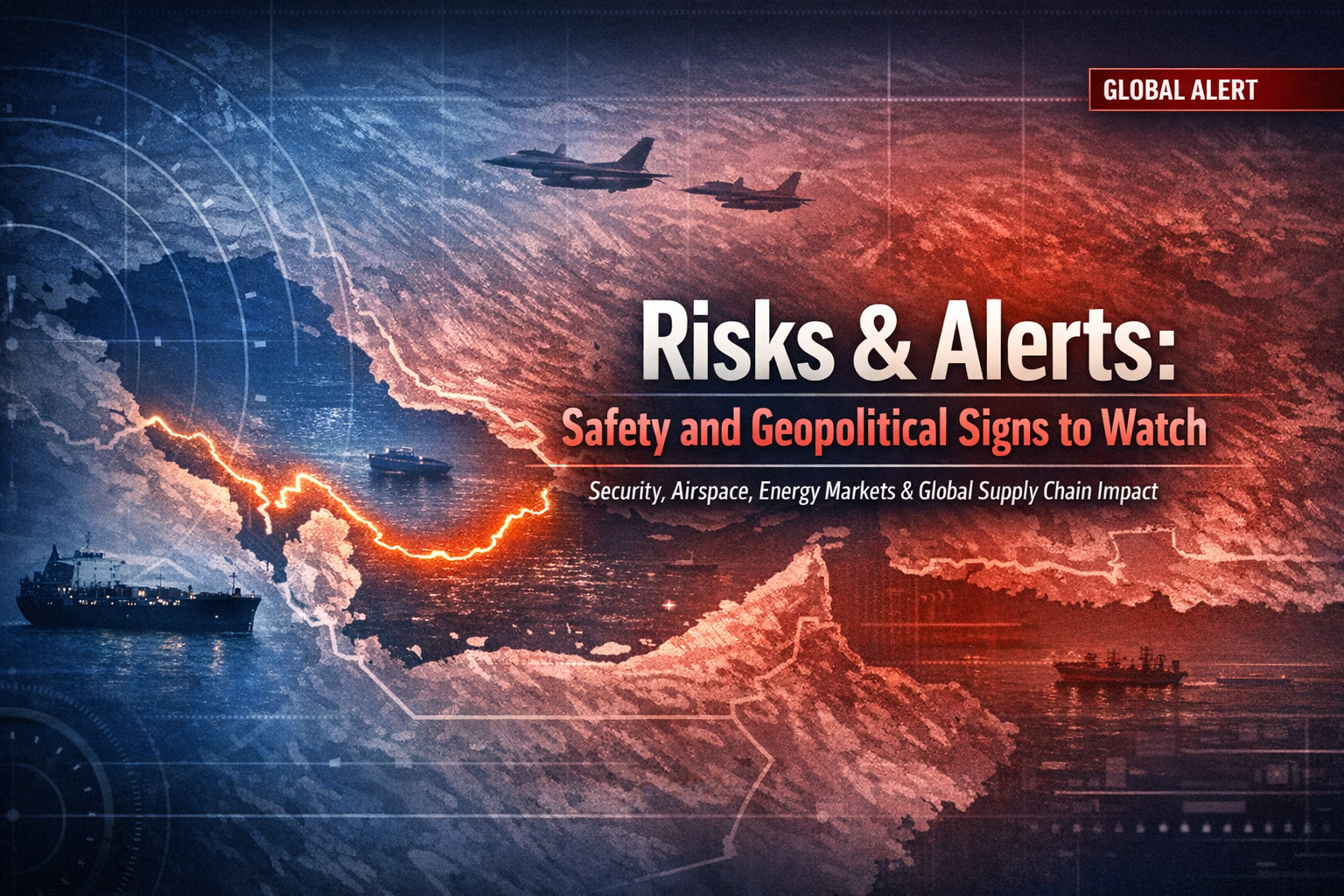
As tensions remain elevated between Iran, the United States, and Israel, attention has shifted from political rhetoric to practical concerns: safety, travel disruptions, economic ripple effects, and warning signs of further escalation.
For residents, business owners, and travelers in the Gulf region, the key question is no longer just “what happened?” but “what should we watch for next?”
This section breaks down current safety alerts, possible escalation scenarios, transport and airspace impacts, and why global supply chains are closely monitoring developments.
Current Security Alerts in the Gulf Region
Countries in the Gulf have increased vigilance, particularly in cities with strategic military, energy, or maritime importance. While daily life continues in most areas, authorities have implemented precautionary measures to prepare for potential instability.
1. Heightened Security Around Critical Infrastructure
Security presence has increased near:
Oil and gas facilities
Ports and maritime terminals
Airports and aviation hubs
Foreign embassies and military bases
Governments in countries such as Saudi Arabia, United Arab Emirates, Qatar, Kuwait, and Bahrain have issued public advisories encouraging residents to follow official updates and avoid spreading unverified information.
Although these measures are precautionary, they signal that governments are preparing for worst-case scenarios.
Airspace Disruptions and Aviation Impacts
One of the most immediate effects of rising tensions is disruption in air travel.
1. Airspace Closures and Flight Rerouting
When regional tensions escalate, airlines often reroute flights to avoid potentially dangerous airspace. Even temporary closures can result in:
Longer flight times
Higher fuel costs
Schedule changes
Cancellations
Flights that would normally pass near Iranian, Iraqi, or Syrian airspace are sometimes diverted, impacting travel between Europe, Asia, and the Gulf.
Major aviation hubs such as Dubai International Airport and Hamad International Airport closely monitor regional developments. Even if these airports remain operational, incoming and outgoing routes may be adjusted.
2. Airline Safety Advisories
International airlines typically rely on government-issued aviation risk assessments. During periods of heightened risk, airlines may suspend flights to certain destinations or temporarily reduce frequency.
Travelers are advised to:
Check flight status regularly
Monitor embassy travel advisories
Consider travel insurance that covers geopolitical disruptions
Local Advisories for Residents
For people living in the Gulf region, most advisories focus on awareness rather than alarm.
Common Recommendations Include:
Following official government updates
Avoiding restricted military or industrial areas
Preparing emergency contact information
Staying informed through reliable news sources
At this stage, advisories are precautionary rather than indicative of imminent danger. However, they reflect the reality that modern conflicts can escalate quickly.
Possible Escalation Scenarios
Understanding potential scenarios helps individuals and businesses prepare without panic.
Scenario 1: Expanded Hostilities Across Multiple Countries
If direct exchanges intensify, more regional actors could become involved—either politically or militarily. This could lead to:
Cross-border strikes
Increased missile or drone interceptions
Wider airspace restrictions
Such a development would likely increase security alerts across the entire Middle East.
Scenario 2: Disruption or Closure of the Strait of Hormuz
One of the most closely watched flashpoints is the Strait of Hormuz.
This narrow waterway connects the Persian Gulf to global shipping routes and is one of the world’s most important energy corridors. A significant portion of global oil shipments passes through it daily.
If tensions result in partial blockage, naval confrontations, or shipping restrictions, the consequences could include:
Sharp increases in oil prices
Delays in fuel deliveries
Rising shipping insurance costs
Strain on global energy markets
Even limited disruptions would have worldwide economic impact.
Scenario 3: Cyber Escalation
Another potential risk involves cyberattacks targeting:
Financial institutions
Energy grids
Airports and transport systems
Government services
Cyber operations can cause disruption without visible military confrontation, making them harder to detect and attribute.
Impact on Global Supply Chains and Logistics
Beyond security concerns, one of the most significant consequences of escalation is economic disruption.
1. Shipping Delays and Higher Insurance Costs
Shipping companies adjust risk premiums based on geopolitical stability. If a region is considered high risk:
Insurance rates increase
Freight costs rise
Some vessels avoid the region
This impacts not only oil but also consumer goods, electronics, food supplies, and industrial materials.
Ports in the Gulf serve as major transshipment hubs for global trade. Even precautionary slowdowns can affect supply timelines across Asia, Europe, and Africa.
2. Airport Delays and Cargo Disruption
Gulf airports function as key cargo transit centers. If airspace restrictions expand:
Cargo flights may be delayed
Perishable goods could face logistical challenges
Manufacturing timelines could shift
Because global supply chains rely on just-in-time delivery systems, even minor disruptions can create ripple effects.
3. Energy Market Volatility
Energy markets react quickly to instability in the Gulf. Increased oil and gas prices can:
Raise transportation costs
Increase inflation
Pressure national budgets
Slow economic growth in import-dependent countries
Even speculation about potential conflict can create temporary market spikes.
Signs to Watch in the Coming Weeks
For those monitoring the situation, several indicators may signal whether tensions are rising or stabilizing:
Expansion of airspace closures
Increased naval activity near major shipping lanes
Suspension of diplomatic talks
Large-scale evacuation advisories
Coordinated multinational military deployments
Conversely, signs of stabilization may include:
Public diplomatic meetings
Announcements of backchannel negotiations
Reduction in cross-border strikes
Gradual lifting of travel advisories
Why This Matters
Understanding these risks is not about fear—it is about preparedness.
For travelers, awareness can prevent inconvenience and ensure safety.
For businesses, early preparation can reduce supply chain losses.
For residents, staying informed helps avoid misinformation and unnecessary panic.
The Gulf region is deeply integrated into the global economy. Disruptions there do not remain local; they ripple outward. Energy markets, aviation networks, shipping routes, and digital infrastructure are all interconnected.
Even if large-scale conflict is avoided, precautionary measures alone can have measurable economic effects.
Conclusion
While the situation remains fluid, current alerts across the Gulf region emphasize vigilance rather than alarm. Airspace disruptions, shipping route concerns, and heightened security measures reflect the seriousness of the moment—but also the determination to prevent escalation.
The key risks to monitor include expanded hostilities, disruptions in strategic waterways like the Strait of Hormuz, and cyber or economic ripple effects.
For now, global leaders continue urging restraint, and regional governments are working to maintain stability. Staying informed, following official advisories, and preparing for temporary disruptions are practical steps for navigating uncertainty.
In times of geopolitical tension, awareness is one of the most important tools individuals and organizations can have.