
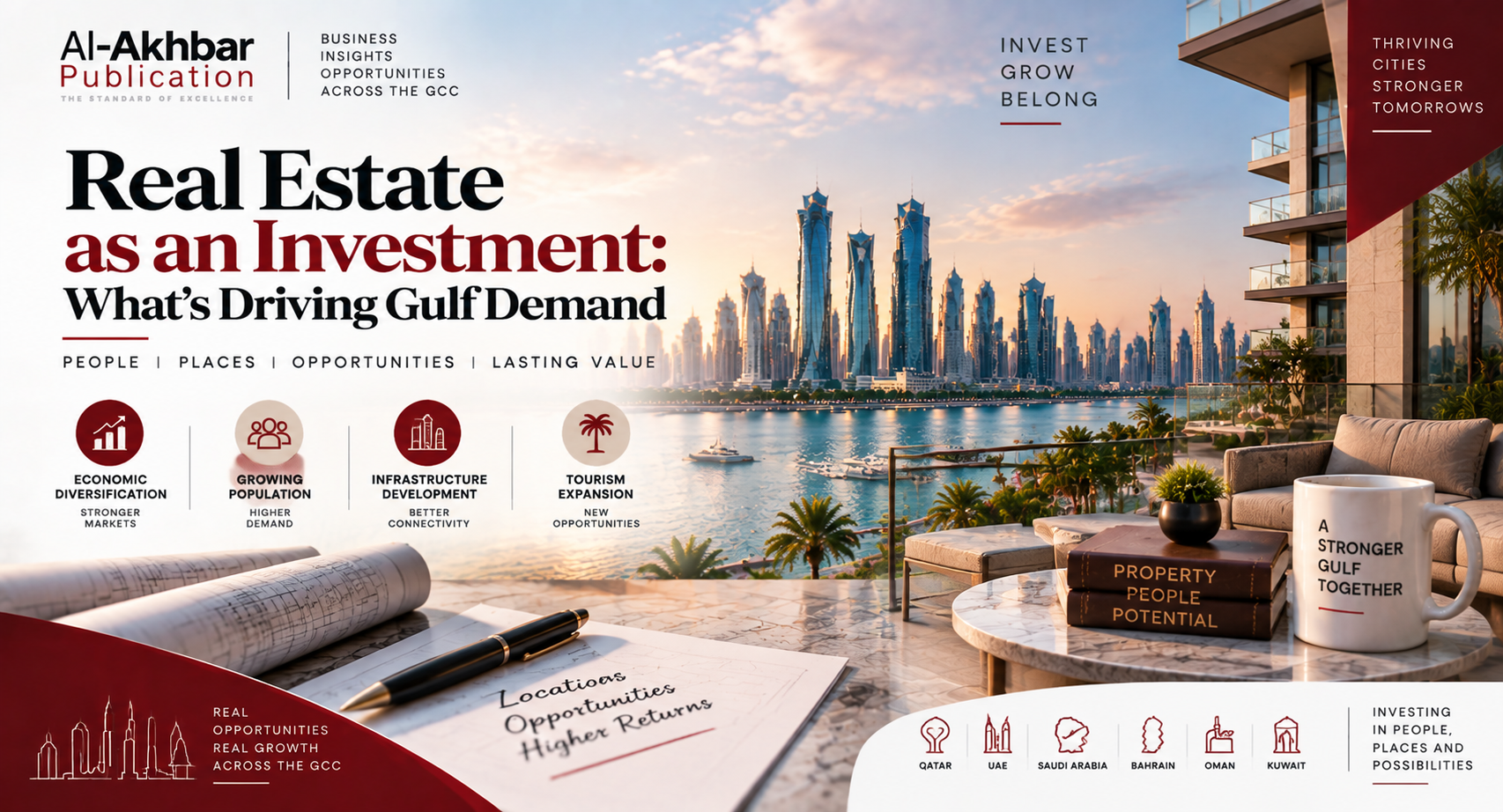
Real estate remains an important part of the Gulf investment landscape. Across markets such as Qatar, the UAE, Saudi Arabia, Bahrain, Oman, and Kuwait, changing demographics, infrastructure development, economic diversification, and international investment are influencing property demand.
For investors researching Gulf real estate investment or following Qatar property market trends, understanding the forces behind this demand is more useful than simply watching property prices.
Why Is Gulf Real Estate Attracting Investors?
Several factors are supporting continued interest in Gulf property markets.
These include:
- Economic diversification
- Population growth
- Infrastructure development
- Tourism expansion
- Business investment
- International buyers
- New residential developments
- Growing demand for commercial space
The Gulf is also developing beyond its traditional dependence on hydrocarbons, creating new economic activity and additional demand for property.
Economic Diversification Is Changing Property Demand
Gulf governments are investing heavily in sectors beyond oil and gas.
Growing areas include:
- Tourism
- Technology
- Financial services
- Logistics
- Manufacturing
- Healthcare
- Education
- Entertainment
As these sectors expand, they can create demand for offices, housing, retail spaces, hotels, warehouses, and mixed-use developments.
This makes real estate closely connected to broader economic growth.
Qatar's Property Market Is Evolving
Qatar's real estate market has gained international attention following major infrastructure development and increased investment activity.
The country continues to develop areas around:
- Doha
- Lusail
- The Pearl
- West Bay
- Msheireb
- Major transport corridors
These developments combine residential, commercial, retail, hospitality, and lifestyle infrastructure.
For investors monitoring Qatar property market trends, location remains an important factor because different districts serve different types of demand.
Infrastructure Can Influence Property Values
Infrastructure is one of the major factors investors consider when evaluating real estate.
New or improved:
- Roads
- Metro connections
- Airports
- Schools
- Hospitals
- Shopping districts
- Entertainment venues
- Business centres
can improve an area's accessibility and attractiveness.
However, infrastructure alone does not guarantee property appreciation. Investors should consider the wider supply and demand environment.
Tourism Is Creating New Property Opportunities
Tourism is becoming increasingly important across the Gulf.
Major investments in:
- Hotels
- Resorts
- Entertainment
- Cultural attractions
- Sports facilities
- Retail destinations
can increase demand for accommodation and supporting commercial property.
Short-term accommodation, hospitality projects, and mixed-use developments can therefore benefit from tourism growth in suitable locations.
International Investment Is Another Driver
Gulf real estate markets have become increasingly accessible to international investors.
Depending on the country and property type, foreign investors may have access to designated investment zones or ownership structures.
International demand can contribute to:
- Higher transaction activity
- New development projects
- Greater market liquidity
- Demand for premium properties
- Increased competition in selected locations
However, foreign ownership rules differ between Gulf countries and should always be checked before investing.
Lifestyle Developments Are Reshaping Residential Demand
Modern buyers increasingly look beyond the property itself.
They may also consider:
- Retail access
- Restaurants
- Parks
- Schools
- Fitness facilities
- Waterfront access
- Public transport
- Entertainment
- Community amenities
This has encouraged developers to create integrated communities rather than isolated residential buildings.
The Rise of Mixed-Use Developments
Mixed-use projects combine multiple property functions within one development.
A project might include:
Residential + Offices + Retail + Hospitality + Entertainment
This model can create a more active environment throughout the day.
For investors, mixed-use developments may provide exposure to multiple sources of demand, although the risks and returns depend on the specific project.
Population Growth Supports Housing Demand
Population changes can influence residential property markets.
When employment opportunities attract workers, professionals, and families, demand for housing can increase.
Investors may therefore monitor:
- Population growth
- Employment trends
- Household formation
- Migration
- Rental demand
- New housing supply
The relationship between population growth and property prices isn't automatic. If new construction significantly exceeds demand, rental yields and prices may face pressure.
Rental Demand Matters
Property investment isn't only about future price appreciation.
Rental income can be an important part of the investment case.
Investors may compare:
- Purchase price
- Expected rent
- Vacancy rates
- Maintenance costs
- Service charges
- Property management expenses
- Financing costs
A property with a high purchase price may not necessarily provide attractive rental returns.
Supply Is Just as Important as Demand
One of the most important factors in any property market is the relationship between available supply and demand.
Strong demand with limited supply can support:
- Rental growth
- Occupancy
- Property values
But large amounts of new inventory can increase competition between landlords and developers.
Investors should therefore research planned developments, not just existing properties.
Gulf Markets Are Not Identical
The Gulf should not be treated as one single property market.
Each country has different:
- Regulations
- Economic conditions
- Ownership rules
- Population trends
- Development pipelines
- Rental markets
- Investment incentives
For example, property conditions in Qatar can differ significantly from those in Saudi Arabia or the UAE.
Investors should evaluate each market individually.
Technology Is Changing Real Estate
Technology is also influencing how property is developed, marketed, and managed.
Examples include:
- Digital property platforms
- Smart buildings
- Automated building systems
- Virtual property tours
- Data-driven market analysis
- Digital property management
Smart-building technologies can also improve energy management and operational efficiency.
Sustainability Is Becoming More Important
Environmental considerations are increasingly relevant to Gulf development.
Modern projects may incorporate:
- Energy-efficient systems
- Solar technologies
- Water-saving systems
- Smart lighting
- Efficient cooling
- Sustainable building materials
- Green spaces
In a hot climate, energy efficiency can have particular importance because cooling represents a significant building energy requirement.
What Should Investors Look At?
Before investing in Gulf property, consider:
Location
Is the property close to employment, transportation, amenities, and major infrastructure?
Demand
Who is likely to rent or buy the property?
Supply
How many competing properties are available or under construction?
Rental Yield
Does expected rental income justify the purchase price and costs?
Regulations
What ownership and investment rules apply?
Developer
Research the developer's track record, delivery history, and reputation.
Costs
Account for:
- Maintenance
- Service charges
- Property management
- Financing
- Registration
- Insurance
- Taxes or applicable fees
Common Real Estate Investment Mistakes
Investors should avoid:
- Buying purely because prices are rising
- Ignoring rental demand
- Focusing only on the purchase price
- Overlooking service charges
- Ignoring new competing developments
- Assuming every Gulf market behaves the same
- Failing to research ownership regulations
- Relying on short-term market speculation
A property should be assessed based on its fundamentals rather than hype.
Qatar Property Market Trends to Watch
Investors following Qatar property market trends can monitor several indicators:
- Transaction volumes
- Rental rates
- Residential supply
- Commercial occupancy
- New development launches
- Infrastructure projects
- Population changes
- Tourism activity
- Foreign investment
- Mortgage and financing conditions
Looking at several indicators together gives a better picture than relying on a single property-price statistic.
Why Long-Term Thinking Matters
Real estate is generally a long-term investment.
Short-term market movements can be influenced by:
- Interest rates
- New supply
- Economic cycles
- Investor sentiment
- Construction activity
Long-term investors may instead focus on the fundamentals supporting a property's future demand.
These include location, infrastructure, economic activity, population, and rental potential.
The Role of Al Akhbar Publications
Al Akhbar Publications provides business and economic content covering developments relevant to the Gulf and wider regional market.
For readers researching Gulf real estate investment, following economic developments, infrastructure projects, business activity, and Qatar property market trends can provide useful context when evaluating the broader investment environment.
Quick Gulf Real Estate Investment Checklist
|
Factor |
What to Evaluate |
|
Location |
Accessibility and surrounding development |
|
Demand |
Buyers, tenants, businesses |
|
Supply |
Existing and upcoming properties |
|
Rental yield |
Potential rental income |
|
Infrastructure |
Transport and major projects |
|
Regulations |
Ownership and investment rules |
|
Developer |
Track record and delivery |
|
Costs |
Maintenance, management and fees |
|
Economy |
Employment and business growth |
|
Long-term outlook |
Sustainable demand drivers |
Final Thoughts
Gulf real estate demand is being shaped by more than traditional property investment.
Economic diversification, infrastructure, tourism, population changes, international investment, lifestyle development, and new business activity are all influencing where demand emerges.
For investors researching Gulf real estate investment, the key is to look at the fundamentals behind a property rather than following market excitement alone.
And for those tracking Qatar property market trends, examining location, supply, rental demand, infrastructure, economic activity, and upcoming development can provide a more informed view of the market's potential.
Real estate opportunities may change, but understanding what drives demand is what helps investors make better decisions.