
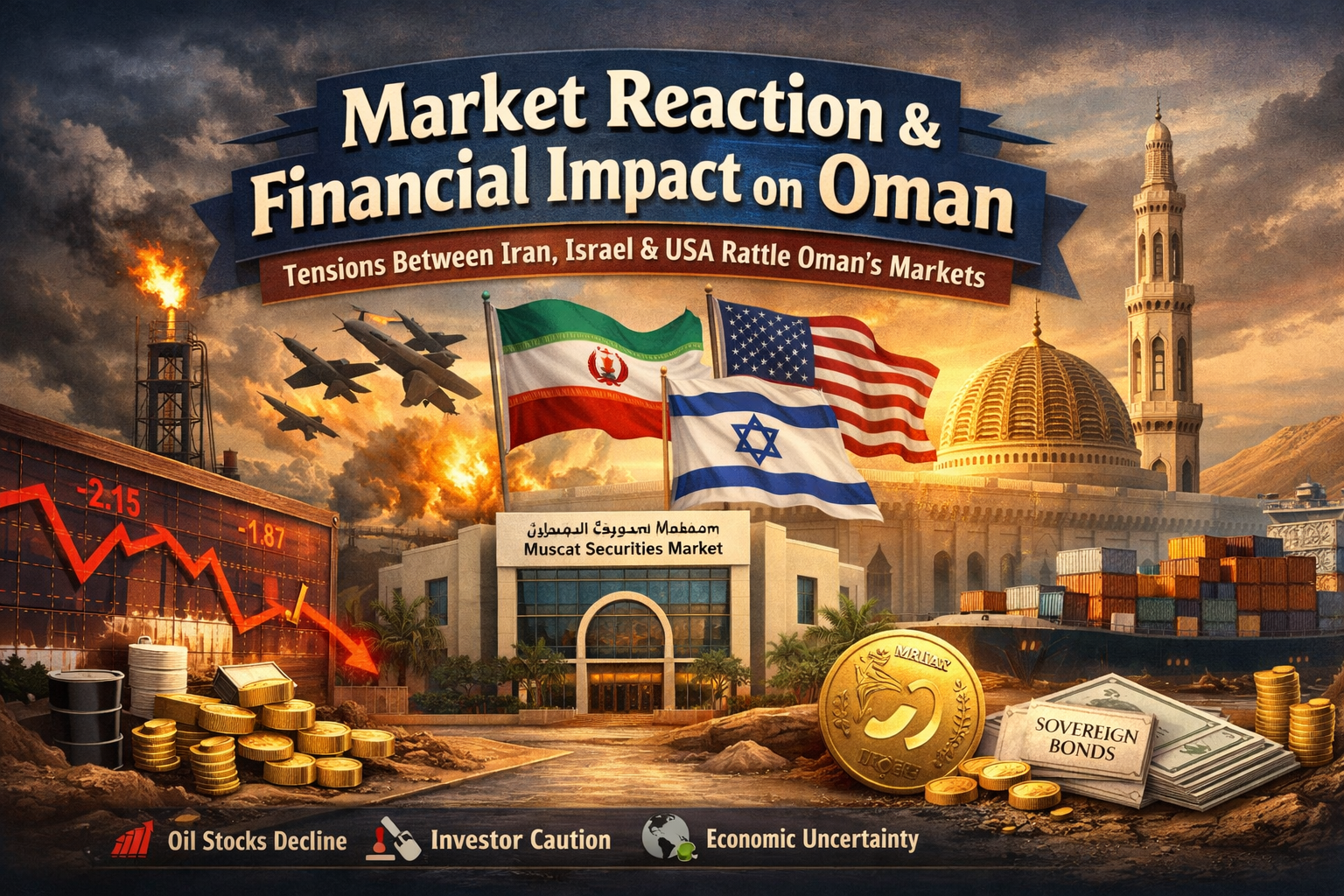
The escalation of tensions between Iran, Israel, and the United States has significantly impacted financial markets in the Gulf region, and Oman, as part of the GCC (Gulf Cooperation Council), has not remained unaffected. While Oman’s financial markets do not usually face the same level of volatility as some of its larger regional counterparts, recent events have caused noticeable shifts in investor behavior, market sentiment, and economic outlook.
Stock Market Volatility in Oman
The Muscat Securities Market (MSM), Oman’s primary stock exchange, witnessed increased volatility in the wake of the Iran-Israel-USA tensions. Although Oman’s stock market did not experience a full-scale collapse, there was a significant dip in equity prices across various sectors, particularly in energy, transportation, and logistics — industries closely tied to the region's stability.
Key Effects:
-
Decline in Energy Stocks: Oil-related stocks, which are crucial to Oman’s economy, saw sharp declines as investors became wary of potential disruptions in global oil supply.
-
Regional Spillover Impact: Investors in Oman were cautious about the broader geopolitical implications, especially with increased military activity in nearby regions. The MSM saw minor sell-offs as global markets reacted to the uncertainty in the Gulf.
-
Investor Caution: The volatility caused a temporary pullback from high-risk investments, and many local investors opted to liquidate positions or wait on the sidelines for signs of stabilization. Institutional investors also increased their focus on safe-haven assets, such as gold and sovereign bonds, contributing to further declines in equity markets.
Market Adjustments and Trading Halts
In line with broader market trends, Oman also saw temporary disruptions. While the MSM did not suspend trading entirely, regional markets, including those in the UAE, temporarily halted trading in the face of extreme volatility. This action was implemented to curb panic-selling and allow markets to stabilize. Oman’s financial authorities maintained vigilance but did not intervene at the same scale, opting for monitoring measures to assess ongoing risks.
Investor Sentiment and Economic Uncertainty
The heightened uncertainty led to weaker investor confidence in Oman’s stock market, even though the country has maintained relatively stable economic fundamentals. With the potential for military escalation and the disruption of global supply chains, investors were more cautious, especially in sectors dependent on regional stability.
-
Financial services, banking, and tourism sectors, while not directly affected by military actions, saw increased hedging activity as businesses and investors alike began preparing for the worst-case scenarios.
-
Currency fluctuations and foreign exchange volatility were also a concern, as global oil price hikes often affect Oman's trading currency, the Omani Rial.
Long-term Outlook and Adaptation
While short-term reactions were marked by market volatility, Oman’s long-term economic strategy remains focused on diversification. The country is working to reduce its reliance on oil revenues through investments in renewable energy, digital transformation, and infrastructure projects.
However, this geopolitical crisis has highlighted the importance of economic diversification efforts in Oman. In the future, less reliance on oil exports and a greater emphasis on sectors like technology and sustainability could help shield Oman’s financial markets from future regional volatility.
Conclusion
In conclusion, the financial markets in Oman have experienced a modest decline due to the escalating tensions between Iran, Israel, and the United States. While the situation is still unfolding, Oman's stock market remains resilient in the face of global uncertainty. The country’s long-term focus on diversification and economic modernization will help ensure that Oman’s financial markets remain stable and less dependent on volatile oil prices.