
Introduction
Global financial markets are highly sensitive to uncertainty, particularly when regional developments influence investor confidence, capital flows, and economic outlooks. In the Gulf region, financial systems are deeply integrated with global trade, energy markets, and international investment networks. As regional tensions increased, financial markets across the Gulf Cooperation Council (GCC) experienced short-term volatility.
The United Arab Emirates stands out as one of the most mature and resilient financial markets in the region. With advanced regulatory frameworks, diversified capital markets, and strong institutional participation, the UAE has demonstrated its ability to manage market fluctuations while preserving long-term investor trust.
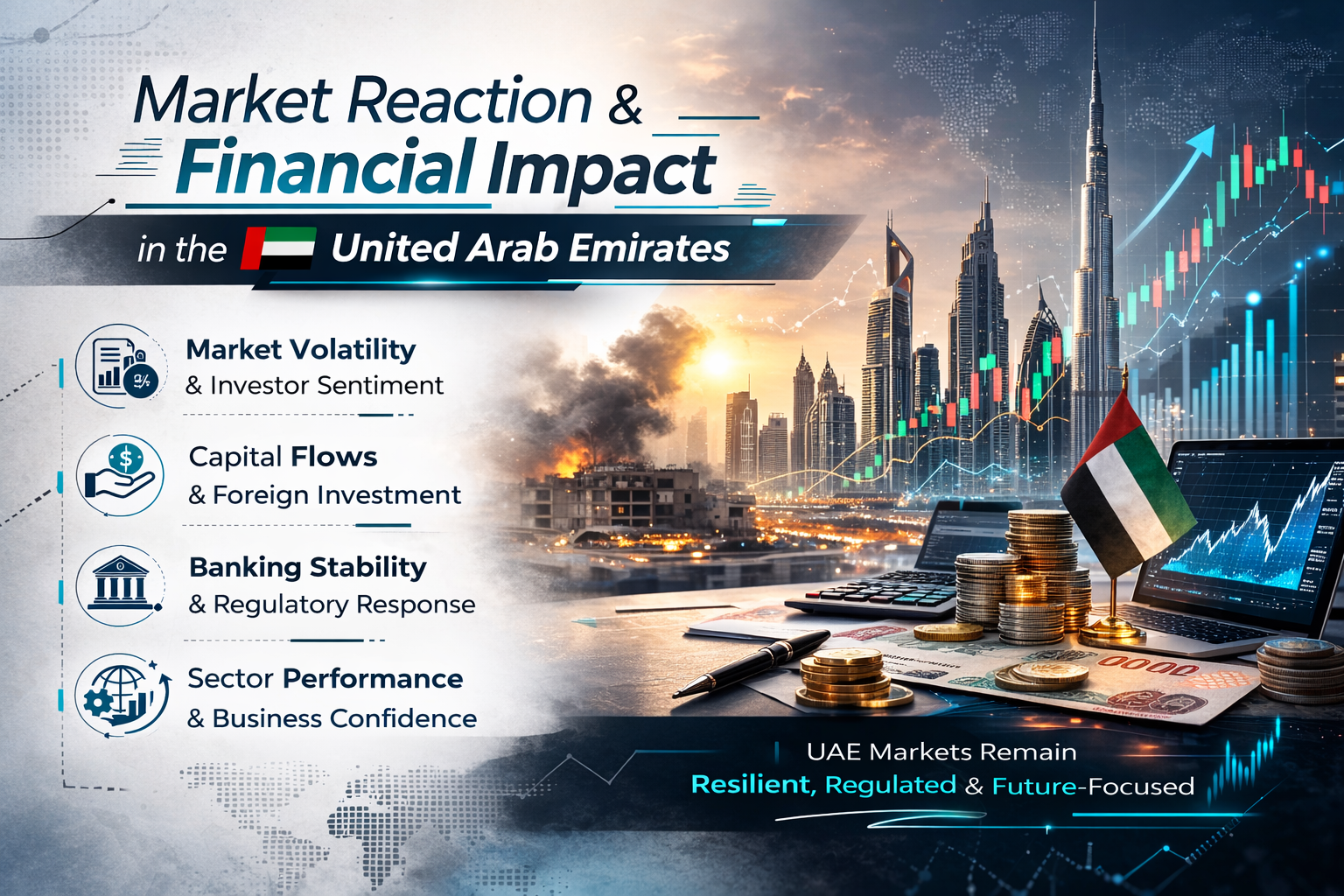
This blog examines how recent regional uncertainty has affected UAE financial markets, investor sentiment, capital flows, and economic confidence — purely from a business and financial perspective.
Short-Term Market Volatility in the UAE
Financial markets in the UAE experienced temporary fluctuations as global investors reassessed regional risk exposure. This volatility was not unique to the UAE, but part of a broader regional and global market reaction.
Key Observations:
Increased daily trading volatility in equity markets
Short-term price corrections in selected sectors
Higher trading volumes during peak uncertainty periods
More cautious investor positioning
Despite these movements, market corrections remained controlled and orderly, reflecting strong regulatory oversight.
Investor Sentiment and Risk Reassessment
Investor sentiment plays a crucial role during periods of uncertainty. In the UAE, market participants focused on risk management rather than panic-driven exits.
Investor Behavior Trends:
Shift toward fundamentally strong companies
Preference for dividend-paying and stable stocks
Reduced speculative trading activity
Continued interest from long-term investors
Institutional investors, including sovereign and regional funds, maintained stable positions, helping to absorb short-term volatility.
Performance of Key Market Sectors
Not all sectors reacted in the same way. Sector-level performance varied depending on exposure to global trade, energy prices, and consumer confidence.
Sector Insights:
Banking sector remained resilient due to strong balance sheets
Utilities and infrastructure stocks showed defensive strength
Logistics and transport stocks experienced short-term pressure
Technology and digital service companies remained stable
Diversification across sectors helped reduce overall market risk.
Role of UAE Financial Regulators
Strong regulatory frameworks are critical during uncertain periods. UAE financial authorities ensured transparency, liquidity, and orderly market functioning.
Regulatory Strengths:
Clear communication with market participants
Continuous monitoring of trading activity
Liquidity support mechanisms in place
Robust risk management standards
These measures prevented excessive speculation and supported investor confidence.
Foreign Investment and Capital Flows
The UAE continues to attract international capital due to its open economy and investor-friendly policies. While some short-term capital flows slowed, long-term investment interest remained intact.
Capital Flow Trends:
Temporary slowdown in speculative inflows
Continued foreign direct investment interest
Strong participation in long-term projects
Stable real estate and infrastructure investments
Global investors continued to view the UAE as a strategic regional base.
Currency Stability and Financial Confidence
Currency stability is a key pillar of financial confidence. The UAE’s stable currency framework supported market calm and protected purchasing power.
Key Benefits:
Reduced currency risk for investors
Stable import and export pricing
Predictable financial planning for businesses
Continued confidence in monetary policy
This stability acted as a buffer against broader market uncertainty.
Corporate Earnings and Financial Planning
UAE-based companies responded proactively by revising financial forecasts and strengthening balance sheets.
Corporate Responses:
Conservative revenue projections
Focus on cost optimization
Strengthened liquidity reserves
Continued capital investment in priority areas
Rather than freezing growth plans, companies adopted disciplined financial strategies.
Banking Sector Stability
The UAE banking sector played a stabilizing role during market fluctuations.
Banking Strength Indicators:
High capital adequacy ratios
Strong liquidity coverage
Continued lending to key sectors
Support for SMEs and large enterprises
Stable banking operations supported overall economic confidence.
Stock Market Liquidity and Trading Activity
Liquidity remained sufficient to support healthy market functioning.
Market Dynamics:
Active participation from institutional investors
Balanced buy and sell orders
Efficient price discovery
No prolonged trading disruptions
Liquidity prevented extreme price swings.
Impact on Business Confidence
Market movements often influence business confidence. In the UAE, confidence remained relatively strong due to predictable governance and economic planning.
Business Sentiment Factors:
Clear government communication
Policy continuity
Strong infrastructure investment
Long-term economic vision
Confidence allowed businesses to continue operations without major disruption.
Technology and Digital Finance Trends
Periods of uncertainty often accelerate innovation. Financial technology adoption continued to grow.
Trends Observed:
Increased digital trading platforms usage
Expansion of online banking services
Growth in fintech adoption
Enhanced cybersecurity investments
Digital systems improved market accessibility and resilience.
Regional vs Global Market Comparison
Compared to some global markets, UAE financial markets demonstrated relative stability.
Comparative Strengths:
Lower systemic risk
Strong government backing
Diversified revenue sources
Effective regulatory controls
This positioning enhanced international perception of UAE markets.
Long-Term Investor Outlook
Long-term investors remained optimistic about the UAE’s financial future.
Reasons for Confidence:
Economic diversification strategies
Strategic global trade position
Innovation-driven growth
Stable political and economic governance
Short-term volatility did not alter long-term investment theses.
Lessons for Businesses and Investors
Periods of uncertainty offer valuable insights.
Key Takeaways:
Importance of diversification
Value of long-term investment strategies
Role of strong regulation
Need for proactive risk management
UAE markets demonstrated maturity in handling uncertainty.
Future Financial Market Outlook
Looking ahead, UAE financial markets are expected to remain stable with gradual normalization.
Outlook Factors:
Continued infrastructure investment
Expansion of capital markets
Increased foreign participation
Focus on sustainable finance
Market fundamentals remain strong.
Conclusion
Recent regional developments tested financial market resilience across the GCC. In the UAE, financial markets responded with caution, discipline, and stability rather than panic. Strong regulatory frameworks, diversified sectors, and long-term investor confidence helped absorb short-term volatility.
From banking stability and investor behavior to capital flows and corporate financial planning, the UAE demonstrated its ability to manage uncertainty while maintaining growth momentum. These strengths reinforce the UAE’s position as a leading financial hub in the Middle East.