
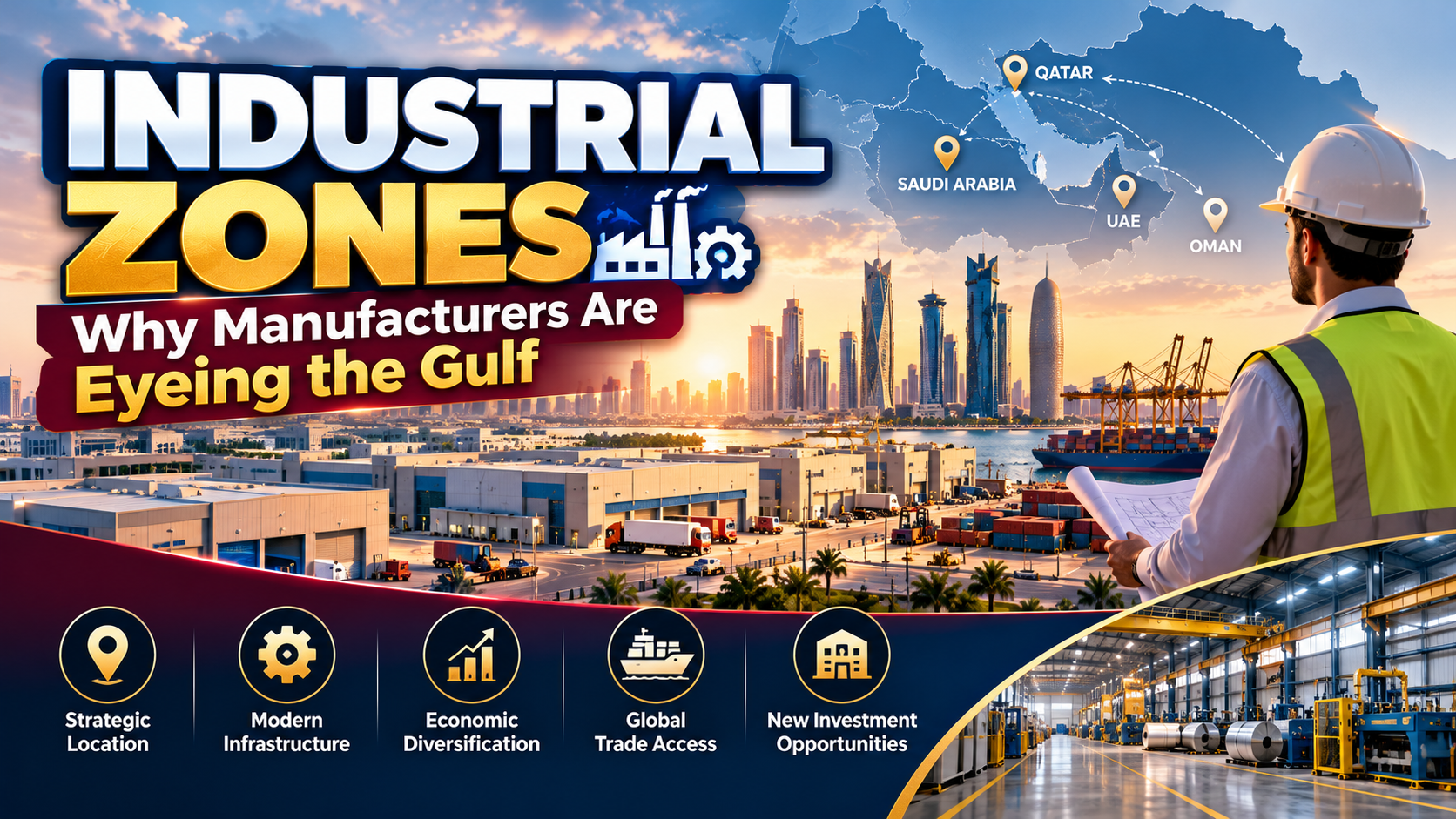
The Gulf region is becoming an increasingly important location for manufacturers seeking new investment opportunities. Strong infrastructure, strategic trade routes, energy resources, and government-backed economic diversification are encouraging companies to establish or expand manufacturing operations across the region.
For businesses evaluating industrial zones Gulf markets, countries such as Qatar, the UAE, Saudi Arabia, and Oman offer access to modern industrial infrastructure and growing regional markets.
Qatar is also attracting attention as it expands its manufacturing base and encourages private-sector investment. For businesses considering manufacturing investment in Qatar, industrial zones can provide the infrastructure and services needed to support production, logistics, storage, and distribution.
What Are Industrial Zones?
Industrial zones are designated areas developed specifically for manufacturing, logistics, processing, warehousing, and related commercial activities.
These zones typically provide businesses with access to:
- Industrial land and facilities
- Roads and transportation networks
- Electricity and water infrastructure
- Warehousing and storage facilities
- Logistics services
- Customs and trade support
- Business and investment services
By concentrating industrial activities in designated areas, governments can create more efficient environments for manufacturers while supporting wider economic development.
Why Are Manufacturers Looking Toward the Gulf?
Several factors are making the Gulf increasingly attractive to manufacturers.
Strategic Geographic Location
The Gulf connects major markets across Asia, Europe, Africa, and the Middle East. This geographic position can help manufacturers serve multiple markets while reducing logistical barriers.
Countries in the region also have established ports, airports, highways, and logistics networks that support international trade.
Modern Industrial Infrastructure
Manufacturing requires reliable infrastructure. Industrial zones are designed to provide businesses with the facilities and utilities needed for production and distribution.
This can include industrial plots, warehouses, transportation connections, power, water, and waste management systems.
For companies entering a new market, having these facilities available can make the process of establishing operations more practical.
Economic Diversification
Many Gulf countries are working to reduce their dependence on oil and gas revenues by developing industries such as:
- Food processing
- Pharmaceuticals
- Chemicals
- Construction materials
- Automotive components
- Technology
- Logistics
- Consumer goods
Manufacturing is an important part of these diversification strategies. Governments are therefore introducing policies and investment programs designed to encourage industrial development.
Qatar's Growing Manufacturing Opportunity
Qatar is positioning manufacturing as an important part of its broader economic development strategy.
The country's existing energy sector provides an industrial foundation, while investments in infrastructure and logistics create opportunities for businesses in other manufacturing segments.
Companies researching manufacturing investment in Qatar may consider industries such as food production, chemicals, metals, plastics, pharmaceuticals, and construction-related manufacturing.
Qatar's relatively compact market can also provide an opportunity for manufacturers to establish regional operations while maintaining access to wider Gulf and international markets.
How Industrial Zones Support Manufacturing Investment
Industrial zones can reduce some of the challenges associated with establishing a manufacturing operation.
Easier Access to Infrastructure
Manufacturers need reliable utilities and transportation networks. Industrial zones bring many of these requirements together in one location.
Better Logistics
Manufacturing does not end when a product leaves the factory. Raw materials must arrive on time, and finished products must reach customers.
Industrial zones located near ports, airports, highways, or logistics hubs can help businesses manage these supply chains more efficiently.
Business Support
Industrial areas may also provide investors with access to administrative, licensing, customs, and other business services.
This can make it easier for companies to coordinate different parts of their operations.
What Makes Gulf Industrial Zones Different?
The Gulf's industrial development is increasingly focused on creating integrated ecosystems rather than simply providing industrial land.
Modern industrial zones may bring manufacturers, logistics providers, suppliers, warehouses, technology companies, and support services together.
This creates opportunities for businesses to develop relationships with nearby suppliers and service providers.
For manufacturers, being part of an established industrial ecosystem can also support supply-chain efficiency and regional expansion.
Which Industries Could Benefit?
Manufacturing opportunities vary across Gulf markets, but several sectors are receiving significant attention.
Food and beverage: Growing populations and food-security strategies are increasing demand for local food production and processing.
Pharmaceuticals: Healthcare investment is creating opportunities for pharmaceutical and medical-product manufacturing.
Chemicals and plastics: The Gulf's energy and petrochemical industries provide an established base for chemical-related manufacturing.
Construction materials: Continued infrastructure and real-estate development can support demand for locally produced construction materials.
Advanced manufacturing: Automation, technology, and Industry 4.0 initiatives are creating opportunities for manufacturers using modern production systems.
What Should Investors Consider Before Choosing a Zone?
Choosing an industrial location requires more than comparing land or facility costs.
Investors should assess:
- Access to ports and highways
- Availability and cost of utilities
- Labour availability
- Warehouse and factory requirements
- Proximity to suppliers
- Target customer markets
- Import and export procedures
- Licensing requirements
- Government incentives
- Long-term expansion opportunities
The best industrial location depends on the company's products, supply chain, workforce requirements, and target markets.
The Gulf's Manufacturing Future
The growth of industrial zones Gulf markets reflects a broader shift in the region's economic strategy.
Governments are investing in infrastructure, logistics, technology, and industrial capabilities to attract new businesses and strengthen existing industries.
For manufacturers, this creates opportunities to establish production facilities closer to important regional markets.
Qatar is part of this wider transformation. Its investment in infrastructure and focus on economic diversification make manufacturing an important area for future private-sector growth.
Final Thoughts
The Gulf is becoming more than an energy-focused region. Its industrial zones are supporting manufacturing, logistics, processing, and other sectors that can contribute to long-term economic diversification.
For companies considering manufacturing investment Qatar, understanding industrial infrastructure, logistics access, regulations, and expansion potential is essential before selecting a location.
As the region continues investing in industrial development, Gulf manufacturing hubs are likely to play an increasingly important role in regional and international supply chains.
For more business, economic, and industry-focused insights from Qatar and the wider region, Al Akhbar Publication provides a platform covering developments shaping the country's business landscape.