
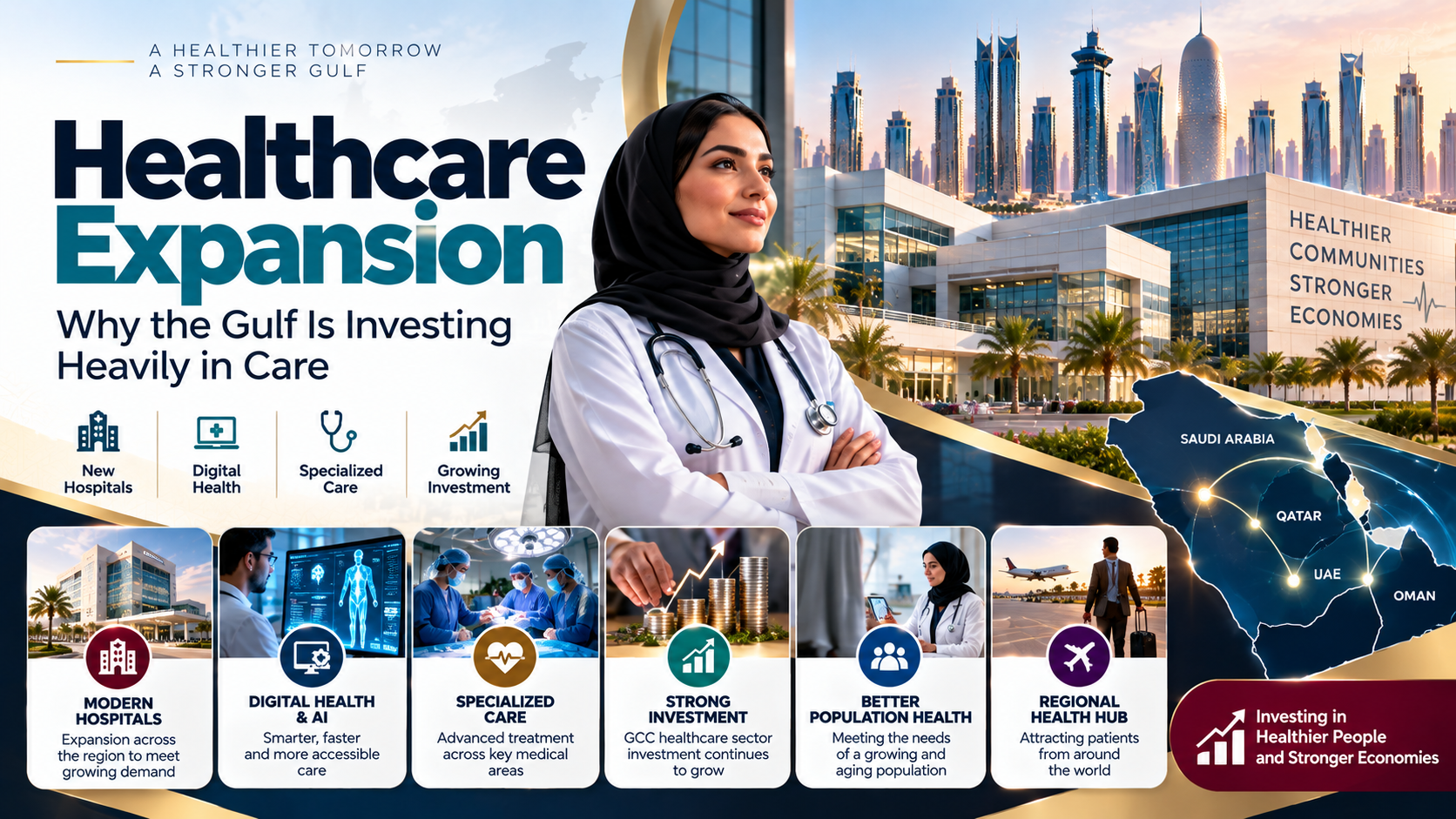
Summary: The Gulf is pouring money into hospitals, digital health, and specialized care to meet a growing, aging population. This blog looks at what's fueling GCC healthcare sector investment, where the money is going, the challenges providers face, and why this Gulf healthcare infrastructure growth story matters for investors and patients alike.
If you've been following business news out of the region lately, you've probably noticed a pattern: healthcare keeps popping up as one of the hottest sectors for money and attention. It's not a coincidence. Governments across Saudi Arabia, the UAE, Qatar, and the wider Gulf are treating hospitals, clinics, and digital health tools as national priorities, not just public services.
This shift is reshaping how care is delivered, who pays for it, and where the next big opportunities lie. Let's break down what's actually happening and why it matters.
A Region Betting Big on Health
Healthcare has become a centerpiece of national planning across the Gulf. Saudi Arabia's Vision 2030 and the UAE's long-term development goals both place medical services near the top of the list, alongside energy, tourism, and technology.
This isn't just political language. It translates into real budgets, new hospital projects, and policies that invite private companies to build and run facilities alongside the government. The result is steady GCC healthcare sector investment flowing into everything from neighborhood clinics to specialized cancer centers.
Executives running major hospital networks in the region have pointed to this same trend: governments and private groups are working together more closely than ever, and that partnership is what's letting the sector expand so quickly.
The Numbers Behind the Growth
The scale of spending is genuinely large. Healthcare expenditure across the Gulf Cooperation Council is projected to climb toward the USD 150-160 billion range by the end of the decade, growing at a healthy annual pace. As a share of overall economic output, health spending is also expected to rise steadily over the same period.
Saudi Arabia is leading much of this expansion, thanks to its large and aging population, wider health insurance coverage, and rising medical costs. Together with the UAE, it's expected to account for the lion's share of regional healthcare spending in the coming years.
The region will also need thousands of new hospital beds to keep pace with demand, with Saudi Arabia responsible for the bulk of that expansion. This kind of Gulf healthcare infrastructure growth doesn't happen overnight — it reflects years of planning and long-term commitment from both governments and private investors.
What's Driving the Gulf Healthcare Infrastructure Growth
A few forces are pushing this expansion forward at the same time:
- A growing, aging population:
More residents means more demand for everyday care and long-term treatment.
- Rising lifestyle diseases:
Diabetes, heart disease, and other chronic conditions are becoming more common, creating steady demand for specialized clinics.
- Mandatory health insurance:
As more countries roll out compulsory coverage, more money flows directly into the healthcare system.
- Medical tourism ambitions:
Several Gulf states want to become regional hubs where patients travel specifically for quality treatment.
- Government-backed reform:
Regulatory changes are making it easier and more attractive for private companies to enter the market.
Put together, these factors explain why GCC healthcare sector investment keeps climbing even as other industries slow down.
Technology Is Changing How Care Is Delivered
Hospitals in the Gulf are no longer just competing on beds and equipment — they're competing on technology. Artificial intelligence is being used to help doctors catch diseases earlier and personalize treatment plans, while automation is cutting down on administrative errors and paperwork.
Industry leaders have stressed one important point: for AI tools to actually work well in this region, they need to be trained on local and regional health data, not just borrowed models built for other populations. That's a subtle but important detail shaping how digital health tools are rolled out here.
Telemedicine has also become a real part of everyday care, not just a pandemic-era experiment. Patients in remote areas can now consult specialists without traveling long distances, and clinics are using predictive analytics to plan staffing and manage patient flow more efficiently. All of this fits into the broader wave of Gulf healthcare infrastructure growth, where digital tools are treated as core infrastructure, not add-ons.
The Challenges Providers Still Face
It's not all smooth sailing. A few real hurdles stand in the way of the sector's ambitions:
- Workforce shortages:
Finding enough skilled doctors, nurses, and technicians remains difficult, and the sector still relies heavily on expatriate talent.
- Import dependency:
Much of the equipment and medicine used in the region is imported, which makes costs vulnerable to global price swings.
- Gaps in specialized care:
Many systems are strong in primary care but still building out advanced, specialized treatment options.
- Rising costs:
Global supply chain issues and inflation are pushing up the price of delivering quality care.
None of these challenges are unique to the Gulf, but they do mean that GCC healthcare sector investment has to be paired with smart planning, not just capital.
Where the Opportunities Lie
For investors, business owners, and healthcare companies watching the region, a few areas stand out as particularly promising:
- Building and operating new hospitals and specialized clinics
- Digital health platforms, including telemedicine and AI diagnostics
- Chronic disease management and preventive care programs
- Pharmaceutical manufacturing and local supply chains
- Services built around medical tourism
Mergers and partnerships are also playing a growing role, as companies team up to strengthen their offerings and expand across borders within the Gulf. This kind of consolidation is often a sign of a maturing, confident market — one where Gulf healthcare infrastructure growth is attracting serious, long-term players rather than short-term speculation.
Why Choose Al Akhbar Publication?
Al Akhbar Publication isn't just another news site — it's a strategic business hub built for the GCC's fast-moving economy. Whether you're a healthcare provider looking for visibility, an investor scanning for opportunities, or a consumer trying to find services you can trust, our platform connects all three sides of the market.
We combine sharp market insight with a verified directory and real B2B networking tools, so businesses get genuine exposure and consumers get transparency. In a sector as fast-changing as Gulf healthcare, having a reliable source for news, connections, and credible listings makes a real difference.
Conclusion:
The Gulf's healthcare sector is entering a genuinely exciting phase. Strong government support, rising demand, and fast-growing technology adoption are pushing the industry forward at a pace few other regions can match. Yes, there are real challenges around workforce, costs, and imports — but the direction is clear.
For anyone watching this space, the message is simple: this is a market built for the long term, and the opportunities are only expanding.
Ready to stay ahead of the Gulf's healthcare boom? Explore verified healthcare listings and market insights on Al Akhbar Publication today.