
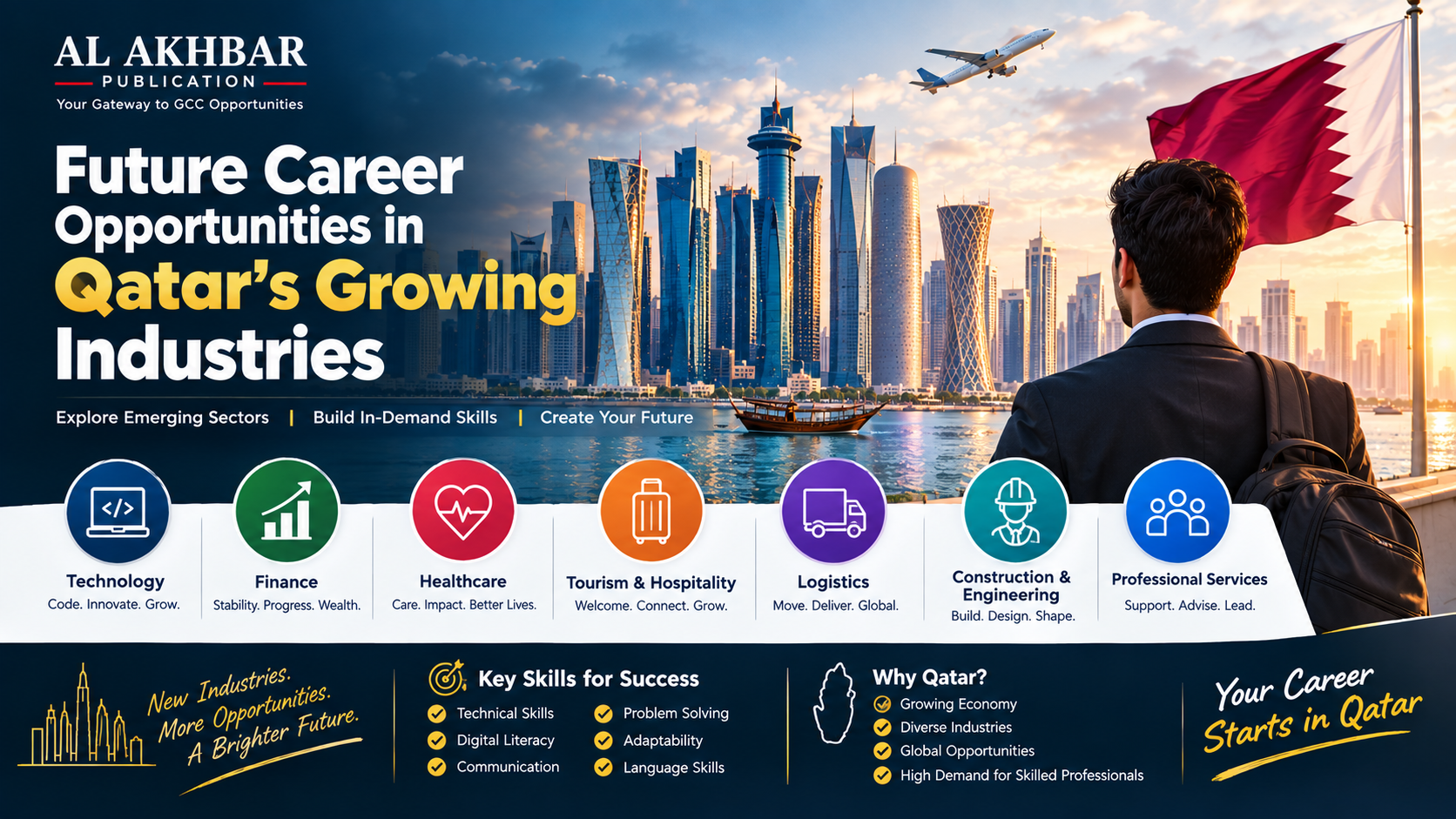
Qatar's economy continues to develop beyond its traditional energy base, creating opportunities across technology, tourism, logistics, healthcare, construction, finance, and professional services.
For people researching career opportunities in Qatar, understanding which industries are expanding can help them identify skills that may remain valuable as the labour market evolves.
The strongest career path will depend on your qualifications, experience, language abilities, and the specific requirements of employers.
Qatar's Changing Employment Landscape
Qatar has invested heavily in infrastructure, digital transformation, tourism, transportation, and other economic sectors.
This diversification can create demand for professionals outside traditional energy-related roles.
Growing areas include:
- Technology
- Finance
- Healthcare
- Tourism and hospitality
- Logistics
- Construction
- Engineering
- Professional services
- Digital business
These industries require different combinations of technical and transferable skills.
Technology and Digital Careers
Digital transformation is affecting businesses across Qatar.
Organisations increasingly rely on software, data, cybersecurity, cloud services, and digital platforms.
Potential career areas include:
- Software development
- Data analysis
- Cybersecurity
- Cloud computing
- Artificial intelligence
- IT support
- Product management
- Digital marketing
Technology skills can also transfer across industries, allowing professionals to work in sectors such as finance, healthcare, retail, and logistics.
Artificial Intelligence and Data Skills
Businesses generate increasing amounts of information through digital systems.
Professionals who can collect, analyse, interpret, and communicate data can support better business decisions.
Relevant skills include:
- Data analysis
- Statistical reasoning
- Data visualisation
- Machine learning
- AI tools
- Database management
- Business intelligence
However, technical skills are most valuable when combined with an understanding of the industry in which they are being applied.
Cybersecurity Careers
As businesses become more digitally connected, protecting information and systems becomes increasingly important.
Cybersecurity professionals may work in areas such as:
- Security monitoring
- Risk management
- Network security
- Cloud security
- Incident response
- Compliance
- Security testing
Professionals entering this field often need both technical knowledge and an understanding of security policies and organisational risk.
Healthcare Opportunities
Healthcare remains an important area of employment.
Potential opportunities can span:
- Medicine
- Nursing
- Physiotherapy
- Medical technology
- Pharmacy
- Healthcare administration
- Laboratory services
- Health information management
Healthcare professionals typically need qualifications recognised by the relevant authorities before practising in Qatar.
Tourism and Hospitality
Qatar's tourism ambitions have supported continued development in hospitality and visitor-focused services.
Career opportunities can include:
- Hotel management
- Guest services
- Food and beverage
- Event management
- Tourism operations
- Travel services
- Marketing
- Customer experience
Strong communication and customer-service skills can be particularly valuable in this sector.
Logistics and Transportation
Qatar's geographic position and infrastructure make logistics an important area of economic activity.
Potential roles include:
- Supply chain management
- Procurement
- Warehousing
- Freight operations
- Logistics planning
- Fleet management
- Customs and trade operations
Professionals who understand both technology and supply-chain processes may be well positioned for increasingly digital logistics environments.
Construction and Engineering
Infrastructure development has created significant demand for specialised construction and engineering expertise.
Potential areas include:
- Civil engineering
- Mechanical engineering
- Electrical engineering
- Project management
- Quantity surveying
- Architecture
- Construction management
- Health and safety
Experienced professionals may also find opportunities in project planning, quality assurance, and infrastructure maintenance.
Finance and Banking
Qatar's financial sector creates opportunities for professionals with expertise in banking, investment, accounting, and financial technology.
Career areas may include:
- Accounting
- Financial analysis
- Banking
- Risk management
- Compliance
- Investment
- FinTech
- Auditing
Financial professionals increasingly benefit from digital and analytical capabilities alongside traditional finance knowledge.
Renewable Energy and Sustainability
Energy remains central to Qatar's economy, while sustainability and energy-transition initiatives are also influencing future business needs.
Potential career areas include:
- Environmental management
- Energy efficiency
- Sustainability reporting
- Renewable energy
- Environmental engineering
- ESG-related roles
- Resource management
Professionals who combine technical expertise with sustainability knowledge may find opportunities across several industries.
Digital Marketing and E-Commerce
Businesses increasingly depend on digital channels to reach customers.
This creates demand for skills in:
- Search engine optimisation
- Paid advertising
- Social media
- Content marketing
- Analytics
- Email marketing
- E-commerce
- Conversion optimisation
Digital marketing professionals can work across industries rather than being limited to one sector.
What Skills Are Employers Looking For?
The most useful in-demand skills in Qatar vary by industry, but several capabilities can apply broadly.
These include:
- Digital literacy
- Communication
- Problem-solving
- Data analysis
- Project management
- Technical expertise
- Adaptability
- Teamwork
- Leadership
- Business awareness
A combination of technical and interpersonal skills can make candidates more adaptable as job requirements change.
Language Skills Can Be Valuable
Qatar's workforce is highly international.
English is widely used in professional environments, while Arabic can be particularly valuable for roles involving local customers, government organisations, or Arabic-speaking stakeholders.
Depending on the industry, additional languages can also help professionals communicate with diverse teams and customers.
Certifications Can Strengthen Your Profile
Formal education provides a foundation, but relevant professional certifications can demonstrate specialised knowledge.
Depending on your field, useful certifications may relate to:
- Project management
- Cybersecurity
- Cloud computing
- Data analytics
- Accounting
- Occupational safety
- Digital marketing
- Supply-chain management
Choose certifications that are recognised and relevant to your intended career rather than collecting credentials without a clear purpose.
Soft Skills Still Matter
Technical ability is only one part of employability.
Employers may also value people who can:
- Communicate clearly
- Work under pressure
- Solve problems
- Manage priorities
- Collaborate with colleagues
- Lead projects
- Adapt to change
These skills can become particularly important for professionals moving into management or client-facing positions.
How to Prepare for Qatar's Future Job Market
Professionals can take practical steps to improve their career prospects.
1. Identify growing industries
Research sectors that align with your interests and qualifications.
2. Compare job descriptions
Look at the skills repeatedly requested by employers.
3. Build relevant expertise
Take courses or pursue certifications where they add genuine value.
4. Develop practical experience
Projects, internships, freelance work, and relevant employment can strengthen your CV.
5. Improve your professional profile
Keep your CV and professional networking profiles current.
6. Build industry connections
Networking can help you learn about opportunities that may not be widely advertised.
Research the Employer Before Applying
A job title alone does not tell you everything about a role.
Before applying, research:
- Company activities
- Industry
- Job responsibilities
- Required qualifications
- Experience requirements
- Work location
- Employment conditions
This helps you target applications rather than sending the same CV to every employer.
Avoid Focusing Only on Job Titles
Two jobs with similar titles can require very different skills.
Instead of searching only for a specific position, look at the underlying capabilities employers need.
For example, a data-focused professional might find opportunities in:
- Banking
- Healthcare
- Logistics
- Government
- Retail
- Technology
Transferable skills can therefore expand the number of industries you can consider.
Why Economic Diversification Matters for Careers
Economic diversification can create employment opportunities across a wider range of sectors.
Instead of relying on a single industry, a diversified economy can support interconnected areas such as:
Technology → Finance → Logistics → Healthcare → Tourism → Professional Services
This can give skilled professionals more potential pathways as businesses evolve.
Why Choose Al Akhbar Publications?
Al Akhbar Publications covers business, economic, and professional developments across the Gulf region.
For readers researching career opportunities in Qatar, understanding economic trends can provide useful context when deciding which industries and skills to explore.
Career planning should still be based on current job vacancies, qualifications, employer requirements, and professional experience.
A Quick Career Planning Checklist
Before pursuing a new opportunity, ask:
- What industries interest me?
- What skills do employers request?
- Are my qualifications recognised?
- Do I need additional certification?
- Can I demonstrate practical experience?
- Is my CV tailored to the role?
- Do I have relevant professional contacts?
- Can my skills transfer to another industry?
These questions can help turn general career research into a practical plan.
Final Thoughts
Qatar's evolving economy is creating opportunities across technology, healthcare, tourism, logistics, finance, engineering, construction, and professional services.
For professionals researching career opportunities in Qatar, the most useful approach is to look beyond individual job titles and understand the skills that different industries increasingly require.
Developing in-demand skills in Qatar such as digital literacy, data analysis, communication, technical expertise, project management, and problem-solving can help professionals remain adaptable.
The future job market will continue to change, so continuous learning and practical experience may be just as important as the qualification you already hold.