
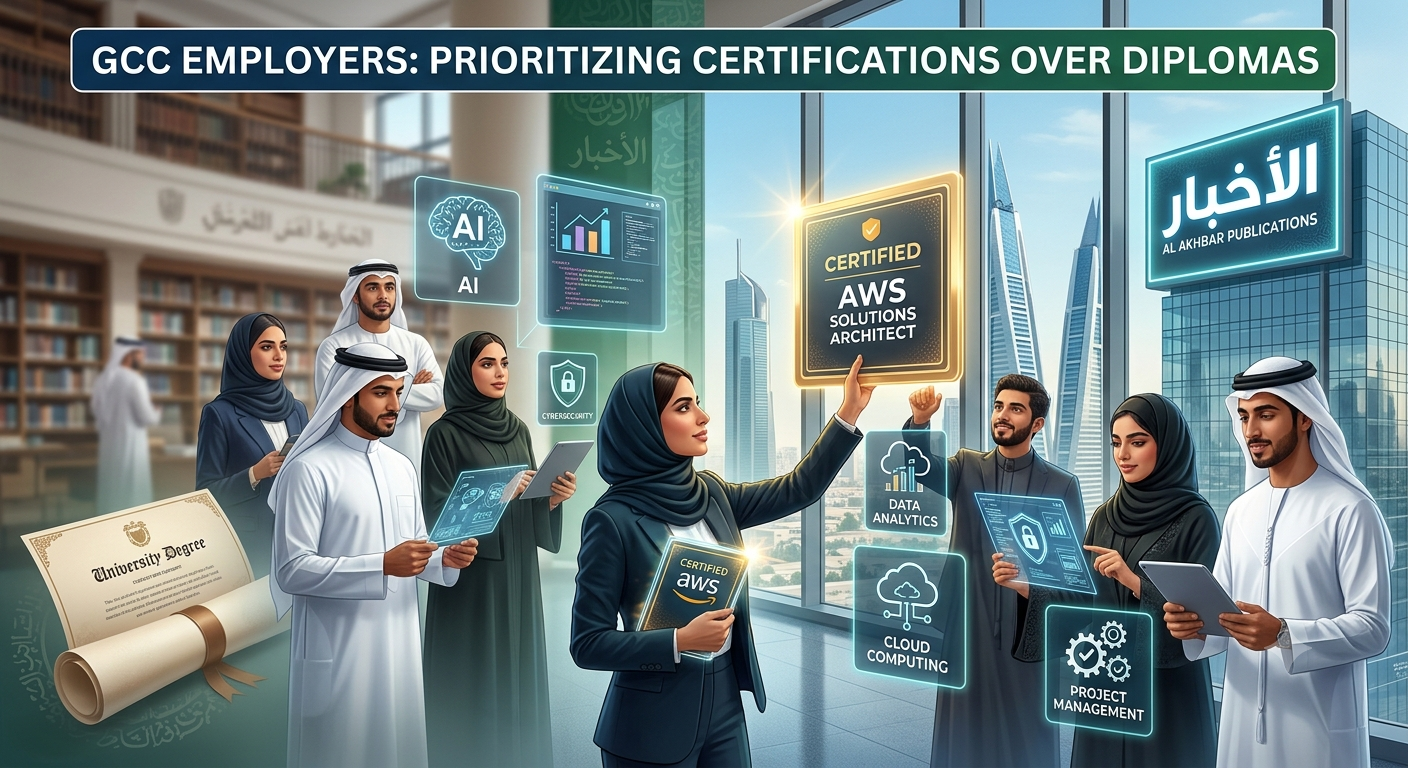
The job market across the Middle East is undergoing a major transformation. From Saudi Arabia to Bahrain, employers are shifting hiring strategies toward a skills-first approach, where practical ability and verified certifications matter more than traditional academic degrees.
For job seekers exploring job vacancies in Middle East markets or specifically searching jobs in Bahrain, this shift is redefining how careers are built and how talent is evaluated. GCC employers are increasingly focused on what candidates can do, not just what they studied.
At Al Akhbar Publications, we analyze these evolving workforce trends shaping recruitment, hiring behavior, and long-term employment opportunities across the region.
The Big Shift: Degrees Are No Longer the Only Ticket
Across GCC countries, companies are moving away from degree-based hiring models.
Instead, employers are prioritizing:
- Practical job-ready skills
- Industry certifications
- Technical assessments
- Real-world experience
- Demonstrated problem-solving ability
Recent workforce analysis shows that many employers now prefer candidates with certifications and proven skills over formal academic qualifications, especially in fast-changing industries like IT, engineering, logistics, and digital services.
This shift is being driven by rapid digital transformation and the need for immediately deployable talent.
Why GCC Employers Are Changing Hiring Standards
Several key factors are pushing this transition:
1. Digital transformation across industries
Companies are adopting AI, automation, and cloud systems, requiring employees who can adapt quickly.
2. Skills shortages in key sectors
Employers across Bahrain, UAE, Qatar, and Saudi Arabia report difficulty finding candidates with niche technical expertise.
3. Faster hiring needs
Project-based economies require workers who can contribute immediately without long training periods.
4. Certification-based validation
Certifications like AWS, Microsoft Azure, PMP, and cybersecurity credentials are becoming trusted indicators of capability.
Most In-Demand Skills in GCC Job Market
The modern GCC job market is heavily skills-driven.
Top in-demand areas include:
- Artificial Intelligence (AI) and machine learning
- Data analytics and business intelligence
- Cybersecurity and network protection
- Cloud computing (AWS, Azure, Google Cloud)
- Digital marketing and SEO
- Project management (PMP, Agile, Scrum)
- Engineering and technical trades
- Healthcare and specialized medical skills
Soft skills are also increasingly important:
- Communication skills
- Adaptability
- Leadership
- Cross-cultural teamwork
- Problem-solving ability
Bahrain Job Market: Skills Over Degrees
In Bahrain, hiring trends are strongly aligned with GCC-wide changes.
Companies hiring for jobs in Bahrain are increasingly:
- Testing technical skills during interviews
- Preferring certified professionals in finance and IT
- Hiring based on portfolio and experience
- Reducing emphasis on academic prestige
Sectors seeing the strongest demand include:
- Banking and financial services
- Information technology
- Construction and engineering
- Hospitality and tourism
- Logistics and supply chain
For job seekers, this means certifications and practical experience now carry significant weight in recruitment decisions.
Certifications That Matter More Than Ever
Industry-recognized certifications are becoming career accelerators.
Highly valued credentials include:
- AWS Certified Solutions Architect
- Microsoft Azure certifications
- Cisco networking certifications (CCNA/CCNP)
- PMP (Project Management Professional)
- Certified Ethical Hacker (CEH)
- Data analytics certifications (Power BI, Tableau)
These certifications often help candidates stand out more than a traditional degree alone.
What This Means for Job Seekers in the Middle East
The shift to skills-based hiring creates both challenges and opportunities.
Opportunities:
- Faster entry into job markets
- Access to high-paying roles without advanced degrees
- Increased demand for skilled workers
- Greater importance of online learning platforms
Challenges:
- Higher competition based on skills
- Need for continuous upskilling
- Pressure to stay updated with technology trends
Candidates must now build a skills portfolio instead of relying only on academic history.
How Employers Are Evaluating Candidates Today
Modern GCC employers use a more practical approach:
- Skill-based assessments during interviews
- Technical tests and simulations
- Portfolio reviews for creative and technical roles
- Certification verification
- Trial or probation-based hiring models
This ensures candidates are job-ready from day one.
Impact on Traditional Education
Universities and colleges are also adapting.
We are seeing:
- Integration of certification programs into degrees
- More industry partnerships
- Focus on practical training over theory
- Growth of short-term professional courses
Education is shifting toward employability rather than purely academic achievement.
Future of GCC Job Market
The GCC job landscape is expected to become even more skills-focused.
Future trends include:
- AI-driven hiring systems
- Remote and hybrid job expansion
- Increased demand for digital and green skills
- Growth of freelance and contract-based work
- Continuous learning as a career requirement
The definition of “qualified candidate” is evolving rapidly.
What Al Akhbar Publications Observes
At Al Akhbar Publications, we track major shifts in job vacancies in Middle East markets and workforce transformation trends across GCC economies.
Our analysis shows a clear direction:
- Skills are replacing degrees as the main hiring filter
- Certifications are becoming global currency for employment
- Employers in Bahrain and the wider GCC are prioritizing adaptability over academic background
This shift is reshaping how professionals build careers across the region.
Final Thoughts
The GCC job market is moving into a new era where skills, certifications, and practical experience matter more than traditional academic pathways. For job seekers targeting jobs in Bahrain or broader Middle East opportunities, this means focusing on continuous learning and professional certifications is now essential.
Degrees still hold value, but they are no longer enough on their own. The future belongs to professionals who can prove what they can do, not just what they studied.