
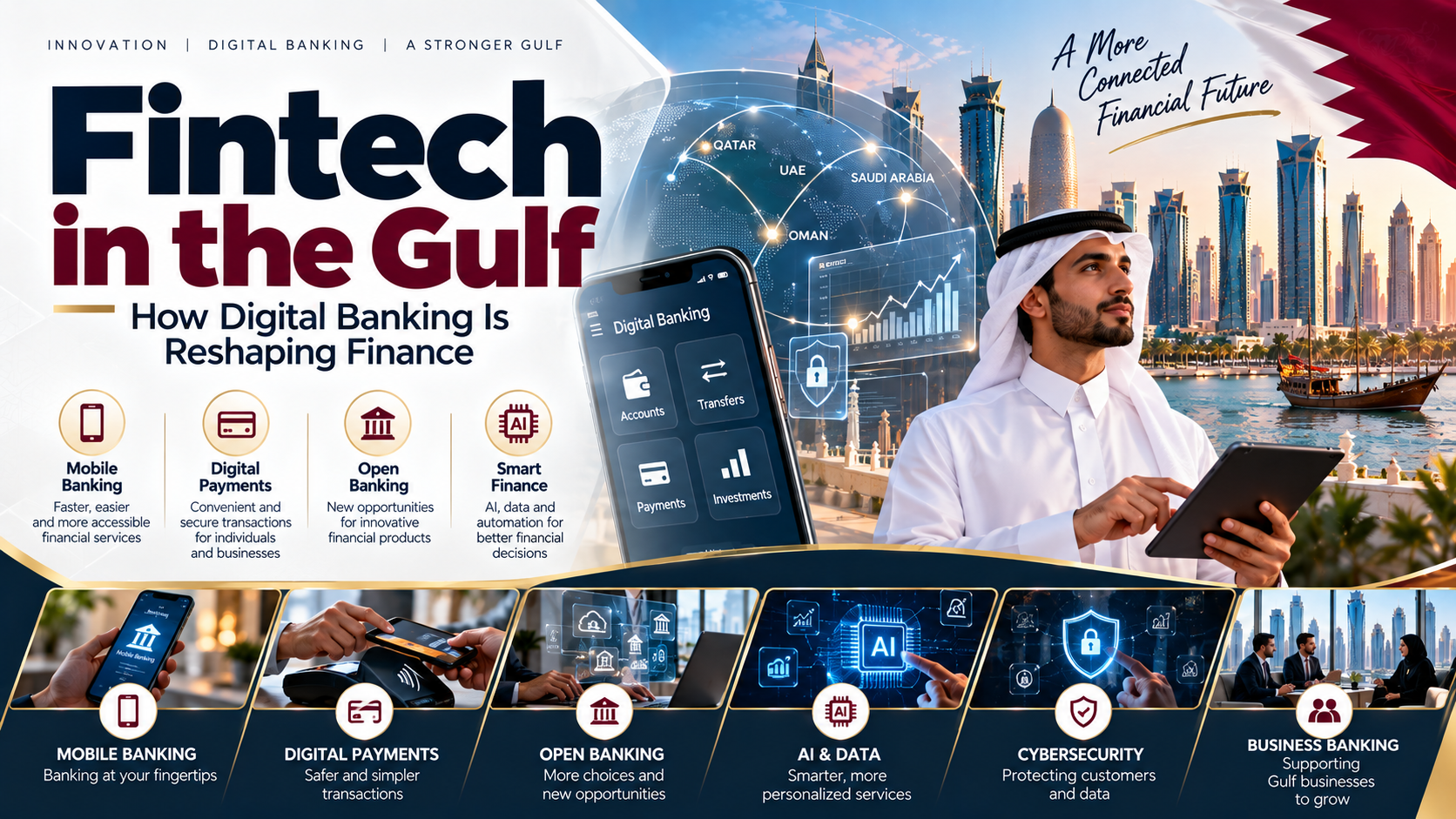
The financial sector across the Gulf is changing rapidly as banks, fintech companies, governments, and consumers adopt digital-first services.
Mobile banking, digital payments, open banking, artificial intelligence, cloud technology, and embedded financial services are changing how people manage money and how businesses access financial products.
This shift is closely connected to the wider digital banking growth Gulf markets are experiencing. Qatar and other GCC countries are investing in financial technology as part of broader digital transformation strategies.
For readers following regional business and technology developments, Al Akhbar Publication covers topics shaping markets and industries across the region.
What Is Driving Digital Banking Growth in the Gulf?
Several factors are contributing to the expansion of digital banking across Gulf markets.
High smartphone adoption, improving digital infrastructure, government-backed technology initiatives, and changing customer expectations have encouraged financial institutions to expand their digital services.
Customers increasingly expect to be able to:
- Open accounts digitally
- Transfer money through mobile applications
- Make contactless payments
- Pay bills online
- Manage cards through apps
- Monitor transactions instantly
- Apply for financial products digitally
- Receive personalized financial services
Banks are responding by investing in technology and redesigning traditional banking processes around digital channels.
Mobile Banking Is Becoming Central to Customer Experience
Mobile applications have become an important connection between customers and financial institutions.
Instead of visiting a branch for routine services, customers can perform many banking activities through their phones.
These can include checking balances, transferring funds, managing cards, paying bills, and receiving transaction notifications.
This does not necessarily mean physical branches will disappear. Instead, banks are increasingly using digital channels for routine transactions while branches focus on services that require greater interaction.
Qatar's Role in Gulf Fintech
Qatar has been developing its financial technology ecosystem through regulatory initiatives, digital infrastructure, financial institutions, and startup development.
The country's financial sector is also connected to wider national digital transformation goals.
Fintech companies can contribute to areas such as:
- Digital payments
- Banking technology
- Financial inclusion
- Wealth management
- Insurtech
- Regtech
- Business finance
- Digital identity
- Data-driven financial services
Qatar's position as a major financial and business centre also creates opportunities for financial technology companies serving consumers and businesses.
Digital Payments Are Changing Everyday Transactions
Payments are one of the most visible areas of fintech adoption.
Consumers can increasingly pay through:
- Mobile wallets
- Contactless cards
- Banking applications
- Online payment gateways
- Digital transfers
- QR-based payment systems
For businesses, digital payments can simplify transactions and create better records of customer activity.
The expansion of digital payments also supports e-commerce and online service businesses.
Open Banking Could Change How Financial Data Is Used
Open banking allows customers, with appropriate consent and regulatory safeguards, to share financial information with authorized third-party providers.
This can create opportunities for new financial products.
For example, a fintech application could potentially use permitted financial data to help customers:
- Track spending
- Manage budgets
- Compare financial products
- Assess financial activity
- Automate certain financial tasks
The development of open banking also increases the importance of data protection, cybersecurity, customer consent, and regulatory oversight.
Artificial Intelligence in Financial Services
Artificial intelligence is becoming another important part of financial technology.
Financial institutions can use AI and machine learning for areas such as:
- Fraud detection
- Customer service
- Risk analysis
- Transaction monitoring
- Personalization
- Credit assessment
- Operational automation
AI can process large amounts of data quickly, but its use also creates questions about transparency, privacy, accuracy, and responsible decision-making.
Financial institutions therefore need appropriate governance alongside technological investment.
Cybersecurity Is Becoming More Important
Greater digital adoption also creates greater exposure to cyber risks.
Banks and fintech companies handle highly sensitive information, including financial transactions and personal customer data.
Security measures can include:
- Multi-factor authentication
- Encryption
- Fraud monitoring
- Identity verification
- Transaction alerts
- Access controls
- Security testing
- Continuous monitoring
Customers also have an important role in protecting their accounts by using strong passwords, avoiding suspicious links, and monitoring transactions.
Fintech Is Changing Business Banking
Digital finance is not limited to individual consumers.
Businesses can also benefit from digital financial services.
Fintech platforms can help businesses manage:
- Payments
- Invoicing
- Payroll
- Cash flow
- Expense management
- Cross-border transactions
- Business accounts
- Financing
For small and medium-sized businesses, easier access to digital financial tools can reduce administrative work and improve financial visibility.
Cross-Border Finance in the GCC
The Gulf is a highly connected regional economy, with businesses and individuals frequently engaging in cross-border transactions.
Digital financial services can help make these transactions more efficient.
However, cross-border finance also involves different regulatory requirements, currencies, compliance processes, and financial institutions.
Fintech companies operating across GCC markets therefore need to understand the regulatory environment in each jurisdiction.
Key Fintech Trends Qatar and GCC Businesses Should Watch
The broader fintech trends Qatar GCC markets are following include several areas that could influence the financial sector in the coming years.
Digital-Only Banking
Digital-first financial institutions can provide banking services without relying on traditional branch networks.
Embedded Finance
Financial services can be integrated directly into non-financial platforms, allowing customers to access payments or financing within other digital experiences.
AI-Powered Financial Services
AI can support fraud prevention, customer service, financial analysis, and operational processes.
Digital Identity
Secure digital identity systems can make remote onboarding and verification more efficient.
Real-Time Payments
Faster payment infrastructure can improve the speed of domestic and cross-border transactions.
Regtech
Technology can help financial institutions manage regulatory reporting, monitoring, and compliance requirements.
What Does Digital Banking Mean for Traditional Banks?
Digital banking does not necessarily eliminate traditional banks.
Instead, it changes how banks operate.
Established institutions have several advantages, including existing customers, financial infrastructure, regulatory experience, and established trust.
Their challenge is modernizing legacy systems while continuing to provide reliable services.
Many banks are therefore investing in partnerships with fintech companies, digital platforms, cloud infrastructure, and internal technology teams.
Fintech Startups and Traditional Financial Institutions
Fintech startups can often develop new products quickly because they are built around specific digital use cases.
Traditional banks, meanwhile, have larger customer bases and established financial infrastructure.
Partnerships between the two can combine these strengths.
A bank may provide regulatory infrastructure and financial services while a fintech company contributes specialized technology or a new customer experience.
This can accelerate innovation without requiring every financial institution to develop every technology internally.
Financial Inclusion and Digital Access
Digital banking can also improve access to financial services.
Customers who have limited access to physical branches may be able to use mobile applications and digital payment systems instead.
However, digital inclusion depends on factors such as:
- Internet access
- Smartphone availability
- Digital literacy
- Accessibility
- Customer trust
- Cybersecurity
- Affordable financial services
Technology alone does not guarantee financial inclusion. Products also need to be accessible and understandable.
What Consumers Should Consider
As digital banking expands, customers should pay attention to more than convenience.
Before using a digital financial service, consider:
- Who operates the service?
- Is it regulated or licensed where required?
- How is personal data handled?
- What security measures are available?
- How can suspicious transactions be reported?
- What fees apply?
- What happens if the service becomes unavailable?
Understanding these details can help customers make more informed choices.
The Future of Gulf Finance
The Gulf's financial sector is likely to become increasingly connected to digital technology.
Banks, fintech companies, payment providers, regulators, and technology businesses will continue to shape the market.
The next phase may involve greater integration between banking, payments, commerce, artificial intelligence, and digital identity.
For businesses, this creates opportunities to improve financial operations and customer experiences. For consumers, it can provide faster and more convenient access to financial services.
Why Follow Al Akhbar Publication?
Al Akhbar Publication covers business, technology, employment, and economic developments relevant to Qatar and the wider region.
Fintech is one part of a broader transformation taking place across Gulf economies. Understanding these developments can help businesses and professionals keep track of changes affecting finance, technology, and commerce.
Final Thoughts
Digital banking is changing the way financial services are delivered across the Gulf.
Mobile banking, digital payments, AI, open banking, cybersecurity, embedded finance, and digital identity are becoming increasingly important parts of the financial ecosystem.
The digital banking growth Gulf markets are experiencing reflects both changing consumer expectations and wider investments in digital infrastructure.
At the same time, emerging fintech trends Qatar GCC businesses should watch include real-time payments, AI-powered services, open banking, digital-only banking, and regulatory technology.
As these technologies develop, financial institutions will need to balance innovation with security, regulation, privacy, and customer trust.
Al Akhbar Publication provides a platform for following these wider business and technology developments across Qatar and the Gulf.