
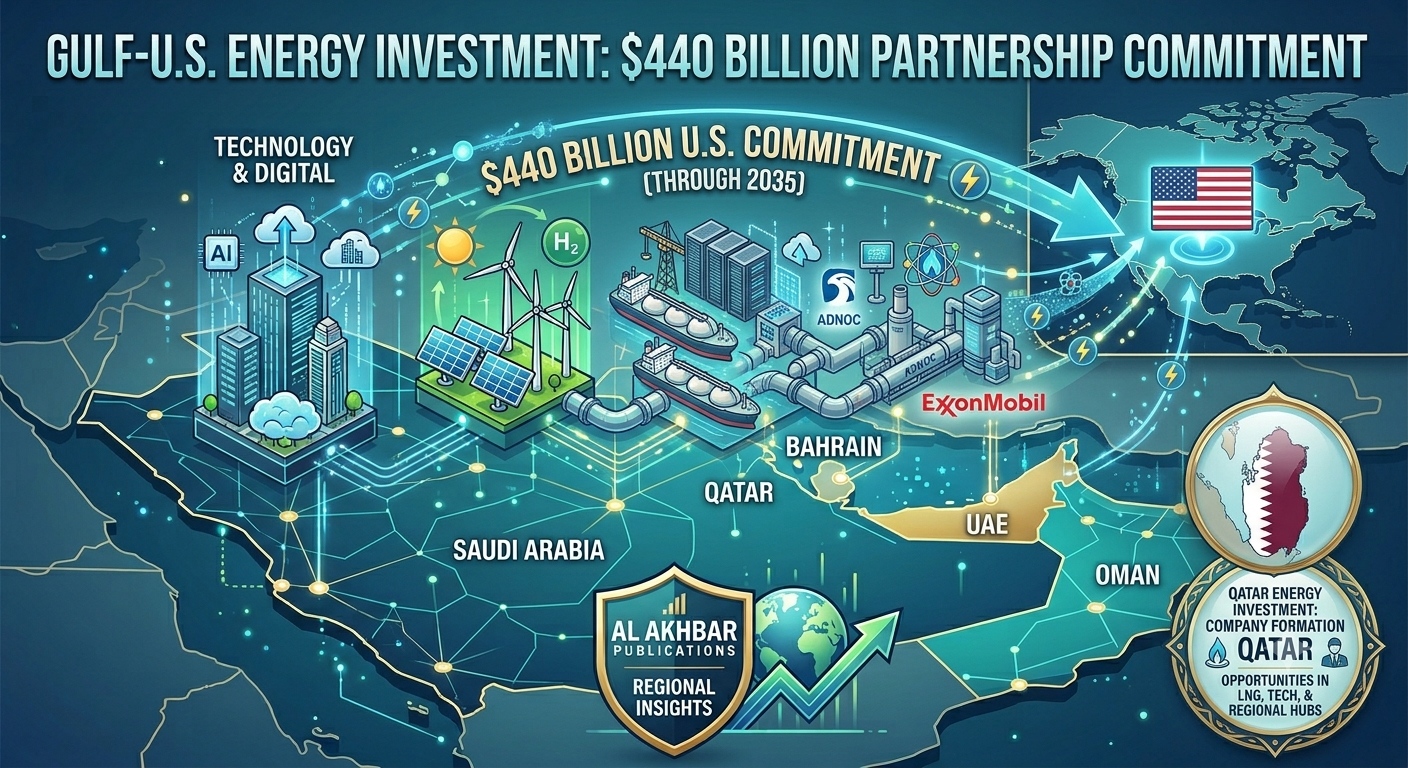
The economic relationship between the United States and Gulf nations continues to strengthen as major energy investment commitments move forward. Recent announcements confirm that energy-sector investments linked to Gulf partners could reach approximately $440 billion over the coming decade, highlighting the growing importance of cooperation in energy, infrastructure, and advanced technologies.
For investors and entrepreneurs exploring Middle East business news today or considering company formation in Qatar, these developments signal a rapidly evolving regional economy that is expanding beyond oil and gas into diversified global industries.
$440 Billion Energy Investment Plan Overview
The UAE has announced plans to significantly expand its energy investments in the United States, with commitments expected to reach around $440 billion by 2035. This marks a major increase from current investment levels and reflects long-term strategic cooperation between Gulf nations and the U.S.
Key highlights include:
- Expansion of Gulf investment in U.S. energy infrastructure
- Long-term energy and industrial partnerships
- Focus on both traditional and emerging energy sectors
- Stronger cross-border economic collaboration
- Increased participation from private-sector energy firms
This scale of investment highlights how energy diplomacy is shaping global economic relationships.
Why This Investment Matters
This announcement is not just financial, it reflects broader geopolitical and economic strategy.
It signals:
- Continued confidence in U.S. energy markets
- Gulf expansion into global investment leadership
- Diversification beyond oil exports
- Increased focus on technology-driven energy systems
- Strengthening of long-term international partnerships
The energy sector is no longer limited to extraction; it now includes innovation, infrastructure, and digital transformation.
Gulf Countries and Their Global Role
Gulf nations such as Qatar, UAE, Saudi Arabia, and Kuwait continue to play a central role in global energy markets. However, their role is shifting from energy exporters to global investors.
Current focus areas include:
- Oil and gas production and exports
- LNG infrastructure expansion
- Renewable energy development
- Hydrogen and carbon management projects
- Technology and industrial investments
This diversification supports long-term economic stability across the region.
U.S.–Gulf Energy Cooperation Trends
Energy cooperation between the U.S. and Gulf states is expanding across multiple sectors.
Key areas include:
- Natural gas development
- Renewable energy projects
- Hydrogen energy initiatives
- Carbon capture technologies
- Artificial intelligence infrastructure linked to energy demand
Energy and technology are increasingly interconnected, with data centers and AI systems driving new electricity demand worldwide.
Major Energy Players Involved
Several major energy companies are associated with ongoing and planned investments, including:
- ExxonMobil
- Occidental Petroleum
- EOG Resources
- ADNOC
These companies are involved in upstream development, natural gas expansion, and large-scale infrastructure projects.
Energy and Technology Convergence
One of the most important shifts in global energy markets is the integration of energy and artificial intelligence.
Modern digital systems require:
- Large-scale computing power
- Stable and long-term energy supply
- Advanced infrastructure development
- High-capacity data centers
This convergence is driving new investment strategies where energy and technology sectors grow together rather than separately.
Impact on Company Formation in Qatar
For entrepreneurs considering company formation in Qatar, these developments create a strong regional business environment.
Potential benefits include:
- Increased foreign direct investment
- Expansion of energy-related industries
- Growth in technology and infrastructure sectors
- Stronger regional trade opportunities
- Improved investor confidence across the Gulf
Qatar continues to position itself as a key business hub connecting energy markets with global investment flows.
Business Opportunities Across the Region
Large-scale energy investments typically create ripple effects across multiple industries.
Sectors likely to benefit include:
- Engineering and construction
- Logistics and transportation
- Financial services
- Industrial manufacturing
- Energy consulting
- Environmental technology
- Project management services
These developments strengthen long-term economic diversification in the Gulf.
Long-Term Economic Outlook
The $440 billion investment commitment reflects a long-term vision extending through 2035. Expected outcomes include:
- Job creation across multiple industries
- Infrastructure expansion
- Increased global trade activity
- Technology transfer and innovation
- Stronger economic partnerships between regions
This stability supports long-term planning for investors and businesses.
Why the Gulf Region Remains Attractive to Investors
The Gulf continues to attract global attention due to:
- Strong sovereign investment capacity
- Strategic geographic location
- Business-friendly regulatory reforms
- Rapid economic diversification
- Growth in technology and energy sectors
These factors make the region a major global investment hub.
The Future of Energy Investment
Future energy partnerships are expected to focus on:
- Natural gas and LNG expansion
- Renewable energy projects
- Hydrogen development
- Carbon reduction technologies
- AI-powered energy infrastructure
- Advanced industrial manufacturing
Energy investment is increasingly linked with digital transformation and sustainability goals.
Al Akhbar Publications Perspective
At Al Akhbar Publications, we track key developments shaping Middle East business news today, including energy investments, market trends, and company formation in Qatar.
As global investment patterns evolve, the Gulf region continues to play a central role in shaping international economic direction. Understanding these shifts is essential for businesses and investors looking to stay ahead of emerging opportunities.
Final Thoughts
The confirmation of a $440 billion energy investment expansion between Gulf partners and the United States highlights a major shift in global economic strategy. It reflects growing cooperation, diversification of energy systems, and increasing integration between energy and technology sectors.
For investors and entrepreneurs, especially those exploring opportunities in Qatar and the wider Gulf region, this development signals long-term growth potential across energy, infrastructure, and business formation landscapes.