
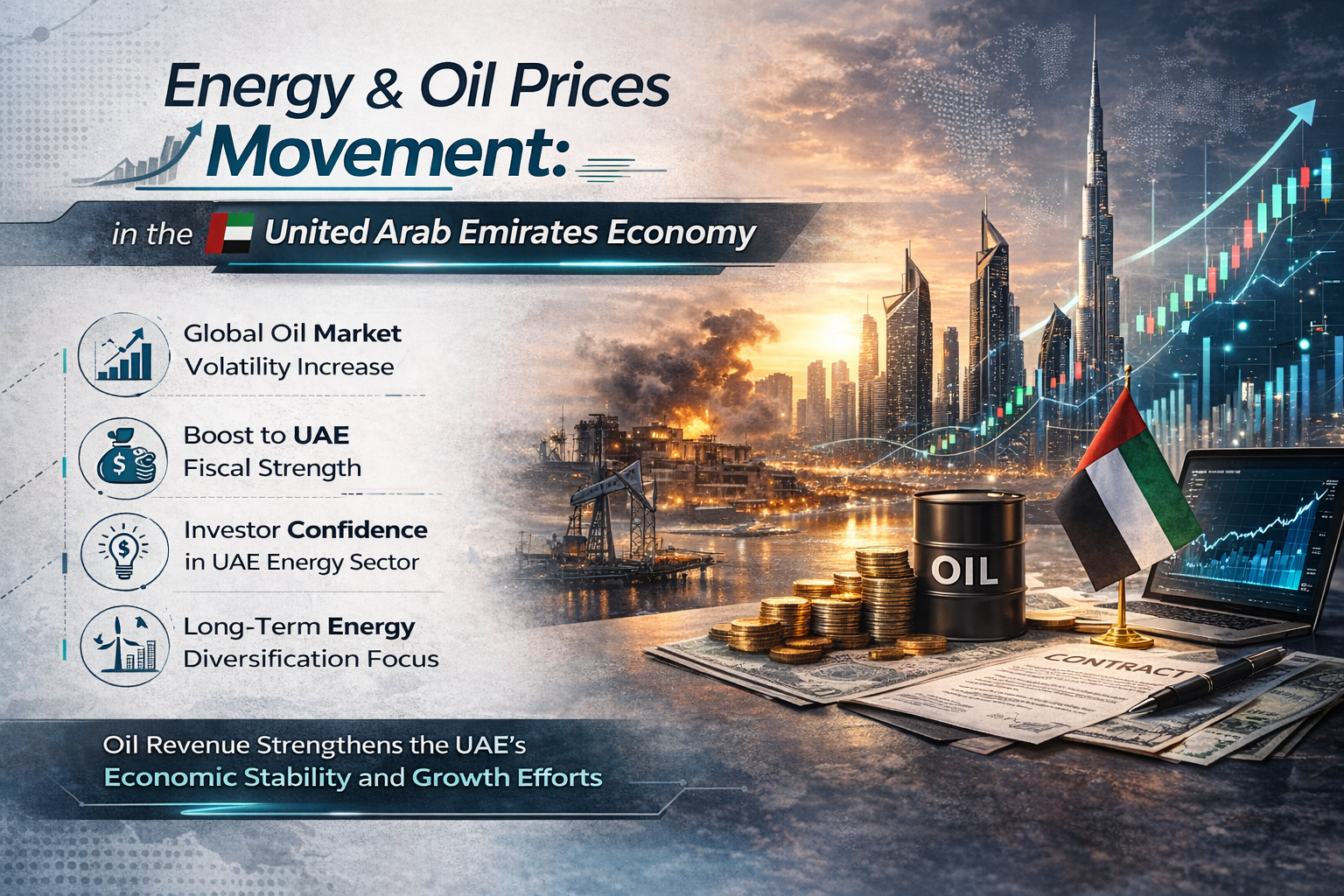
Introduction
Energy markets are among the most sensitive components of the global economy. Even small shifts in regional stability, supply routes, or market sentiment can influence oil prices, investment decisions, and government revenues. In the Gulf region, where energy exports remain a core economic driver, oil price movements have wide-reaching effects on public finances, business confidence, and economic planning.
The United Arab Emirates plays a central role in global energy markets as a major oil producer and exporter. While the UAE has made significant progress toward economic diversification, oil revenues still contribute substantially to fiscal strength and macroeconomic stability. Recent regional uncertainty has renewed attention on energy supply risks, resulting in noticeable oil price fluctuations.
This blog provides a detailed business-focused analysis of oil price movements and their economic impact on the UAE, without political or conflict-related discussion.
Global Oil Market Sensitivity to Regional Conditions
Oil prices are influenced by a combination of supply-demand dynamics, investor sentiment, and perceived geopolitical risk. When regional uncertainty increases, traders often price in potential supply disruptions, even if actual production remains stable.
Key Market Dynamics:
Increased risk premiums in oil futures markets
Higher short-term price volatility
Strong reaction from speculative traders
Heightened attention to Middle East supply routes
These dynamics often lead to price spikes driven more by perception than physical shortages.
Oil Price Increase and Immediate Market Reaction
Recent market conditions saw oil prices rise as traders responded to uncertainty surrounding global energy flows. This increase had immediate implications for oil-exporting economies like the UAE.
Immediate Effects:
Improved revenue outlook for oil exporters
Increased interest from energy market investors
Strengthening of fiscal buffers
Positive sentiment within energy-linked industries
For the UAE, higher prices translated into stronger near-term fiscal confidence.
Importance of Oil Revenues for the UAE Economy
Although the UAE has diversified significantly, oil remains a strategic economic pillar. Oil revenues support government budgets, infrastructure development, and sovereign investment strategies.
Role of Oil in the Economy:
Supports public spending and capital projects
Contributes to trade surplus
Strengthens foreign reserves
Funds long-term development initiatives
Oil price movements therefore directly influence national financial planning.
Government Revenue and Fiscal Planning Impact
Higher oil prices provide additional fiscal space for governments. In the UAE, this supports stable budget execution and economic continuity.
Fiscal Benefits:
Increased government income
Reduced budgetary pressure
Flexibility for public investment
Continued funding for social and economic programs
This fiscal stability reassures investors and credit rating agencies.
Impact on Energy Companies and State Enterprises
Energy companies operating in the UAE benefit from higher oil prices through improved profitability and cash flow.
Corporate-Level Effects:
Higher revenue per barrel
Improved balance sheets
Increased capital expenditure capacity
Stronger shareholder confidence
This allows companies to invest in efficiency, technology, and expansion.
Energy Sector Employment and Workforce Stability
Oil price stability supports employment levels across the energy value chain.
Employment Impacts:
Job security in upstream operations
Continued demand for skilled professionals
Training and workforce development investment
Stability across supporting industries
Workforce confidence contributes to broader economic stability.
Oil Prices and Business Confidence Across Sectors
Oil price movements influence confidence beyond the energy sector. Higher prices often signal economic strength in oil-exporting nations.
Cross-Sector Impact:
Improved confidence in construction and infrastructure
Positive outlook for financial services
Increased spending capacity in public projects
Enhanced private sector optimism
This ripple effect supports economic momentum.
Inflationary Considerations and Cost Pressures
While higher oil prices benefit exporters, they can also influence inflation and operational costs.
Potential Challenges:
Increased transportation costs
Higher energy input costs for businesses
Pressure on logistics and supply chains
Need for careful price management
The UAE’s stable currency and subsidies help mitigate inflationary risks.
Energy Prices and Trade Balance
Oil exports play a major role in shaping the UAE’s trade balance.
Trade Benefits:
Higher export revenues
Stronger current account position
Increased foreign currency inflows
Improved balance of payments stability
A strong trade position supports long-term economic resilience.
Investor Interest in UAE Energy Assets
Rising oil prices renewed investor interest in energy-related assets and projects.
Investor Trends:
Increased interest in upstream investments
Strong participation in energy-linked equities
Continued foreign partnerships
Focus on long-term energy security
This reinforces the UAE’s position in global energy markets.
Strategic Energy Diversification Efforts
Despite short-term gains from oil prices, the UAE remains focused on energy diversification.
Strategic Priorities:
Investment in renewable energy
Expansion of clean energy projects
Research and innovation in energy efficiency
International energy collaborations
These efforts reduce long-term dependency on oil price cycles.
Role of Renewable Energy During Price Volatility
Energy price volatility highlights the importance of alternative energy sources.
Renewable Sector Benefits:
Reduced exposure to oil price swings
Stable long-term energy costs
Environmental sustainability
Attraction of green investment capital
Renewables complement traditional energy revenues.
Impact on Small and Medium Enterprises (SMEs)
Oil price movements indirectly affect SMEs through government spending and market confidence.
SME Impacts:
Increased business opportunities from public projects
Improved cash flow in energy-linked supply chains
Stronger demand for professional services
Greater confidence in expansion plans
SMEs benefit from broader economic stability.
Energy Market Volatility and Risk Management
Businesses in the UAE increasingly adopt risk management strategies to handle energy price fluctuations.
Risk Management Measures:
Hedging strategies
Long-term supply contracts
Cost optimization initiatives
Diversified energy sourcing
These practices improve resilience.
Long-Term Economic Planning and Oil Revenues
Oil revenues continue to support long-term national development strategies.
Planning Advantages:
Funding for infrastructure and innovation
Investment in education and technology
Support for diversification initiatives
Strengthening sovereign investment funds
Oil income is used as a growth enabler, not a dependency.
Comparison with Previous Oil Price Cycles
Compared to past oil cycles, the UAE is better prepared to manage volatility.
Improved Preparedness:
More diversified economy
Stronger fiscal discipline
Advanced financial systems
Long-term strategic planning
This reduces vulnerability to market shocks.
Business Strategy Adjustments During Price Volatility
Businesses adjust strategies in response to oil price changes.
Strategic Adjustments:
Flexible budgeting
Scenario-based planning
Focus on efficiency
Investment prioritization
These approaches support sustainable growth.
Energy Prices and Financial Market Linkages
Oil prices influence equity markets, banking liquidity, and investment sentiment.
Financial Linkages:
Positive correlation with energy stocks
Improved bank liquidity from energy revenues
Increased investor confidence
Support for capital market activity
This strengthens the overall financial ecosystem.
Long-Term Outlook for UAE Energy Sector
Looking ahead, the UAE energy sector remains strong and adaptive.
Outlook Factors:
Balanced oil production strategy
Continued diversification investment
Strong global partnerships
Focus on sustainability
The UAE is well-positioned for future energy transitions.
Conclusion
Oil price movements remain a powerful force shaping the UAE economy. Recent price increases, driven by global market perceptions and regional uncertainty, have strengthened fiscal revenues, boosted business confidence, and supported economic stability.
At the same time, the UAE continues to pursue long-term diversification within the energy sector and the broader economy. This balanced approach ensures that while oil prices provide short-term benefits, long-term growth remains sustainable and resilient.
The UAE’s ability to leverage energy revenues strategically while investing in the future highlights its maturity as a global economic leader.