
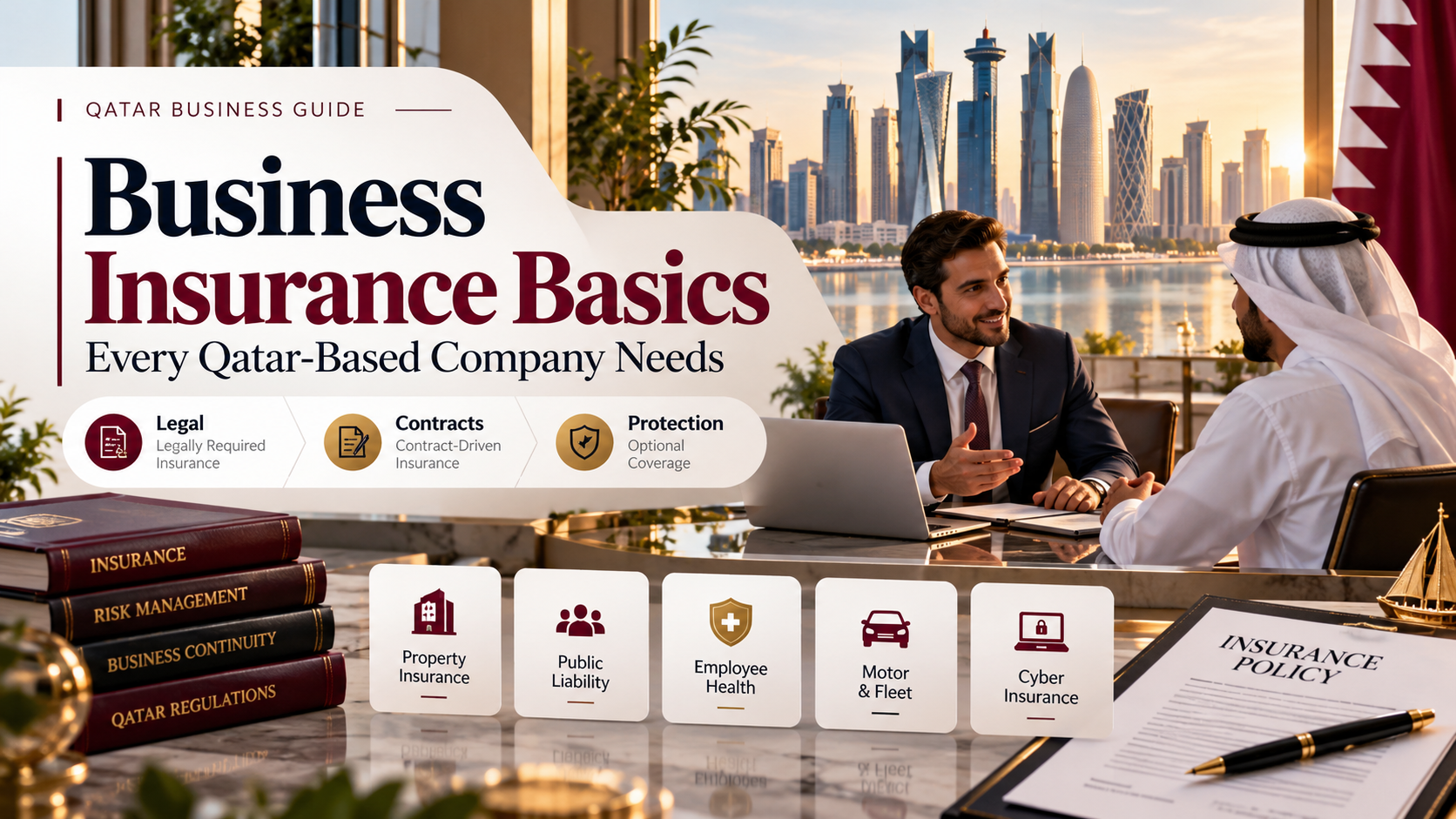
Summary: Not every company in Qatar needs the same insurance policies, but every company needs to know which ones apply to them. This guide breaks down what's legally required, what's commonly demanded by contracts, and how to choose coverage that actually protects your business.
If you run a company in Qatar, whether it's a shop in Souq Waqif, a contracting firm in the Industrial Area, or a startup in Lusail, the question "do I need insurance?" doesn't have one simple answer. It depends entirely on what your business does.
Some insurance is legally required. Some are demanded by landlords, lenders, or client contracts. Other coverage is optional but protects you from losses that would otherwise come straight out of your own pocket. Understanding business insurance in Qatar starts with knowing which category each policy falls into.
Confusing these categories is one of the most common mistakes business owners make. Assuming a landlord's insurance requirement applies universally, or assuming a legal obligation doesn't exist simply because nobody's asked for proof yet, can leave real gaps in your protection.
Why This Matters More Than Business Owners Realize
A business can face financial losses from fire, water damage, equipment failure, theft, third-party injury, vehicle accidents, or even a cyber incident. Insurance lets you transfer that risk to an insurer in exchange for a premium.
But insurance isn't just about protecting against disaster. It's often a commercial requirement too. A landlord might require specific coverage in your lease. A lender financing equipment may require it to stay insured. A client might ask for proof of liability coverage before signing a contract.
Beyond compliance, insurance protects cash flow. A serious property loss or liability claim can cost far more than the annual premium for an appropriately structured policy, sometimes enough to threaten the business entirely.
The Core Types of Coverage Every Company Should Know
Not every business needs every policy. Start with what's legally required, then assess your actual risks from there.
1. Property and Commercial Asset Insurance
This protects physical assets like office contents, shop fit-outs, machinery, stock, and electronics. Basic cover usually centers on fire and specified risks, so don't assume it automatically covers every type of flooding, theft, or accidental damage.
If you rent your premises, check your lease carefully. Landlords often insure the building itself while requiring tenants to cover contents, stock, and any improvements made to the space.
2. Public and Product Liability Insurance
Public liability covers your legal responsibility when your business activities cause injury to a third party or damage to their property. This might include a customer getting injured on-site or a contractor damaging a client's property.
Product liability, on the other hand, addresses claims tied to products your business supplies or manufactures. Neither is universally mandatory under Qatar law, but they're commonly required for customer-facing, retail, and contracting businesses, especially when bidding on tenders.
3. Workers' Cover and Employee Health Insurance
This is one area where legal obligations are clear. Qatar's Labour Law places responsibility on employers when a worker suffers a qualifying occupational injury, including treatment costs and compensation in serious cases.
Separately, Qatar's healthcare legislation establishes mandatory basic health insurance for expatriate employees, with employers responsible for covering the premiums. This isn't optional or simply "good practice," it's a legal requirement tied directly to your workforce.
4. Motor and Fleet Insurance
Motor insurance is one of the clearest compulsory requirements in Qatar. Under the country's Traffic Law, third-party motor coverage is mandatory for any registered vehicle, protecting third parties and passengers in the event of an accident.
If your business operates delivery vehicles, vans, or service trucks, each one needs the required compulsory coverage. Comprehensive motor insurance, which also covers damage to your own vehicles, is worth considering for newer or high-value fleets.
5. Professional Indemnity Insurance
This applies to businesses whose advice, designs, or professional services could allegedly cause a client financial loss, think consultancies, engineering firms, or accountancy practices. While not universally mandatory, certain regulated activities under the Qatar Financial Centre specifically require it.
6. Business Interruption and Cyber Insurance
Business interruption coverage compensates for lost income when an insured event, like a fire, forces your business to stop operating temporarily. Cyber insurance, meanwhile, has become increasingly relevant as businesses rely more on cloud platforms, online payments, and customer data.
Neither is legally required across the board, but both are worth serious consideration given how costly a single incident can become.
Understanding Corporate Insurance Requirements in the Gulf
Qatar isn't unique in having a mix of mandatory and contract-driven insurance requirements. Across the wider region, corporate insurance requirements in the Gulf tend to follow a similar pattern: compulsory motor and health coverage, combined with contract-specific demands for liability and professional indemnity.
Businesses operating across multiple Gulf countries should pay close attention to how these requirements shift from one jurisdiction to another, since assuming Qatar's rules apply elsewhere can create compliance gaps.
This regional awareness matters especially for companies expanding into Saudi Arabia, the UAE, or Bahrain, where mandatory coverage thresholds and contract expectations can differ meaningfully from what's standard in Doha.
How Much Does Business Insurance Actually Cost?
There's no single standard price for business insurance in Qatar. Premiums depend on multiple factors specific to your business:
- Value of property, stock, and equipment
- Number of employees and payroll size
- Business activity and industry risk level
- Claims history and required coverage limits
- Number and type of vehicles, if applicable
A small office and a warehouse holding significant stock shouldn't expect to pay comparable premiums. The most useful approach is comparing several like-for-like quotations rather than chasing the lowest number alone.
Steps to Buying the Right Policy
Getting proper coverage doesn't need to be complicated if you approach it methodically.
- List your risks: Premises, stock, vehicles, employees, and professional activities all count
- Separate compulsory from optional coverage: Know what's legally required versus contract-driven
- Gather your documents: Commercial registration, trade license, employee details, and asset lists
- Get multiple quotations: Compare limits, deductibles, and exclusions, not just price
- Read the exclusions carefully: Pay attention to flood damage, wear and tear, and cyber exclusions
- Review your policy annually: Update coverage as your business grows or changes
Common Mistakes to Avoid
A few missteps can leave your business underinsured or non-compliant without you realizing it.
- Assuming a policy required by one landlord or client applies to every business in Qatar
- Undervaluing stock or equipment to reduce premiums, which can backfire during a claim
- Treating employee health insurance as optional rather than a legal obligation
- Choosing a policy based solely on price without checking exclusions
Why Choose Al Akhbar Publication?
At Al Akhbar Publication, we connect businesses across Qatar and the wider GCC with the information and resources they need to operate confidently.
- We provide a verified directory connecting businesses with reliable service providers, including insurance and compliance resources
- Our platform offers market insights that help companies stay informed on regional business requirements
- We support B2B networking, helping businesses find the right partners for their specific needs
- As a Strategic Business Hub, we bridge the gap between industrial leaders, local sellers, and modern consumers
- Our focus stays 100% commercial, giving businesses transparent, practical information they can actually use
Whether you're researching business insurance in Qatar or exploring other business needs, our platform helps you make informed decisions with confidence.
Conclusion:
Business insurance in Qatar isn't a one-size-fits-all requirement. Some coverage is mandatory, some is contract-driven, and some depends entirely on your specific risks. Taking the time to understand which policies actually apply to your business protects both your finances and your ability to win future contracts.
Understanding business insurance in Qatar alongside broader corporate insurance requirements in the Gulf puts your company in a stronger position, whether you're just starting out or scaling across the region.
Ready to make smarter business decisions? Explore trusted resources and connections with Al Akhbar Publication today.