
Introduction
Modern businesses operate in an environment shaped by rapid change, global connectivity, and evolving risk factors. When uncertainty affects travel, logistics, and markets, companies must adapt quickly to maintain productivity and competitiveness. Across the Gulf region, recent disruptions accelerated changes in how businesses operate, collaborate, and manage their workforce.
The United Arab Emirates has emerged as a regional leader in business adaptability. With strong digital infrastructure, forward-thinking government initiatives, and a globally connected private sector, UAE companies responded to uncertainty not by slowing down, but by transforming how work gets done.
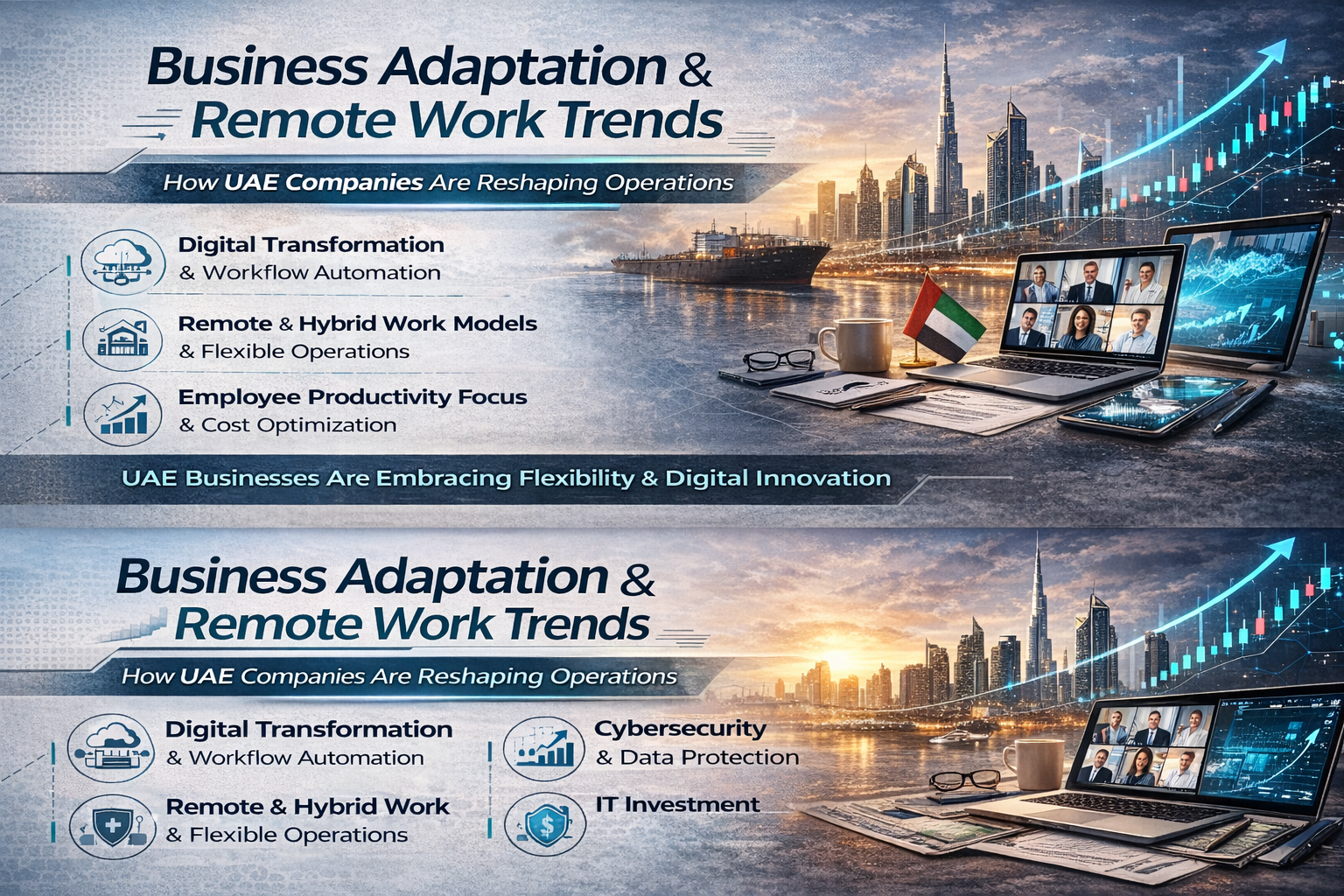
This blog explores how businesses in the UAE are adapting through digital transformation, remote and hybrid work models, flexible operations, and new corporate strategies — focusing entirely on business and economic trends.
The Need for Business Adaptation in a Changing Environment
Business continuity has become a strategic priority rather than a contingency plan. Regional and global uncertainty highlighted the importance of operational flexibility.
Key Drivers of Adaptation:
Disruptions in travel and physical meetings
Market volatility affecting planning cycles
Supply chain and logistics uncertainty
Changing employee expectations
These factors pushed companies to rethink traditional operating models.
Acceleration of Digital Transformation Across UAE Businesses
Digital transformation moved from a long-term goal to an immediate necessity.
Key Digital Shifts:
Migration to cloud-based systems
Automation of internal processes
Adoption of digital communication platforms
Integration of data-driven decision-making
Companies that had already invested in digital tools adapted faster, while others accelerated adoption.
Remote Work as a Strategic Business Tool
Remote work evolved from a temporary solution into a permanent business strategy.
Key Remote Work Trends:
Work-from-anywhere policies
Reduced dependency on physical office space
Increased use of collaboration platforms
Performance measured by output, not location
Remote work allowed companies to remain fully operational despite travel limitations.
Hybrid Work Models Gain Popularity
Many UAE businesses adopted hybrid models that combine office-based and remote work.
Hybrid Model Benefits:
Flexibility for employees
Improved work-life balance
Lower office operating costs
Maintained team collaboration
Hybrid work offered a balance between productivity and company culture.
Impact on Business Productivity and Efficiency
Contrary to early concerns, productivity remained strong in many sectors.
Productivity Outcomes:
Fewer time losses from commuting
Increased focus-driven work hours
Faster decision-making through digital tools
Improved employee satisfaction
Efficiency gains reinforced confidence in flexible work models.
Technology Investment and IT Infrastructure Growth
Companies increased investment in technology to support new work models.
Key Investment Areas:
Cybersecurity systems
Cloud computing services
Virtual private networks (VPNs)
IT support and monitoring tools
Robust IT infrastructure became a competitive advantage.
Cybersecurity and Data Protection Priorities
Remote operations increased the importance of digital security.
Cybersecurity Measures:
Enhanced data protection protocols
Employee cybersecurity training
Multi-factor authentication systems
Continuous threat monitoring
Strong security frameworks protected business continuity and trust.
Workforce Management and Talent Strategies
Remote work expanded access to global talent.
Talent Management Trends:
Hiring without geographical limitations
Flexible contracts and freelance models
Focus on skills rather than location
Investment in employee upskilling
This strengthened UAE companies’ competitiveness.
Impact on Office Spaces and Commercial Real Estate
Changing work models influenced office space demand.
Real Estate Shifts:
Smaller, flexible office layouts
Co-working and shared spaces
Focus on collaboration areas rather than desks
Cost optimization in long-term leases
Office spaces evolved to support collaboration rather than daily attendance.
SMEs and Startups Embrace Flexible Operations
Small and medium enterprises adapted rapidly due to their agility.
SME Adaptation Strategies:
Digital sales and marketing channels
Cloud-based accounting and operations
Remote teams to reduce overhead
Online customer engagement
Flexibility allowed SMEs to remain competitive and scalable.
Sector-Specific Adaptation Trends
Different industries adapted in unique ways.
Sector Examples:
Technology: fully remote operations
Finance: secure digital platforms and hybrid work
Consulting: virtual client engagement
Education and training: online delivery models
Sector-specific strategies ensured continuity.
Government Support for Digital Business Models
Public sector initiatives supported private sector adaptation.
Supportive Measures:
Smart government services
Digital licensing and documentation
Online compliance and reporting
Support for innovation and startups
Government digital readiness accelerated private sector adoption.
Business Cost Optimization Through Remote Models
Remote work delivered measurable cost benefits.
Cost Savings Areas:
Reduced office rent and utilities
Lower travel and accommodation costs
Optimized operational expenses
Scalable workforce structures
Cost efficiency improved financial resilience.
Employee Experience and Workplace Culture
Maintaining culture became a new challenge.
Cultural Adaptation:
Virtual team-building activities
Regular digital check-ins
Transparent communication
Performance-based recognition
Strong leadership helped sustain engagement.
Challenges of Remote and Hybrid Work
Despite benefits, challenges remained.
Common Challenges:
Communication gaps
Managing performance remotely
Employee burnout risks
Data security concerns
Companies addressed these through policies and training.
Training, Upskilling, and Digital Learning
Continuous learning became essential.
Learning Trends:
Online training platforms
Digital skills development
Leadership training for remote management
Continuous professional development
Upskilling supported long-term growth.
Business Continuity and Crisis Preparedness
Adaptation strengthened resilience.
Preparedness Improvements:
Business continuity planning
Scenario-based risk management
Backup systems and processes
Flexible operational structures
Preparedness reduced future risk exposure.
Long-Term Strategic Shifts in Business Models
Remote work influenced long-term strategy.
Strategic Changes:
Digital-first business models
Platform-based service delivery
Global market access
Innovation-driven growth
Adaptation became part of corporate identity.
Competitive Advantage of Flexible Businesses
Flexibility emerged as a differentiator.
Competitive Benefits:
Faster response to change
Access to diverse talent
Lower fixed costs
Scalable operations
Flexible businesses gained market advantage.
Future Outlook for UAE Business Operations
Looking ahead, flexibility will remain key.
Future Trends:
Continued hybrid work adoption
Increased automation and AI tools
Focus on employee well-being
Ongoing digital innovation
The UAE is well-positioned for future work evolution.
Conclusion
Recent uncertainty accelerated a transformation that was already underway in the UAE business environment. Companies embraced digital tools, remote work, and flexible operations not only to survive disruption, but to strengthen efficiency and competitiveness.
From large corporations to startups, UAE businesses demonstrated adaptability, innovation, and resilience. Remote and hybrid work models are no longer temporary solutions; they are strategic assets shaping the future of work.
By combining strong digital infrastructure, supportive governance, and a forward-looking private sector, the UAE continues to set a benchmark for modern business adaptation.