
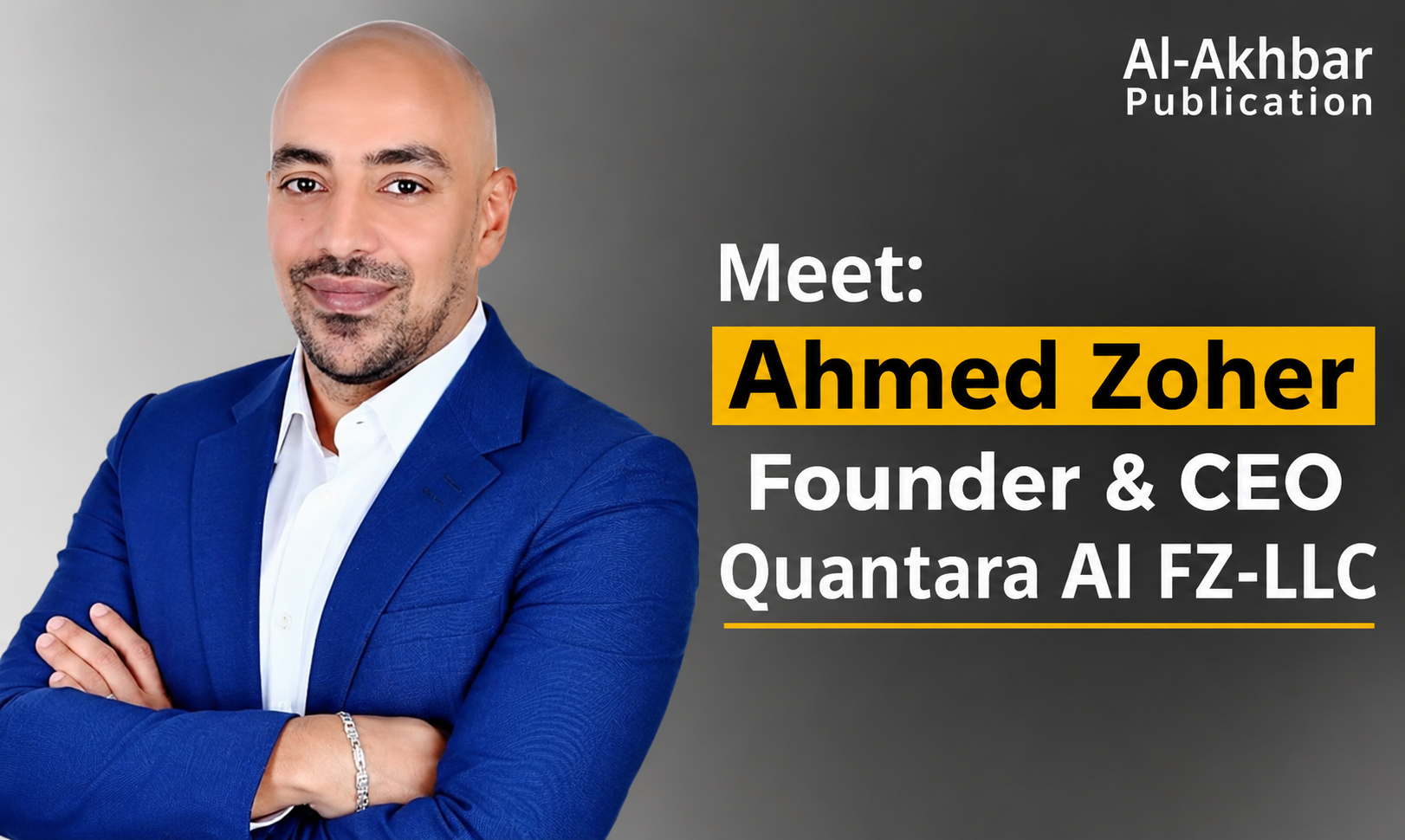
How a customer-operations veteran with 18 years of experience is building a UAE-based AI
consultancy that turns contact centres from cost centres into engines of growth.
Who Is Ahmed Zoher?
Ahmed Zoher is the Founder and CEO of Quantara AI FZ-LLC, a UAE-based consultancy
operating at the intersection of customer experience and applied artificial intelligence. With 18
years of professional experience behind him, Zoher describes his perspective as one that
blends “operator experience” with “consultant perspective” — the rare combination of someone
who has run contact centres and now advises organisations on how to transform them.
Under his leadership, Quantara AI has positioned itself around a simple proposition: better
service builds stronger businesses. The company’s tagline — “Customer experience × Applied
AI” — captures a philosophy that treats AI not as a buzzword but as a practical tool for
improving how organisations serve their customers.
The Vision Behind Quantara AI
Quantara AI was founded to address a recurring problem in modern customer-service
operations: the gap between technology investments and actual service outcomes. Many
organisations buy AI tools, chatbots, and CRM platforms, only to find that customer satisfaction
barely moves. Zoher built Quantara to close that gap by connecting people, processes, and
technology under a single governance-led model.
The company’s approach follows a clear three-stage philosophy: Design, Build, Operate. Rather
than handing over a strategy document and walking away, Quantara works with clients from
initial assessment through implementation to ongoing managed operations — what the
company calls its “connected service model.” The model rests on three pillars: human expertise
(judgement and ownership), applied AI (practical, not theoretical), and connected operations
(end-to-end accountability).
A Portfolio of AI-Powered Services
Quantara AI offers a focused suite of services aimed at customer-service leaders. These include
contact centre consulting, gap and TAP (Training and Process) assessments, AI and digital
transformation programmes, outsourcing and managed operations, standards and service
excellence frameworks, and WhatsApp and workflow automation. Each engagement begins
with a diagnostic — understanding where the contact centre is losing momentum — and ends
with a measurable improvement in service quality, cost efficiency, or both. The company’s experience spans multiple industries, including government, telecoms, retail,
property, and broader customer-service operations. Zoher’s own background includes exposure
to large, complex service environments — organisations where thousands of interactions
happen daily and small process improvements translate into significant business outcomes.
Flow AI: Quantara’s Flagship Platform
Beyond consulting, Quantara has developed Flow AI, an AI-enabled support platform that brings
conversations, cases, and operational insight together in one place. Flow AI is designed to do
what traditional contact-centre tools often cannot: detect trends in real time, run AI-driven quality
reviews, and perform root cause analysis on recurring issues. For operations leaders, this
means moving from reactive problem solving to proactive service design — identifying why a
problem exists, not just that it exists.
Flow AI reflects Zoher’s belief that applied AI should reduce complexity, not add to it. The
platform is built around the realities of service delivery, not abstract AI capability. Its features
exist because they solve operational problems that Quantara has encountered firsthand.
Why Applied AI Matters for Customer Experience
Customer expectations in the UAE and the wider Gulf have shifted sharply in recent years.
Citizens and residents now expect the speed and personalisation they receive from global
consumer apps — and they expect it from government services, telecoms, banks, and retailers
alike. Meeting that expectation at scale is no longer possible with human agents alone; it
requires applied AI that can triage, assist, and surface insight in real time.
Zoher’s argument is that the organisations that thrive in this environment will be those that treat
customer experience as a strategic capability, not a back-office function. Applied AI is the lever
that makes this possible — but only when it is deployed with governance, operational discipline,
and a clear line of sight to business outcomes. That conviction sits at the heart of Quantara AI’s
work.
Frequently Asked Questions
1. What does Quantara AI do?
Quantara AI is a UAE-based consultancy specialising in customer experience and applied AI. It
helps organisations design, build, and operate modern contact centres through consulting, AI
transformation, managed operations, and its Flow AI platform.
2. Who is the founder of Quantara AI?
Ahmed Zoher is the Founder and CEO. He brings 18 years of professional experience in
customer operations and AI transformation, combining operator experience with consultant
perspective.
3. Where is Quantara AI based? Quantara AI operates as Quantara AI FZ-LLC, a Free Zone Limited Liability Company based in
the United Arab Emirates. Website: quantaraai.ae.
4. What is Flow AI?
Flow AI is Quantara’s AI-enabled support platform that brings conversations, cases, and
operational insight together. It offers trend detection, AI quality review, and root cause analysis
for contact-centre operations.
Conclusion:
Ahmed Zoher’s work through Quantara AI reflects a broader shift in how the Gulf approaches
customer experience. For years, the region’s service organisations invested in technology faster
than they invested in the operating models needed to make that technology pay off. Quantara
exists to close that gap — bringing governance, applied AI, and operational discipline together
under one roof. For Zoher, the promise of AI in customer service is not about replacing human
judgement but about augmenting it; not about cost-cutting but about building stronger
businesses through better service. In a region where customer expectations are rising as fast as
the technology meant to meet them, that combination is increasingly the difference between
organisations that lead and those that fall behind.