
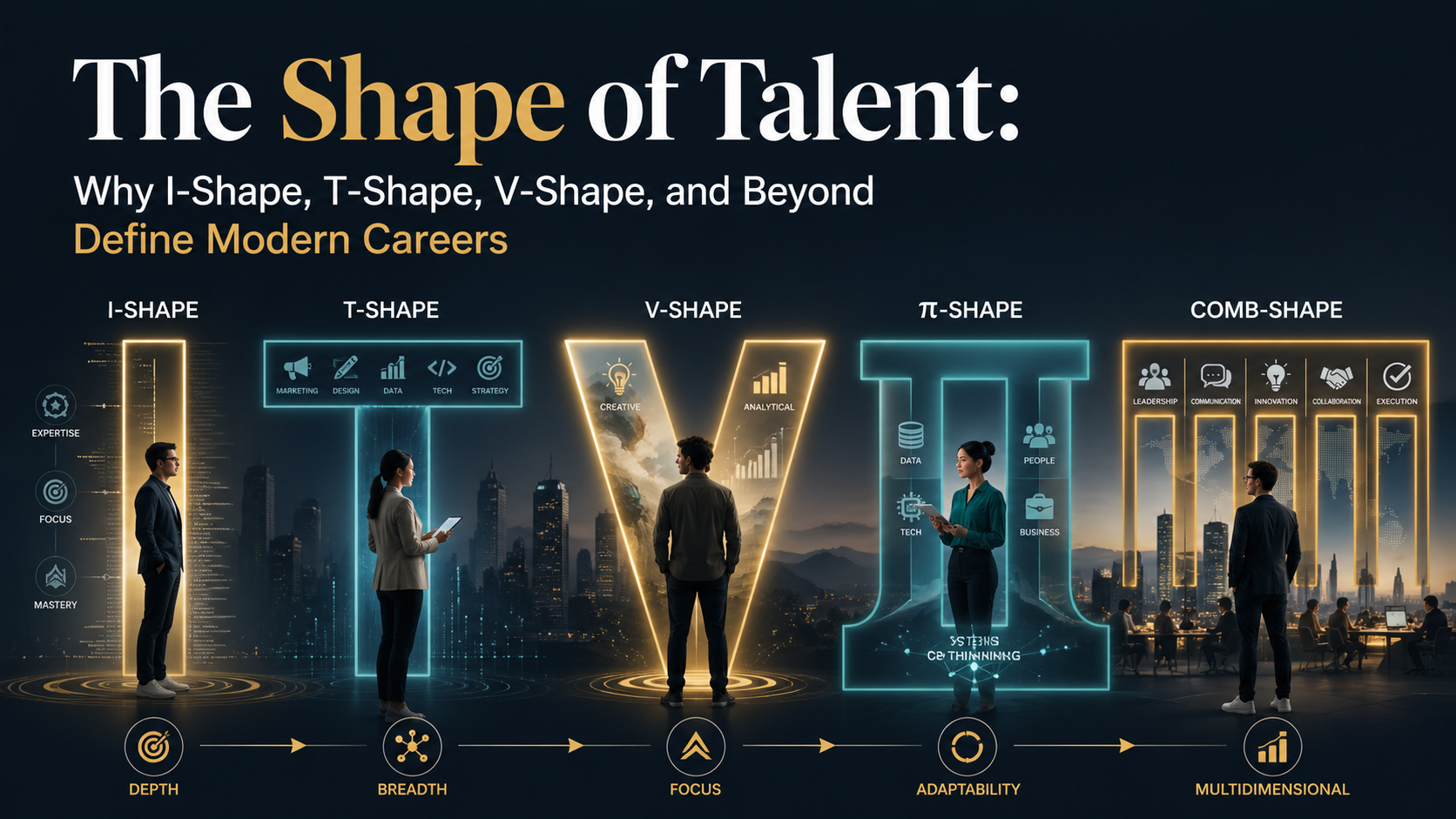
For decades, talent was evaluated in straight lines. You studied one discipline, mastered it deeply, and spent your career refining that expertise. The system was predictable, and so were the roles within it.
This thinking produced the I-shaped professional someone with strong vertical depth in a single domain. The I-shape still matters. Surgeons, engineers, researchers, accountants, and specialists of every kind depend on it. Depth creates precision. Without it, quality collapses.
But depth alone no longer guarantees relevance.
As work became more interconnected, problems stopped respecting departmental boundaries. Strategy collided with execution. Technology merged with creativity. Communication became as important as competence. That’s when the T-shaped professional emerged.
The T-shape combines deep expertise with horizontal awareness the ability to collaborate, communicate, and understand adjacent disciplines. T-shaped individuals don’t dilute expertise; they amplify it by making it usable across teams. They are often the glue in modern organizations, translating complexity into shared understanding.
Yet even the T-shape began to feel insufficient in highly complex environments.
Some professionals developed not one, but two strong verticals, forming the V-shaped talent profile. A V-shaped individual might combine business and technology, strategy and execution, or creativity and analytics. This dual depth allows them to operate at intersections where real leverage exists. They don’t just collaborate they integrate.
As careers lengthened and industries evolved faster, another form began to appear: the π-shaped (Pi-shaped) professional. Instead of two related verticals, Pi-shaped talent represents multiple deep capabilities supported by a strong base of collaboration and adaptability. These individuals often move into leadership, architecture, or system-level roles because they can hold complexity without losing clarity.
Beyond this, modern work has produced even more nuanced shapes.
The Comb-shaped professional develops multiple skill “teeth” across domains not all equally deep, but each strong enough to be operational. Comb shapes thrive in fast-moving environments like startups, creative industries, and digital teams where flexibility matters more than purity.
The M-shaped professional focuses on mastery across multiple areas at a high level, often seen in senior leaders, consultants, or domain integrators who must make decisions across finance, people, operations, and strategy simultaneously.
Then there is the Dash (–) shape, often misunderstood. Dash-shaped individuals are adaptable generalists with strong learning velocity. They may not have deep verticals yet, but they absorb context quickly and shift effectively. In the right environment, Dash shapes evolve into T, V, or Pi shapes over time.
Each shape serves a purpose. None is inherently superior.
The mistake is not choosing the wrong shape — it is staying stuck in one shape when the environment demands another.
Most careers fail not because people lack skill, but because they cling to an outdated structure. An I-shape in a volatile industry becomes fragile. A T-shape without depth becomes superficial. A V-shape without balance burns out. Talent must evolve structurally, not just expand endlessly.
This is why modern growth is no longer about collecting skills. It is about designing capability.
When professionals understand talent geometrically, their questions change. They stop asking, “What should I learn next?” and start asking, “What shape should my talent take now?” Organizations that understand this stop hiring for job descriptions and start building systems of complementary shapes.
The future of work will not reward those who know the most tools or hold the most certificates. Automation and AI will handle execution. What remains human is judgment, integration, and adaptability.
Those qualities don’t belong to a single skill. They belong to well-designed talent shapes.
About the Book
This article draws from my book The Shape of Talent Framework: Redefining Skills, Growth, and Collaboration in the Modern Workforce, which explores I-shaped, T-shaped, V-shaped, π-shaped, Comb-shaped, M-shaped, and evolving talent models in depth — helping individuals and organizations intentionally design careers, teams, and capabilities that remain resilient in a changing world.
If you’re thinking about growth beyond titles and trends, the book offers a structured way to rethink what talent really means today.