
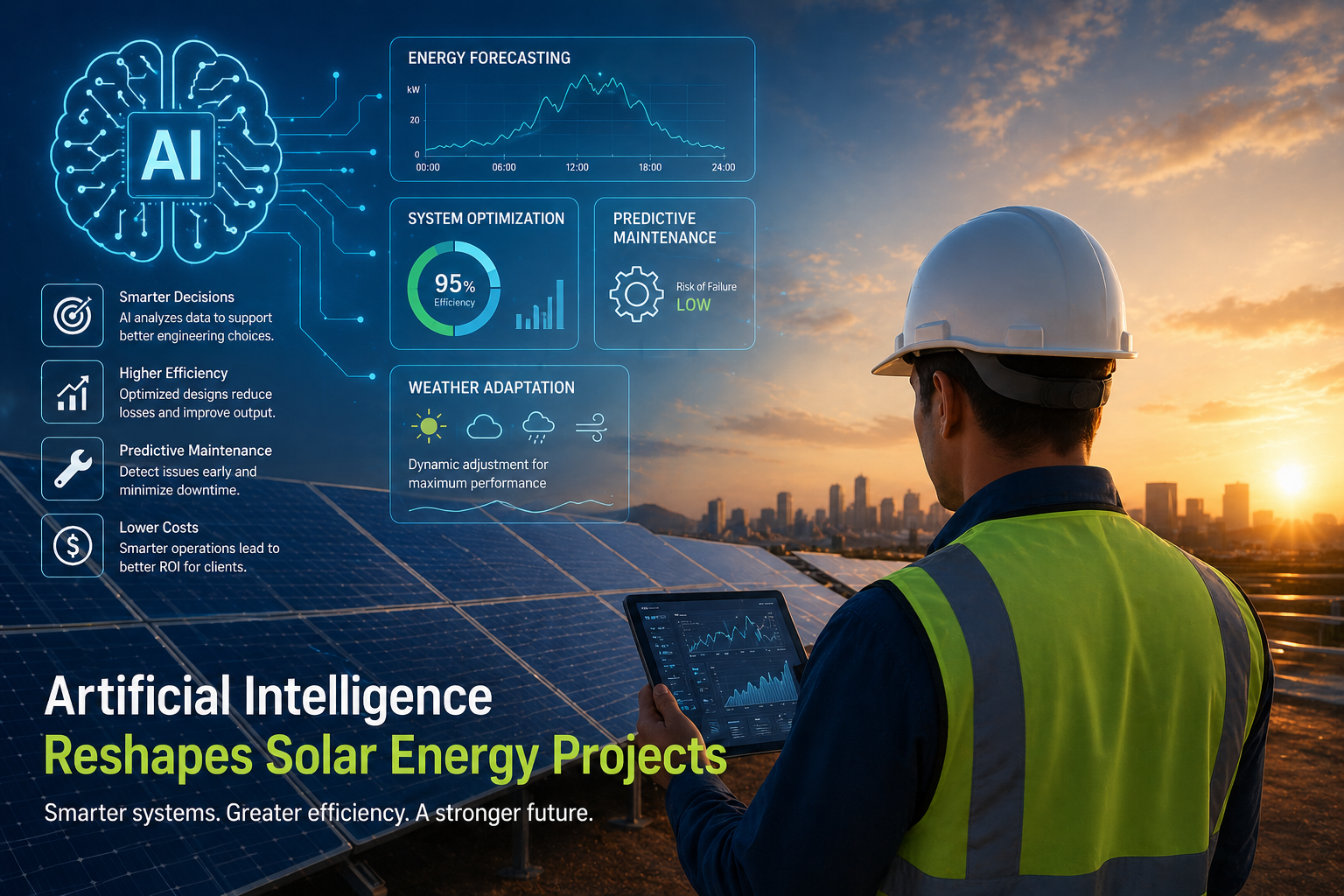
Artificial intelligence (AI) is rapidly transforming the solar energy sector, introducing new levels of efficiency, accuracy, and reliability in project design and operation.
Industry experts indicate that AI is no longer limited to data analysis but is now playing a critical role in decision-making across solar projects. From optimizing system sizing and forecasting energy production to enabling predictive maintenance, AI technologies are helping reduce costs and improve overall performance.
Engineers working in the field report that AI-driven tools significantly reduce the time required to analyze consumption patterns and evaluate system configurations, while delivering more precise results compared to traditional methods.
In regions such as Saudi Arabia, where environmental conditions and temperature variations impact system efficiency, AI-powered adaptive designs are proving especially valuable. These systems can adjust to changing loads and weather conditions, enhancing long-term reliability.
Moreover, predictive maintenance enabled by AI allows early detection of potential system failures, minimizing downtime and operational risks.
Despite these advancements, experts emphasize that AI does not replace human expertise but rather enhances it. Accurate data input and professional interpretation remain essential to achieving reliable outcomes.
As the solar energy market continues to evolve, integrating AI is increasingly viewed as a necessity rather than an option, with early adopters expected to gain a competitive advantage in the industry.
Ziad Salah
CEO of Sigma Energy